


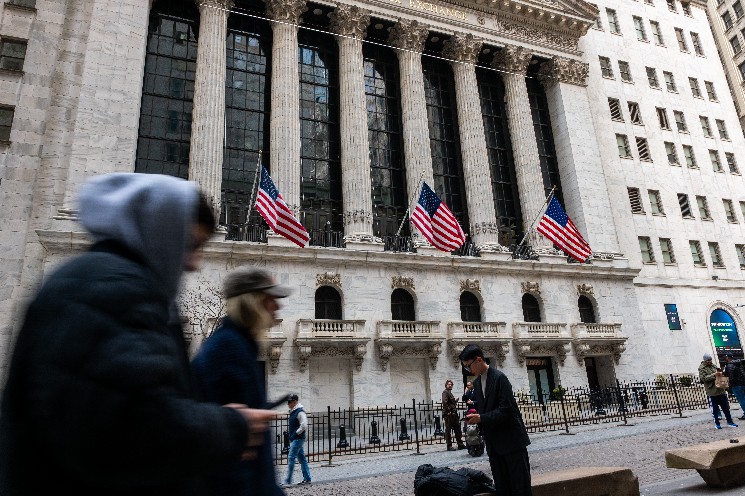
Wall Street is rushing toward tokenized stocks and 24/7 trading, but many institutional investors are wary of the instant settlement model.
Tokenization refers to the representation of traditional assets such as stocks on blockchain networks. In theory, this approach could modernize decades-old market infrastructure, allowing securities to move and settle instantly while potentially enabling 24/7 trading.
This vision has gained momentum in recent months. ICE, owner of the New York Stock Exchange, and Nasdaq, recently announced major partnerships with native crypto exchanges, aimed at bringing tokenized stocks to market.
But for many institutional investors, this change raises practical concerns about liquidity, funding and the day-to-day functioning of the markets.
“Institutional investors generally don’t like instant settlement,” said Reid Noch, vice president of U.S. equity market structure at TD Securities. While technology could streamline the back end of markets, he said, forcing immediate settlement of trades would create new friction for professional investors.
The current US system settles stock trades one business day after execution, known as T+1 settlement. This time frame allows brokers and trading firms to offset their positions and manage their funding throughout the day. In contrast, instant settlement would require transactions to be fully funded before they take place.
“No one really wants to be pre-funded,” Noch said. If instant settlement becomes the market norm, trading firms would have to arrange funding throughout the day, which could increase costs and reduce liquidity at key times.
The impact could be particularly visible during periods of high activity, such as at market close when large volumes of trades are executed simultaneously. Balance sheet constraints could make these periods more costly for investors, thereby distributing liquidity more unevenly throughout the trading day.
However, retail traders could adopt tokenized markets more quickly. Many of the benefits offered – such as holding stocks directly in digital wallets or trading outside of traditional market hours – are aimed at individual investors rather than large institutions.
Retail trading already accounts for about 20% of U.S. stock trading volume, although for some stocks that share can reach more than half of daily activity. In highly speculative “meme stocks,” retail participation has sometimes exceeded 90%.
Tokenized trading platforms could particularly appeal to international retail investors looking to access U.S. stocks when U.S. markets are closed, Noch said. For these investors, opening accounts on crypto platforms may be easier than complying with the requirements of traditional brokers.
Over time, institutional investors could track whether liquidity shifts to tokenized sites. “If retail liquidity migrates to this country and becomes significant, institutions won’t really have a choice but to participate,” Noch said.
Yet the transition carries risks. One concern is market fragmentation if multiple versions of the same title exist on different blockchains or tokenized platforms. This could weaken the transparency and price discovery that underpins the U.S. stock market.
“Typically, most companies only own one stock,” Noch said. “If suddenly there are multiple tokenized versions with different rights or liquidity profiles, this could create confusion about what investors actually own.”
Despite these concerns, industry momentum continues to grow. Exchanges are already considering longer trading hours, with some offering almost 24-hour markets in the coming years.
Tokenization could ultimately be part of this change – modernizing infrastructure behind the scenes while gradually reshaping how investors access stocks. But for now, technology may advance more quickly among retail traders than among the institutions that dominate today’s markets.

