


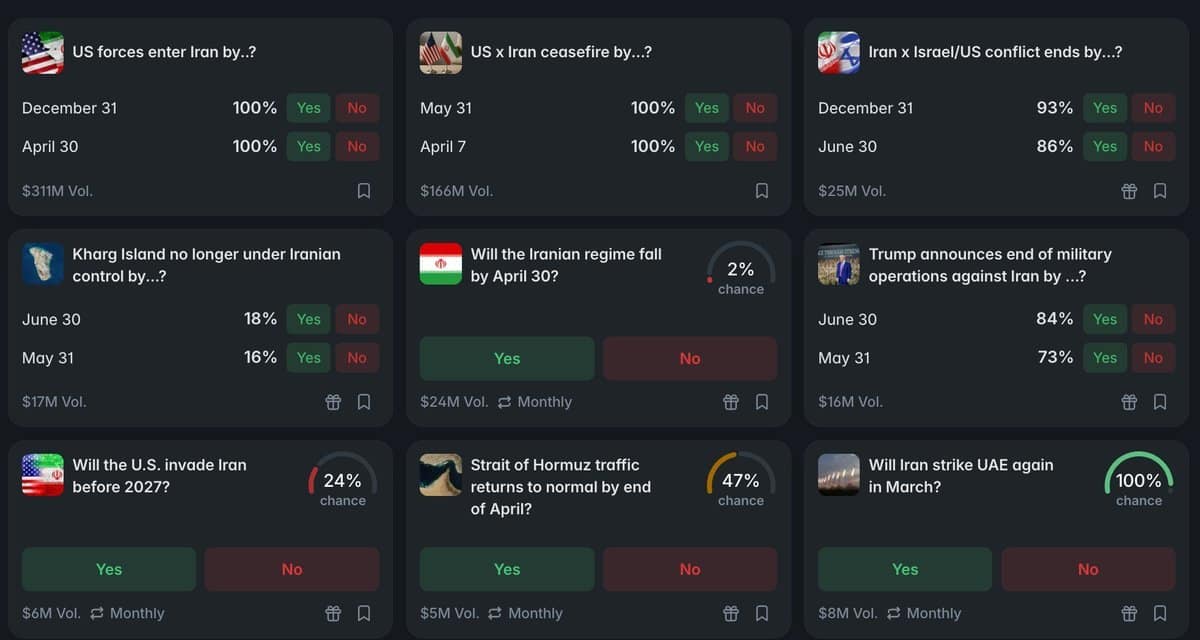
Three wallets. Half a million dollars. Before that, he had not recorded any operations on the network. A recurring trend in the US-Iran ceasefire market on Polymarket raises questions about the existence of insider trading, questions that have yet to be clearly answered, even though blockchain records are now publicly available.
Crypto markets digested the news of the ceasefire with a sharp rise in the price of Bitcoin towards $71,000, but the real story may lie in what happened on Polymarket hours before Trump released anything.
So this guy on Polymarket put $10,000 on the Iran-US ceasefire that same day, at 2.8¢ on average.
And I walked away with a pure profit of $450,000
Insider trading or pure coincidence? pic.twitter.com/0vRGwnpHPN
– Baba Cryptonath ♣️ (@BabaCryptonath) April 8, 2026
Blockchain analytics firm Lookonchain monitored three newly created wallets that collectively generated profits amounting to $484,575 by betting “yes” on the “US-Iran ceasefire by April 7” market. The odds of participating in a bet varied between just 2.9% and 10.3%. Interestingly, these wallets were created and funded on Tuesday without any prior activity on the network before placing their bets.
Accusations of leaks within Polymarket
Individual profits were distributed in the amounts of $200,525, $158,600 and $125,450. A trader executed his first trade on the market on Tuesday at 1:59 p.m. UTC, just 8.5 hours before Trump confirmed the deal via the Truth Social platform at 10:32 p.m. As for the other two portfolios, they entered the market at 10:01 a.m. Tuesday and 8:50 p.m. Monday respectively.
This is not the first time that suspicious accounts have appeared on Polymarket linked to geopolitical issues. An anonymous wallet had previously generated profits of around $400,000 during events linked to the United States and Venezuela under similar circumstances.
WOW!
Yesterday, a new account on Polymarket placed a massive bet that Maduro would be removed from office on January 31.
Today, the United States carried out strikes against Venezuela and captured Maduro.
The trader has now earned over $400,000.
Insider or just lucky? pic.twitter.com/4g3os3eUE2
– Increase profits! (@uptheprofits) January 6, 2026
The Ceasefire Market saw $60 million in trading volume in 24 hours, for a total of $162.6 million, indicating real interest from the public, but the timing of these three wallets seems too specific to ignore.
Trading volume in Iran-related markets on Polymarket reached $90 million in 48 hours (April 6-8), with the ceasefire contract alone generating $57 million during this period. The “America-Iran Ceasefire by April 7” market settled at 100 cents (total probability) after the two-week truce was confirmed, paying maximum profits. A parallel market was also decided, titled “Ceasefire before oil hits $120?” With a “yes” result of 100 cents.
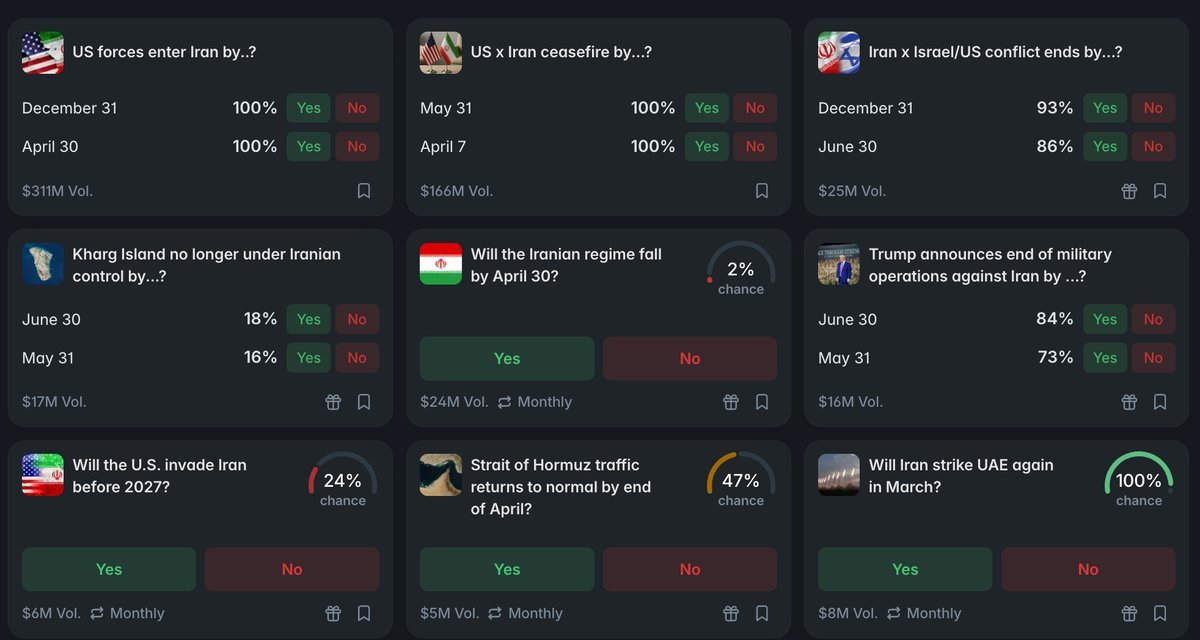
The platform has already faced political pressure, withdrawing markets related to “rescue missions” amid bipartisan criticism, calling war-related forecasting contracts “dystopian.”
LiquidChain Focuses on Cross-Chain Infrastructure as DeFi Demand Grows
Geopolitical shocks not only shift prediction markets, but also cause liquidity dispersion, with traders moving between Bitcoin, Ethereum, and Solana positions simultaneously, while most infrastructure is still unable to handle this smoothly. This is a structural problem that LiquidChain is specifically looking to solve.
LiquidChain is a layer 3 infrastructure project that integrates Bitcoin, Ethereum and Solana liquidity into a single execution environment as a unified liquidity layer.
The order is growing. The Order is evolving. ⟁👁 pic.twitter.com/stB6CDGAVD
– LiquidChain (@getliquidchain) April 8, 2026
Developers can deploy once and have access to all three systems. The architecture also includes “one-step execution” and “verifiable settlement” features, aimed at solving the delay and dispersion issues faced by cross-chain traders in volatile conditions, much like those seen on April 7.
The project collected more than 645 thousand dollars At the current pre-sale price of $0.01447. LiquidChain has gained attention alongside Bitcoin ETF flows as institutional appetite for multi-chain DeFi infrastructure grows. Remember that the project offers a staking reward of over 1600% APY For first time buyers.

