


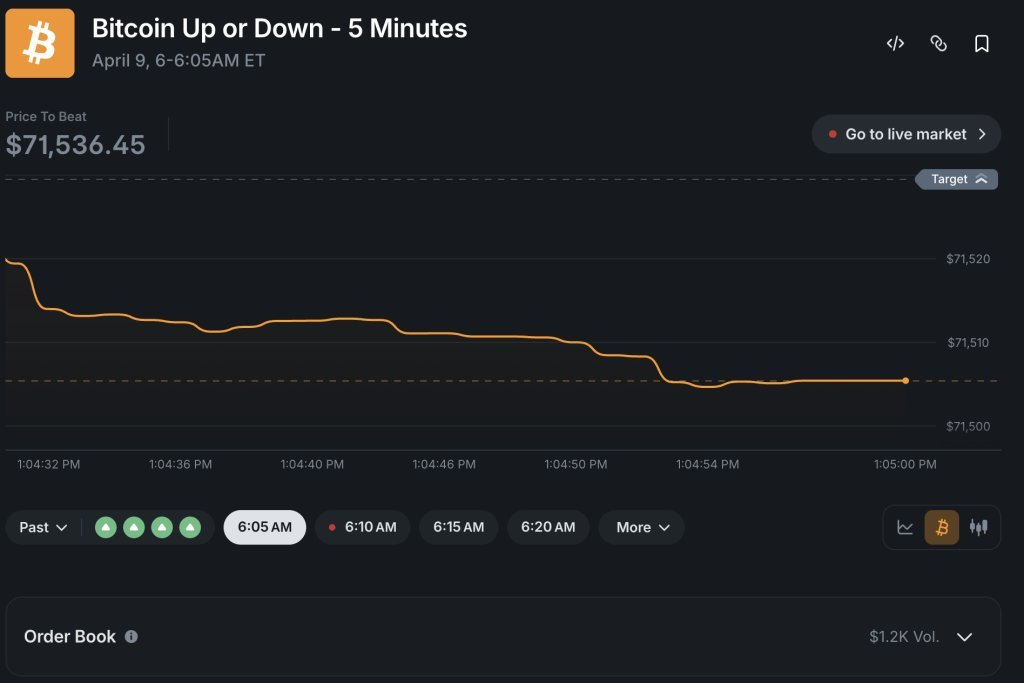
Polymarket’s 5-Minute Forecast Markets has exploded from a beta product to one of the most liquid trading platforms in the DeFi industry, with an average daily trading volume of $153 million and a cumulative total of $4 billion, including $200 million in the first week alone. The oracles of a network Chain link The main driver of this technical success.
This significant increase in volumes, confirmed by data available on the network via encrypted analytics channels, represents an increase of almost 400% compared to previous benchmark figures, with the weekly growth rate continuing to increase threefold according to the latest reports.
Why do 5 minute markets require a different Oracle architecture?
Standard Oracle infrastructure designed to settle markets hourly or daily can tolerate some limited delay; A 30 second delay in updating the price may not be effective when the contract is settled within 48 hours. But in 5-minute forecast markets, that same time frame makes the difference between fair settlement and price manipulation, which is why Polymarket has adopted radically different oracle configurations.
The integration of Chainlink’s Data Streams technology, deployed on the Polygon network where Polymarket settlements take place, provides time-stamped price reports at sub-second intervals. Using Chainlink Automation technology to manage on-chain settlement triggers, the system manages the entire cycle (price confirmation, contract settlement, and USDC payment) without human intervention and free from the manipulation risks that central price feeds can pose.
Since adopting Chainlink to power the 5 and 15 minute crypto markets, @Polymarché saw:
• Average daily volume of more than $153 million, a 3-fold increase.
• Volume of over $4 billion in the 5 and 15 minute markets
• More than $200 million in one week of 5-minute markets
The Chainlink effect is real. pic.twitter.com/YwDluD6vWS– Chainlink (@chainlink) April 8, 2026
These oracles provide the official pricing information that triggers contract settlement processes, completely eliminating the need for a central authority. The volume of activity flowing through this infrastructure is enormous, with over 3,000 traders actively using Chainlink Data Streams technology on the integrated platforms. The Dashlink dashboard shows a direct correlation between an increase in Polymarket volumes and a decline in LINK coin reserves on exchanges, with whales withdrawing their supplies as network usage hits record levels.
The adoption of USDC as a native security in these markets has also helped accelerate institutional participation by improving capital efficiency. The attraction seems clear; The platform, which has faced criticism over insider trading practices in its long-term markets, now offers a format that reduces information asymmetry to just 5 minutes.
However, risks remain; Short time frames increase volatility, high-frequency trading flows (HFT) can marginalize small traders, and any oracle delays, while rare, can have disastrous consequences when settlement windows are measured in minutes. But commercial data confirms that this format meets a demand that previously lacked a similar investment instrument.
Conclusion of the Convergence Hackathon: the Liquid Chain project receives the grand prize
The Liquid Chain project won the grand prize after building a unified liquidity layer that pools capital across multiple Layer 2 networks, leveraging Chainlink’s Cross-Chain Interoperability Protocol (CCIP) as the messaging backbone.
The project addresses a real and costly problem; Assets held in separate Layer 2 networks require manual bridging, leading to slippage and delays, risks that institutional investors cannot accept.
The Liquid Chain architecture allows users to seamlessly transfer assets between chains without the need for manual interactions with bridges, as the CCIP protocol handles verification and message passing beneath the surface. The project presented Layer-3 DeFi as a reliable solution to the fragmentation problem, which was approved by the hackathon judges.
Other notable hackathon entries focused on real-world asset (RWA) tokenization and DeFi automation, signaling the Chainlink developer community’s focus toward institutional infrastructure rather than consumer speculation. CCIP adoption rate confirms the success of Chainlink’s cross-chain strategy, while tamper-proof settlement requests reach record numbers on Polymarket.
Polymarket Daily Trading Volume Soars to $153 Million Powered by Chainlink appeared first on Cryptonews Arabic.

