


Tom Lee, president of BitMine Immersion Technologies, set an ambitious price target for Ethereum at $22,000 during an event in Miami this week. With Ethereum currently trading at $2,280.70, this prediction represents an increase of approximately 10 times the current value.
This vision is based on a two-part assumption: the first is that the ETH/BTC ratio returns to its historical rates relative to an assumed fair price of Bitcoin at $250,000. The second part concerns the structural demand argument, in which Lee argues that AI agents will need on-chain settlement infrastructure that traditional banking systems cannot provide.
This combination, as Lee has argued publicly and on stage, makes Ethereum look cheap right now.
JUST IN: Tom Lee says Ethereum’s fair value is $22,000
-Kalshi Crypto (@Kalshi_Crypto) May 7, 2026
But the challenge posed by this prediction is real; All conditions in this chain must be met simultaneously. Bitcoin must first reach $250,000.
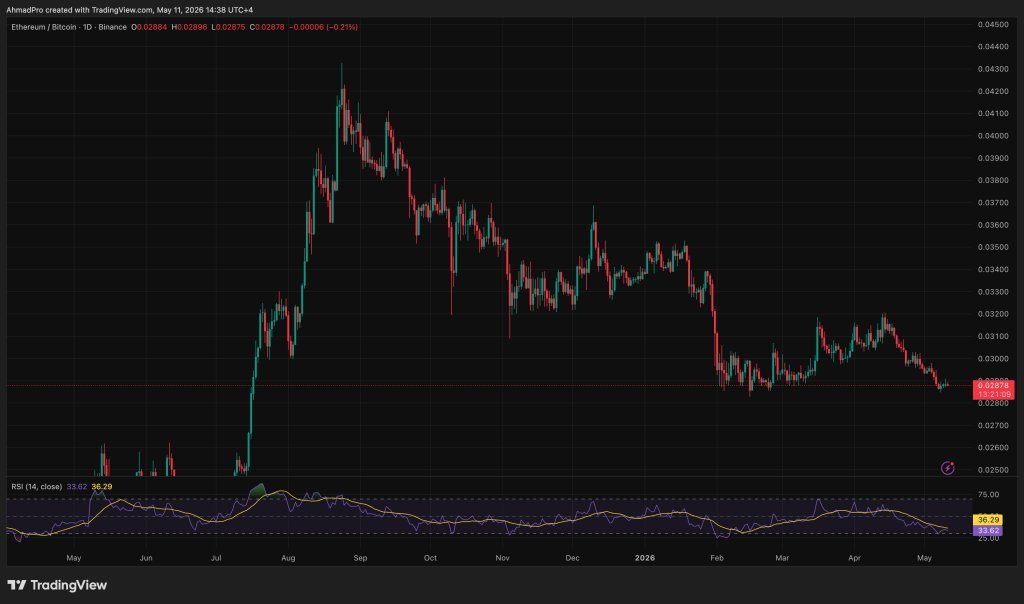
The ETH/BTC ratio is also expected to return to its 2021 high of 0.087, up from its current level of 0.03. Additionally, AI adoption of blockchain technologies is expected to take shape on a scale that the market has not yet captured.
Below is an examination of whether the data supports any of these hypotheses and which ones weigh most heavily in the equation.
The math behind the $22,000 goal: precise and difficult
The ratio calculations that I propose are simple; The long-term average of the ETH/BTC ratio is around 0.048, while the 2021 cycle peak reached 0.087.
Applying these ratios to an assumed Bitcoin price of $250,000, they produce targets for Ethereum of around $12,000 and $21,750, respectively. As a result, the $22,000 figure represents the most optimistic case: the maximum ratio coincides with Bitcoin reaching its supposed highest levels.
The AI-generated demand component is where Lee moves away from simple trading of price ratios. His argument is that AI agents operating autonomously in the global economy will need a payment layer that operates around the clock, without relying on correspondent banks.
Ethereum’s seamless ledger and decentralized notary pool make it the default candidate for this task. Lee also cited stable transaction volumes exceeding Visa’s annual throughput, a claim supported by numbers; Volumes of Ethereum-based stablecoins (USDC, USDT, and DAI combined) will reach approximately $220 trillion per year in 2025, compared to Visa’s $12.2 trillion. These statements are not just speculation.
On the supply side, Lee’s position at BitMine adds immediate context; The company owns over 4% of the total Ethereum in circulation and generates over $300 million annually in staking rewards. This places Lee’s optimistic view in direct financial proximity to his organization’s balance sheet, a conflict of interest worth noting, but it does not necessarily mean the hypothesis is wrong, but rather requires careful examination of the assumptions.
Where is Ethereum price currently trading and what does the chart need?
Ethereum currently stands at $2,330 on the daily chart. The overall picture shows a coin that peaked at nearly $4,900 in August and entered a downtrend for more than a year, losing more than 60% of its value before bottoming around $1,750 in February.
The recovery from this bottom has been the most sustained positive price movement since the start of the downtrend, as the price recorded higher lows from February to May and is now stabilizing in the $2,300 to $2,400 area, which is a very critical area.
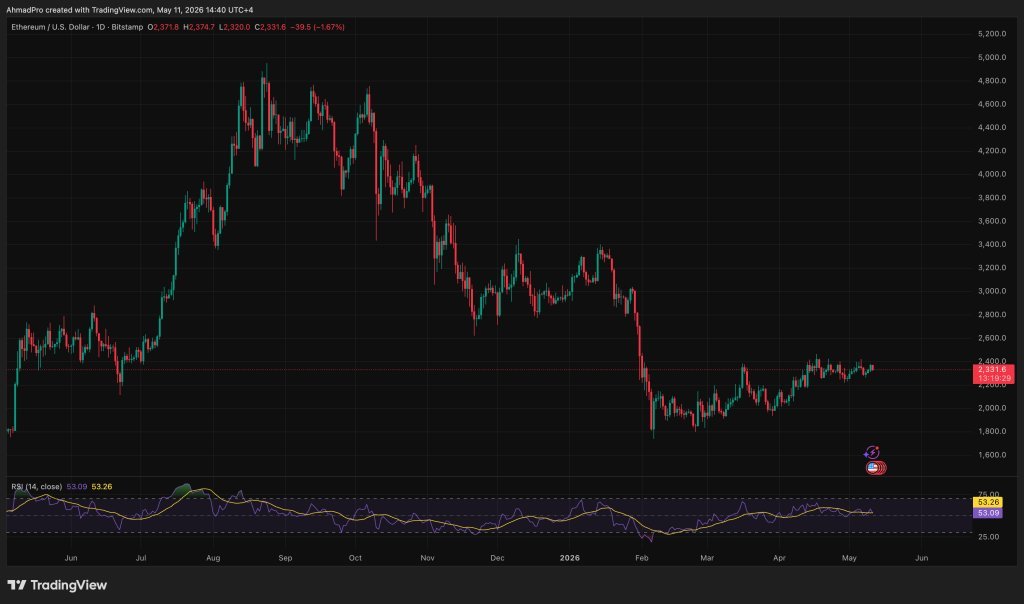
The $2,400 level is the point from which the collapse accelerated in February, making it the first major supply zone to clear before a significant recovery could occur. The price has been fluctuating below for weeks without a clear breakthrough.
A daily close above $2,400 and holding above for several sessions will pave the way towards $2,800 first and then towards the $3,000 and $3,400 levels as the next resistance zones resulting from the November and December distributions.
On the downside, the $2,000 level represents the immediate bottom that has resisted every decline since March, while the $1,750 level remains the dividing line that cannot be crossed without the collapse of the entire basic structure.
The longer Ethereum spends accumulating below the $2,400 level without going lower, the greater the pressure towards a potential upside price explosion. But until that breakout occurs, this move is just a resumption within a long-term downtrend and not a definitive turnaround.
Post Ethereum to $22,000 Forecast: How Does Tom Lee See ETH Rising? appeared first on Cryptonews Arabic.

