


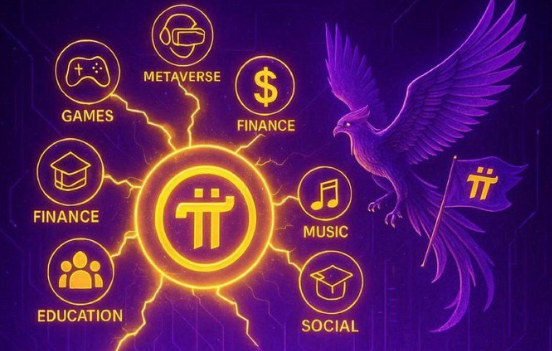
Pi Network has become a major topic in the global debate on web3 and artificial intelligence following the introduction of an expanded AI application development framework designed for its large-scale user ecosystem.
According to recent community updates, the ecosystem is now positioning itself as an entry point for AI-generated applications that can be deployed to a network of over 60 million verified users.
This development has sparked great interest among blockchain developers, creators, and enthusiasts who see it as a convergence point between artificial intelligence and decentralized digital infrastructure.
The initiative introduces Pi App Studio as a central platform for creating and integrating AI-powered applications within the Pi Network ecosystem.
The emergence of AI-powered Web3 ecosystems
The integration of artificial intelligence into blockchain ecosystems represents one of the most important technological trends in the current digital landscape.
Artificial intelligence technologies are increasingly used to simplify application development, automate processes, and improve user interaction within decentralized environments.
Pi Network’s latest direction reflects this broader industry shift by enabling developers to create AI-generated applications that can connect directly to a large-scale web3 user base.
This combination of AI and blockchain infrastructure creates new opportunities for rapid application deployment and ecosystem expansion.
By reducing technical barriers, the system allows both experienced developers and non-technical creators to participate in creating decentralized applications.
Pi App Studio as a development gateway
At the center of this initiative is Pi App Studio, a platform designed to simplify the process of creating and deploying applications within the Pi Network ecosystem.
The platform supports integration with popular AI coding tools such as Cursor, Replit, and Claude Code, making development more accessible and efficient.
One of the key features highlighted is the use of pre-optimized prompts that allow developers to integrate with the Pi software development kit using simple copy and paste methods.
This significantly reduces the complexity typically associated with blockchain integration and smart application development.
By streamlining the development process, Pi App Studio aims to accelerate the creation of new applications within the ecosystem.
This approach reflects a growing trend in the technology industry where AI-assisted development tools are transforming the way software is built and deployed.
Access to a large-scale verified user base
One of the most notable aspects of the Pi Network ecosystem is its large KYC verified user base.
With more than 60 million users worldwide, the network provides developers access to a significant audience for application deployment.
This scale represents a huge advantage for developers looking to test, release, and scale their applications in a real-world environment.
In traditional app development ecosystems, user acquisition is often one of the most challenging aspects of scaling a product.
Pi Network’s integrated user base reduces this barrier by offering immediate access to a large, active community.
This allows developers to focus more on innovation and functionality rather than early-stage user acquisition challenges.
Integrated portfolio and Web3 infrastructure
Another key component of the ecosystem is the integrated Pi wallet and Web3 infrastructure.
This infrastructure allows for seamless integration of payment systems within the applications created on the platform.
Developers can implement payment functionality in a short period of time, reportedly in as little as two minutes, according to community descriptions.
This streamlined payments integration is designed to support frictionless transactions within the ecosystem.
 |
| Source: Xpost |
By combining wallet functionality with application development tools, Pi Network aims to create a fully integrated digital economy environment.
This framework supports both developers and users by allowing direct interaction with decentralized financial tools.
Accelerate the development of AI-powered applications
The introduction of AI-assisted development tools is significantly changing the way applications are built within the ecosystem.
Developers can now leverage artificial intelligence to generate application frameworks, automate coding processes, and optimize integration with blockchain infrastructure.
This reduces development time and reduces technical barriers for new creators entering the ecosystem.
The concept of vibration coding, as mentioned in community discussions, reflects a shift toward more intuitive, AI-guided development experiences.
Instead of writing complex code manually from scratch, developers can now rely on AI systems to help create functional applications.
This approach has the potential to dramatically increase the speed and volume of application development within the ecosystem.
Web3’s role in AI integration
The combination of web3 and artificial intelligence is emerging as a powerful technological convergence.
Web3 provides a decentralized infrastructure, while AI adds intelligence and automation to application development and user interaction.
Together, these technologies enable new forms of digital ecosystems that are more dynamic, scalable, and user-driven.
The Pi Network initiative reflects this convergence by integrating AI development tools directly into its blockchain ecosystem.
This allows applications to be decentralized and intelligently optimized for user engagement.
As this trend continues, AI-powered web3 ecosystems may become a standard model for future digital platforms.
Opportunities for developers and creators
The expansion of AI application development within the Pi Network creates new opportunities for developers and creators around the world.
By providing simplified tools and access to a large user base, the ecosystem reduces traditional barriers to entry in software development.
This opens the door for independent developers, startups, and AI enthusiasts to participate in creating decentralized applications.
The availability of integrated payment systems further enhances monetization opportunities for creators.
Developers can create applications that not only work within a decentralized environment but also support real economic activity.
This combination of accessibility and monetization potential is a key driver of ecosystem growth.
Community Driven Innovation
The Pi Network ecosystem has always emphasized community participation as a fundamental principle.
The introduction of AI App Studio further strengthens this model by allowing users to actively contribute to app development.
With millions of users participating in the ecosystem, innovation is no longer limited to just professional developers.
Instead, a broader community of creators can contribute ideas, apps, and services that expand the ecosystem.
This community-driven approach helps ensure continued innovation and ecosystem diversity.
It also strengthens engagement by allowing users to become active participants rather than passive consumers.
The future of AI and Blockchain integration
The integration of AI and blockchain technology is still in its early stages, but it is evolving rapidly.
The Pi Network approach represents one of the most structured attempts to combine these technologies at scale.
By offering tools that simplify development and provide access to a large user base, the ecosystem is positioning itself within this emerging technological frontier.
As AI capabilities continue to advance, its integration with decentralized systems is expected to become more sophisticated.
This could lead to fully automated application ecosystems where AI manages both development and optimization processes.
In this context, the current Pi Network initiative may represent a first step towards a much larger transformation in digital infrastructure.
Conclusion
Pi Network’s introduction of AI app development through Pi App Studio marks a significant evolution in its ecosystem strategy.
By combining artificial intelligence, web3 infrastructure, and a large base of verified users, the platform is creating new opportunities for developers and creators.
The ability to quickly integrate payments, access integrated wallets, and deploy applications to millions of users positions the ecosystem as a growing hub for AI-driven innovation.
As the convergence of AI and blockchain continues to accelerate, Pi Network’s approach highlights the potential of integrated digital ecosystems to shape the future of application development and decentralized technology.
hoka.news – not just cryptocurrency news. It’s cryptoculture.
Writer @Victoria
Victoria Hale is a writer focused on blockchain and digital technology. It is known for its ability to simplify complex technological developments into clear, easy-to-understand and engaging-to-read content.
Through her writing, Victoria covers the latest trends, innovations and developments in the digital ecosystem, as well as their impact on the future of finance and technology. It also explores how new technologies are changing the way people interact in the digital world.
His writing style is simple, informative, and focuses on giving readers a clear understanding of the rapidly evolving world of technology.
Disclaimer:
HOKA.NEWS articles are here to keep you up to date on the latest rumors in crypto, technology, and more, but they are not financial advice. We share information, trends and knowledge, we don’t tell you to buy, sell or invest. Always do your own homework before making any money moves.
HOKA.NEWS is not responsible for any loss, profit or chaos that may occur if you act on what you read here. Investment decisions should arise from your own research and, ideally, the guidance of a qualified financial advisor. Remember: cryptocurrencies and technology move fast, information changes in the blink of an eye, and while we strive for accuracy, we cannot promise that it is 100% complete or up-to-date.

