


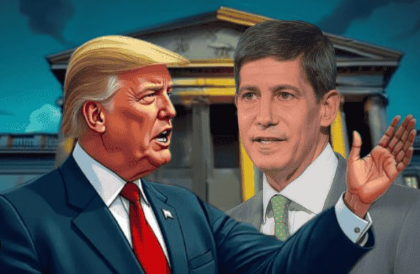
Former US President Donald Trump is reportedly preparing to swear in Kevin Warsh on Friday as the new chairman of the Federal Reserve, in a move that is already attracting intense attention in financial markets due to Warsh’s alleged connections to Bitcoin and broader cryptocurrency-related investments.
If confirmed, Warsh would become the first Federal Reserve chair in history to have personally owned Bitcoin before taking office, marking a significant moment in the current convergence between traditional monetary policy leadership and the digital asset industry.
Reports circulating in the financial and crypto communities suggest that Warsh has disclosed more than $100 million in cryptocurrency-related investments, a figure that has fueled widespread debate about the implications of such holdings for one of the world’s most influential monetary policy functions.
Reference was also made to developments on crypto commentary platforms and social media discussions, including mentions associated with the X Coin Bureau account, which highlighted the possible historical significance of a Bitcoin-linked Federal Reserve Chair.
While official confirmation and full policy details remain limited at this stage, the narrative around Warsh’s appointment has already sparked significant debate among economists, investors and digital asset market participants.
The Federal Reserve plays a central role in shaping U.S. monetary policy, including interest rate decisions, inflation control strategies, liquidity management, and broader financial system stability measures.
As such, any leadership transition at the Federal Reserve is closely watched by global markets, often influencing valuations of stocks, bonds, commodities and cryptocurrencies.
The possibility of a Federal Reserve chair having direct exposure to Bitcoin introduces a new dimension to the current relationship between digital assets and central banking institutions.
Kevin Warsh is not new to the financial policy landscape. He was previously a member of the Board of Governors of the Federal Reserve and has long participated in economic policy debates both domestically and internationally.
His experience in monetary policy, financial markets and institutional economics has made him a recognizable figure within central banking circles.
However, the alleged scale of his cryptocurrency-related investments has placed him at the center of a broader debate over the intersection of personal financial exposure and public monetary leadership.
Bitcoin and other digital assets have seen significant institutional adoption in recent years, particularly following the entry of major financial firms, asset managers and publicly traded companies into the cryptocurrency market.
The approval of spot Bitcoin exchange-traded funds in major financial jurisdictions has further legitimized digital assets as part of mainstream investment portfolios.
As a result, exposure to Bitcoin is no longer limited to retail investors or crypto-native participants, but has expanded to institutional finance, corporate treasuries, and high-net-worth individuals.
Therefore, the possible appointment of a Federal Reserve chair with Bitcoin holdings reflects a broader shift in the way digital assets are being integrated into global financial systems.
Supporters of cryptocurrency adoption argue that such a development could represent a step towards greater understanding of digital asset markets within central banking institutions.
They believe policymakers with direct exposure to emerging financial technologies may be better positioned to assess risks, innovation potential, and regulatory frameworks.
However, critics have raised concerns about potential conflicts of interest and the implications of personal cryptocurrency investments within a role responsible for overseeing monetary policy and financial stability.
Historically, the Federal Reserve’s decisions on interest rates and liquidity conditions have had a major impact on Bitcoin and the broader cryptocurrency markets.
Periods of monetary tightening have often coincided with downward pressure on digital asset prices, while looser financial conditions have tended to support the growth of risk assets.
This dynamic has made the relationship between central banks and cryptocurrency markets one of the most watched interactions in global finance.
If Warsh takes on the role of Federal Reserve chairman with significant exposure to Bitcoin, analysts expect increased scrutiny on how monetary policy decisions could be perceived in relation to digital asset markets.
Regulatory experts also note that the Federal Reserve operates under strict ethics and disclosure requirements designed to avoid conflicts of interest among senior officials.
 |
| Source: Xpost |
Any confirmed appointment would likely go through extensive review processes to ensure compliance with financial disclosure rules and institutional governance standards.
The broader financial community is now closely watching the official confirmation and additional details on Warsh’s policy stance, particularly in relation to inflation management, interest rate strategy, and digital asset regulation.
Bitcoin has grown from a niche technological experiment to a globally recognized financial asset class over the past decade.
Its increasing integration into institutional portfolios, payment systems, and macroeconomic debates has fundamentally changed the way policymakers approach digital finance.
Central banks around the world are increasingly studying the implications of decentralized assets, blockchain infrastructure, and tokenized financial systems.
Some countries have even begun to explore central bank digital currencies as part of broader efforts to modernize payment systems and maintain monetary sovereignty in a digital economy.
In this evolving landscape, the role of central bank leadership has become more complex than ever.
Now monetary policymakers must consider not only traditional financial indicators, but also the impact of digital asset markets, decentralized financial platforms, and global liquidity flows influenced by blockchain-based systems.
Therefore, the possible appointment of a Bitcoin-linked Federal Reserve chair comes at a time of significant transformation in the global financial architecture.
Market analysts suggest that investors’ reaction to this development may largely depend on how Warsh’s political approach is perceived once in office.
If his leadership is seen as supporting innovation while maintaining regulatory discipline, it could strengthen confidence in the long-term integration of digital assets into mainstream finance.
On the other hand, concerns about bias or influence from policies related to personal holdings could raise doubts among institutional observers.
The cryptocurrency market, known for its sensitivity to macroeconomic signals, is expected to closely monitor any policy statements or indications from the Federal Reserve leadership following the transition.
Bitcoin in particular has increasingly been viewed as a speculative asset and macroeconomic hedge by different segments of the investment community.
Institutional investors have often compared Bitcoin’s behavior to traditional risk assets such as technology stocks, while some long-term holders see it as a store of value similar to digital gold.
This double narrative has contributed to the current volatility, but has also sustained long-term interest in this asset class.
The broader implications of a Fed chair with direct exposure to Bitcoin extend beyond cryptocurrency markets.
Global financial institutions, foreign central banks and sovereign wealth funds are closely watching US monetary policy for signals that will influence international capital flows.
Therefore, any perceived change in attitudes towards digital assets could have a ripple effect on global markets.
While the situation continues to develop, analysts emphasize that official confirmation and political clarity will be essential before drawing conclusions about the long-term impact of the appointment.
For now, the financial world remains focused on the potential historical significance of the development and what it could mean for the future relationship between central banking and digital assets.
If confirmed, Kevin Warsh’s appointment would mark a notable moment in the ongoing evolution of global finance, where traditional monetary institutions and decentralized digital systems continue to converge in increasingly complex ways.
The coming days are expected to provide greater clarity as markets react and authorities can address the implications of the transition.
Regardless of the outcome, the discussion itself highlights how deeply Bitcoin and the broader crypto ecosystem have become integrated into mainstream financial discourse at the highest levels of economic governance.
hoka.news – not just cryptocurrency news. It’s cryptoculture.
Writer @Victoria
Victoria Hale is a writer focused on blockchain and digital technology. It is known for its ability to simplify complex technological developments into clear, easy-to-understand and attractive-to-read content.
Through her writing, Victoria covers the latest trends, innovations and developments in the digital ecosystem, as well as their impact on the future of finance and technology. It also explores how new technologies are changing the way people interact in the digital world.
His writing style is simple, informative, and focuses on giving readers a clear understanding of the rapidly evolving world of technology.
Disclaimer:
HOKA.NEWS articles are here to keep you up to date on the latest rumors in crypto, technology, and more, but they are not financial advice. We share information, trends and knowledge, we don’t tell you to buy, sell or invest. Always do your own homework before making any money moves.
HOKA.NEWS is not responsible for any loss, profit or chaos that may occur if you act on what you read here. Investment decisions should arise from your own research and, ideally, the guidance of a qualified financial advisor. Remember: cryptocurrencies and technology move fast, information changes in the blink of an eye, and while we strive for accuracy, we cannot promise that it is 100% complete or up-to-date.

