


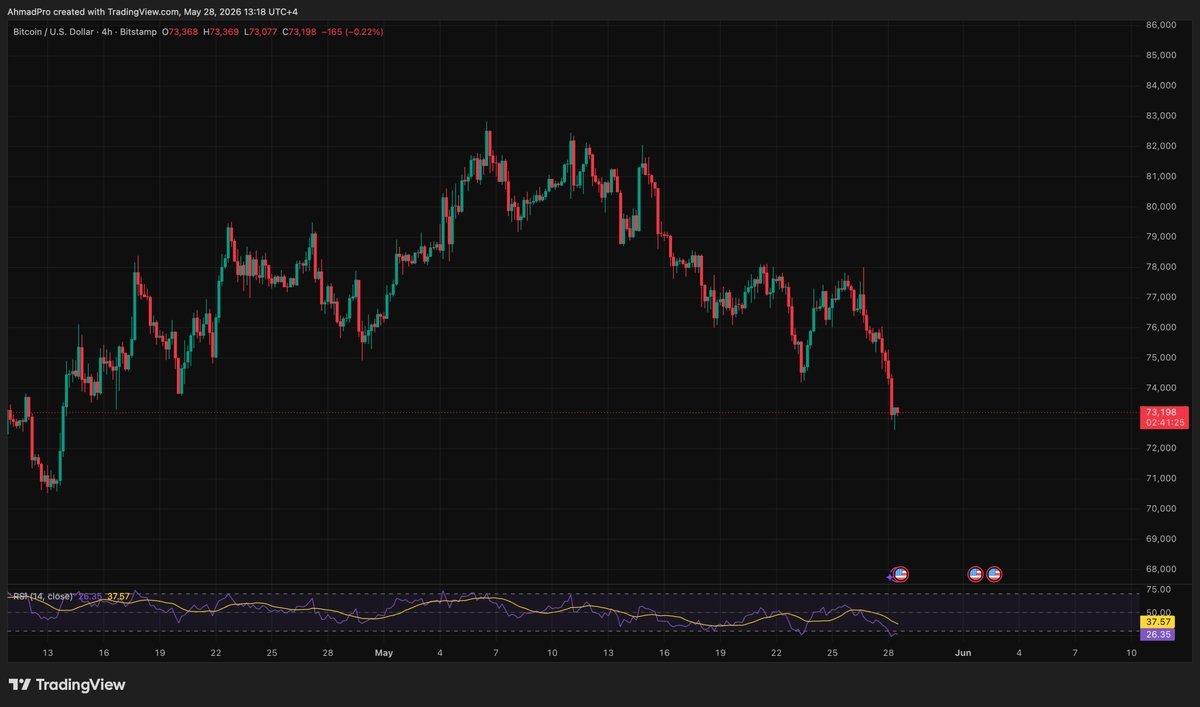
The price of Bitcoin (BTC) saw a sharp decline, surpassing the $73,000 level on Thursday, following the targeting of a US airbase in Kuwait by Iran’s Islamic Revolutionary Guard Corps. This incident triggered a widespread wave of risk aversion that swept global markets, causing the total market value of digital currencies to plummet from $2.54 trillion to $2.45 trillion in a single session.
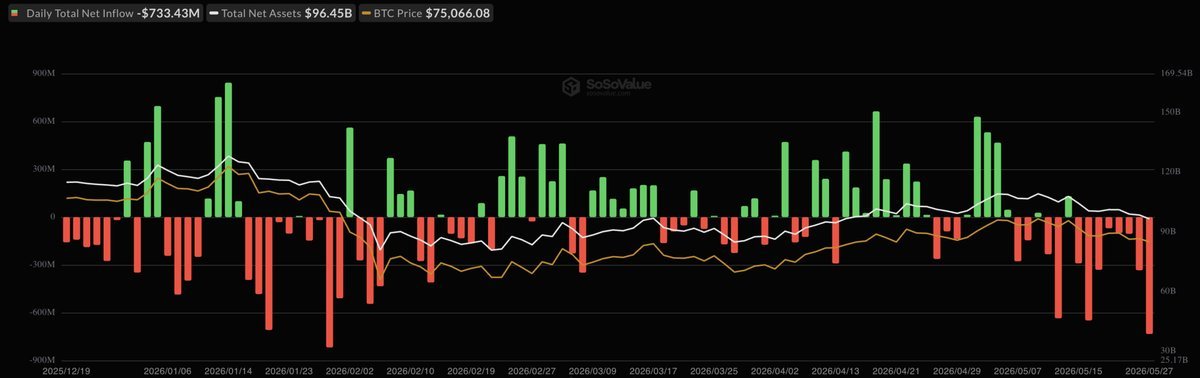
The pressure was not limited to geopolitical tensions alone, but was reinforced by massive outflows from Bitcoin and Ethereum ETFs which surpassed $800 million on Thursday, recording the largest daily net redemption in weeks. This number didn’t come out of nowhere; Wednesday’s session actually saw the outflow of $737.70 million from Bitcoin funds and $67.10 million from Ethereum funds, extending the streak of net outflows to the eighth consecutive day. So, it appears that the institutional dynamics that pushed Bitcoin from the $60,000 level to its previous highs have completely reversed its direction for the moment.
Bitcoin News: Mutual Fund Loss Extends Eight Days as Institutional Demand Diminishes
Data confirms that the total outflows from Bitcoin and Ethereum funds in just two days have exceeded $870 million. This rolling series of eight sessions constitutes one of the longest institutional withdrawal periods since the launch of Bitcoin spot funds in the United States. Notably, capital has begun to decisively move away from Bitcoin and Ethereum toward lower beta digital assets rather than back to cash, a distinction critical to understanding future BTC price movements.
On a related note, the Crypto Fear and Greed Index fell to the level of 31 on Thursday, which clearly places the market in the “fear” zone. This change in sentiment indicates that the crisis is not limited to derivatives positions alone. To reverse this series of outflows, traders are waiting for either a sign of easing geopolitical tensions or a macroeconomic catalyst, such as weaker-than-expected CPI inflation data or dovish statements from the Federal Reserve, which are not near-term.
How do US-Iranian tensions stimulate risk aversion?
The influence mechanism works here directly; Rising geopolitical risks in the Middle East are prompting institutional investors to adopt defensive positions, which initially involves reducing exposure to high-volatility assets. Although Bitcoin has been touted as “digital gold,” it has acted as a high-risk asset during severe crises rather than as a safe haven; While gold rose with oil prices surpassing $94 globally, Bitcoin saw a notable decline.
Iran’s Revolutionary Guards warned that “any additional US attacks would result in a more decisive response”, holding Washington responsible for the consequences. That concern was reflected in Asian stock markets in Taiwan, South Korea and Japan, which each fell about 3% on Thursday. Liquidations in the crypto market also exacerbated the decline, as more than $900 million was liquidated in 24 hours, including $873 million from long positions, accelerating the decline in the spot price beyond just the effect of outflows.
Will Bitcoin price regain the $74,000 level or head towards further decline?
BTC price is currently trading below the $74,000 level, a level that has moved from psychological support to immediate resistance. Massive investment fund movements and falling prices have reinforced the belief that the $73,000 zone – which analysts saw as the dividing line between a cyclical correction and a structural collapse – is now a ceiling to watch and not a floor to rely on.
The next critical support lies between $70,500 and $71,000, where on-chain data shows a high concentration of buy orders. As for crossing the $70,000 level and stabilizing below, this will pave the way towards the $68,000 level, where the 200-day exponential moving average (200-day EMA) lies. The Relative Strength Index (RSI) is currently stable near 38 on a daily basis, indicating continued bearish momentum without yet reaching the oversold stage, meaning there is room for more selling before a possible technical rebound occurs.
To return to the upside, Bitcoin needs to reclaim the $74,000 level and close above it with strong trading volume, then hold the $73,500 level as support. This scenario will indicate that the bottom of $70,500 will hold and the correction wave will end. On the other hand, a daily close below $70,000 would confirm a structural change in the market, and not just a passing geopolitical reaction, making $68,000 the next technical target.
The post Bitcoin Falls Below $73,000 Amid Geopolitical Tensions and Massive Outflows appeared first on Cryptonews Arabic.

