


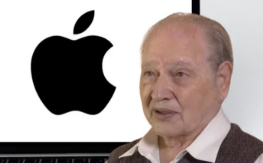
In one of the most surprising “what might have been” stories in the history of modern technology, Ronald Wayne, Apple’s third, lesser-known co-founder, sold his 10% stake in the company in 1976 for just $800. At the time, the decision seemed rational, even cautious. Apple was a fledgling startup with uncertain prospects, operating out of a garage with no guarantee of success.
Nearly five decades later, that same stake would be worth roughly $455 billion at Apple’s current market valuation, making Wayne’s decision one of the most talked-about missed opportunities in corporate history.
The story has resurfaced again amid renewed discussions about early technology investments, risk-taking and the unpredictable nature of startup success in Silicon Valley.
Apple’s early days in the garage startup era
Apple was founded in 1976 by Steve Jobs, Steve Wozniak and Ronald Wayne. While Jobs and Wozniak are widely recognized as the faces of Apple’s creation, Wayne played a crucial, but often overlooked, role in the company’s formation.
At that time, Wayne was hired to provide management structure and act as a stabilizing force between the two younger co-founders. He helped draft the first partnership agreements, designed the original Apple logo, and contributed to the founding documentation that legally established the company.
Despite his involvement, Wayne’s position at the startup was far from secure. Unlike Jobs and Wozniak, he had personal assets that could be exposed to financial risks if the company failed or racked up debt.
The decision to sell a 10% stake for $800
Just 12 days after Apple was officially founded, Ronald Wayne made the decision to sell his 10% stake for $800. He also later received an additional $1,500 to waive any future claims against the company.
At the time, this decision was motivated by risk aversion. Wayne reportedly feared that if Apple failed or incurred debt, he would be personally liable as a partner in the business.
In the context of 1976, Apple was an unproven startup competing in an emerging personal computer market. The risk of failure was extremely high and Wayne preferred financial security to long-term speculation.
A decision seen through the lens of history
In retrospect, Wayne’s decision has become one of the most famous examples of opportunity cost in business history. As Apple grew from a garage startup to one of the most valuable companies in the world, his small stake would have transformed into an extraordinary fortune.
Based on Apple’s current market capitalization, that original 10% stake would now be worth approximately $455 billion. This figure places it among the greatest theoretical fortunes in modern financial history.
However, it is important to note that this valuation is purely hypothetical and reflects current market conditions rather than actual realized wealth.
Apple’s rise to becoming a global technology giant
After Wayne’s departure, Apple continued its rapid growth. The company released its first major products, including the Apple I and Apple II computers, which helped establish its early reputation in the personal computing industry.
Over the following decades, Apple evolved into a global technology leader, revolutionizing multiple industries, including computing, music, telecommunications, and consumer electronics.
The launch of iconic products such as the Macintosh, iPod, iPhone and iPad transformed Apple into one of the most valuable corporations in the world.
Today, Apple is a cornerstone of the global technology sector and consistently ranks among the highest-valued public companies by market capitalization.
The Psychology of Early Exit Decisions
Ronald Wayne’s decision highlights a broader theme common in startup ecosystems: the difficulty of predicting future success in early-stage companies.
At the time of Apple’s founding, there was no guarantee that personal computers would become commonplace, much less dominate global technology markets. Many early startups of the same era failed, reinforcing the rationality of Wayne’s caution.
Behavioral economics experts often point out that early exit decisions are influenced by risk perception, liquidity needs, and uncertainty about future outcomes.
Wayne’s choice reflects a rational decision based on the information available at the time, even if it seems extraordinary in retrospect.
 |
| Source: Xpost |
Risk, reward and the startup mythology
The story of Ronald Wayne has become part of Silicon Valley mythology, often cited in debates about risk-taking and entrepreneurial success. It is frequently used to illustrate the extreme asymmetry of startup outcomes, where small early decisions can lead to very different financial outcomes.
However, financial analysts warn against oversimplifying such narratives. For every Apple, there are thousands of startups that fail completely, leaving early adopters with nothing.
In that context, Wayne’s decision to obtain immediate financial compensation rather than maintain a risky stock position may have been a reasonable compensation.
Life after Apple
Following his departure from Apple, Ronald Wayne led a relatively modest life compared to his former co-founders. He remained involved in various business and engineering ventures, but never again found an opportunity of comparable scale.
Despite the enormous hypothetical value of his former involvement, Wayne has consistently stated in interviews that he has no regrets about his decision. He has described it as a practical choice made under uncertain conditions and not a mistake.
His perspective offers a counterpoint to the popular narrative of lost fortune, emphasizing realism over retrospective regret.
The broader impact on investment culture
Ronald Wayne’s story continues to resonate in modern investment culture, particularly in discussions about venture capital, equity compensation, and startup risk.
It serves as a reminder that early-stage capital is inherently speculative and that even the most successful companies start out as uncertain ventures.
In today’s startup ecosystem, employees and founders often receive equity stakes as part of compensation packages, reflecting the high-risk, high-reward nature of innovation-driven industries.
A symbol of what is at stake in Silicon Valley
Ronald Wayne’s brief relationship with Apple has become a symbol of the extreme outcomes of Silicon Valley, where fortunes can be made or lost based on early decisions that may seem minor at the time.
The contrast between $800 billion and $455 billion represents one of the most dramatic financial divergences in modern business history.
However, it also highlights the unpredictability of technological innovation and the difficulty of identifying future global giants from their inception.
Conclusion
Ronald Wayne’s decision to sell his 10% stake in Apple for $800 in 1976 remains one of the most cited examples of missed financial opportunities in corporate history. While hindsight transforms the decision into a multimillion-dollar “what if,” the reality at the time was determined by uncertainty, risk, and rational caution.
Apple’s evolution into a trillion-dollar technology powerhouse has made Wayne’s story a lasting lesson in risk, timing, and the unpredictable nature of innovation.
Ultimately, his choice reflects a broader truth about entrepreneurship: Even the most successful companies in history were once long-shot bets, and not all early entrants are destined to share in their long-term success.
hoka.news – not just cryptocurrency news. It’s cryptoculture.
Writer @Victoria
Victoria Hale is a writer focused on blockchain and digital technology. It is known for its ability to simplify complex technological developments into clear, easy-to-understand and engaging-to-read content.
Through her writing, Victoria covers the latest trends, innovations and developments in the digital ecosystem, as well as their impact on the future of finance and technology. It also explores how new technologies are changing the way people interact in the digital world.
His writing style is simple, informative, and focuses on giving readers a clear understanding of the rapidly evolving world of technology.
Disclaimer:
HOKA.NEWS articles are here to keep you up to date on the latest rumors in crypto, technology, and more, but they are not financial advice. We share information, trends and knowledge, we don’t tell you to buy, sell or invest. Always do your own homework before making any money moves.
HOKA.NEWS is not responsible for any loss, profit or chaos that may occur if you act on what you read here. Investment decisions should arise from your own research and, ideally, the guidance of a qualified financial advisor. Remember: cryptocurrencies and technology move fast, information changes in the blink of an eye, and while we strive for accuracy, we cannot promise that it is 100% complete or up-to-date.

