


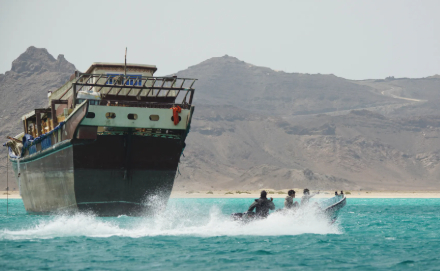
The announcement, which was widely circulated in international media and social platforms, including comments from accounts such as @AshCrypto on X, has sparked immediate alarm among geopolitical analysts due to the strategic importance of the waterway.
The Bab al-Mandab Strait is one of the world’s most important maritime chokepoints, connecting the Red Sea to the Gulf of Aden and ultimately to the Arabian Sea. It serves as a key passage for global maritime traffic, including crude oil, liquefied natural gas and commercial goods traveling between Europe, Asia and Africa.
According to maritime data estimates, billions of dollars of goods and energy supplies pass through the strait daily, making any disruption a significant risk to global supply chains and energy markets.
Iran’s statement declaring the closure of the strait comes in the wake of Israeli attacks in the region, which have further escalated already high tensions across the Middle East.
This development has raised urgent questions among international observers about the possible economic and geopolitical consequences if the closure is maintained or enforced militarily.
The Bab al-Mandab Strait is considered one of the most strategically important maritime corridors in the world due to its narrow geography and its role as a gateway to the Suez Canal, one of the busiest shipping routes on the planet.
Any disruption to this passage could have immediate ripple effects on global trade, shipping insurance costs, oil prices and supply chain logistics.
Energy analysts warn that even temporary disruptions in the region can trigger volatility in global oil markets due to concerns about supply bottlenecks and shipping delays.
The Strait is particularly critical for Middle Eastern oil exports to Europe and North America, as well as Asian imports of energy resources.
A closure of this magnitude, if implemented in practice, could force shipping companies to divert vessels around the southern tip of Africa, significantly increasing transit times and transportation costs.
Such a diversion would also put additional pressure on global shipping capacity, potentially leading to higher freight rates and logistical disruptions across multiple industries.
Financial markets have historically reacted strongly to geopolitical instability in maritime hotspots, and analysts expect similar sensitivity in response to this latest development.
Oil prices, in particular, tend to be very sensitive to perceived threats to supply routes in the Middle East.
Traders typically price geopolitical risk premiums when critical infrastructure or shipping lanes are threatened, even if physical disruptions remain uncertain.
The Bab al-Mandab Strait has long been considered a fragile geopolitical point due to its proximity to conflict zones and its importance to global trade.
In recent years, the region has experienced periodic instability involving regional military activity, maritime security incidents, and tensions between state and non-state actors.
The latest escalation involving Iran and Israel adds a new layer of complexity to an already volatile geopolitical environment.
 |
| Source: Xpost |
Iran’s closure declaration has not yet been independently verified by all international maritime authorities, and operational control of the strait remains a matter of strategic dispute between regional powers.
However, even the announcement itself has the potential to influence global markets and shipping behavior due to uncertainty and risk perception.
Shipping companies often adjust routes and insurance coverage based on perceived threats, even before actual disruptions occur.
Insurance premiums for ships passing through high-risk maritime areas often increase significantly during periods of geopolitical tension.
The Bab al-Mandab Strait, along with the Suez Canal and the Strait of Hormuz, is part of a trio of global energy chokepoints that together handle a substantial portion of the world’s oil and trade flows.
Disruptions in any of these places can have enormous effects on global economic stability.
The Strait closure announcement comes at a time when global energy markets are already navigating volatility driven by shifts in demand, production adjustments by major oil producers and broader macroeconomic uncertainty.
Additional geopolitical pressure has raised concerns among analysts about potential inflationary impacts if energy supply chains are significantly disrupted.
Higher oil prices can translate into higher transportation costs, elevated consumer prices and broader inflationary pressures in global economies.
Central banks and authorities are closely monitoring these developments due to their potential influence on monetary policy decisions.
Beyond energy markets, global trade flows involving manufactured goods, electronics, agricultural products and raw materials could also be affected by disruptions to shipping routes through the Bab al-Mandab Strait.
The Strait is a vital artery for maritime container traffic, connecting major production centers in Asia with consumer markets in Europe and beyond.
Any prolonged disruption could create delays in supply chains that are already sensitive to logistics bottlenecks and global demand fluctuations.
The situation has also attracted the attention of defense analysts, who highlight the strategic military importance of the region.
Control of maritime bottlenecks is often considered a key element of geopolitical influence, particularly in times of regional conflict.
The presence of naval forces from multiple countries in and around the Red Sea and Gulf of Aden further complicates the security environment.
Historically, international naval coalitions have been deployed to the region to ensure freedom of navigation and protect commercial shipping routes from potential threats.
However, the effectiveness of such measures depends on the level of coordination between participating nations and the intensity of regional tensions.
The reported escalation between Iran and Israel introduces additional uncertainty into an already complex security landscape.
Analysts warn that the continued escalation could lead to further disruptions to maritime traffic, a greater military presence in the region and greater risks to commercial vessels operating in the area.
Global shipping companies are likely to reassess risk exposure and contingency plans in response to the announcement, including potential route adjustments and insurance coverage updates.
Market participants will also closely monitor diplomatic developments to assess whether the situation stabilizes or continues to deteriorate.
Historically, geopolitical crises involving maritime hotspots have often led to rapid diplomatic engagement aimed at preventing prolonged disruptions to global trade.
The international community has strong economic incentives to maintain open and safe shipping routes, particularly in regions that serve as critical arteries for global trade.
At the moment, there remains much uncertainty regarding the operational status of the Bab al-Mandab Strait and the practical implementation of the reported closure.
Until clearer confirmation emerges from maritime authorities and shipping operators, markets are expected to remain sensitive to developments in the region.
The situation underlines the continued vulnerability of global supply chains to geopolitical shocks in strategically important regions.
For now, Iran’s announcement has placed one of the world’s most important shipping corridors in the global spotlight, with potential implications for energy markets, international trade and geopolitical stability.
hoka.news – not just cryptocurrency news. It’s cryptoculture.
Writer @Victoria
Victoria Hale is a writer focused on blockchain and digital technology. It is known for its ability to simplify complex technological developments into clear, easy-to-understand and engaging-to-read content.
Through her writing, Victoria covers the latest trends, innovations and developments in the digital ecosystem, as well as their impact on the future of finance and technology. It also explores how new technologies are changing the way people interact in the digital world.
His writing style is simple, informative, and focuses on giving readers a clear understanding of the rapidly evolving world of technology.
Disclaimer:
HOKA.NEWS articles are here to keep you up to date on the latest rumors in crypto, technology, and more, but they are not financial advice. We share information, trends and knowledge, we don’t tell you to buy, sell or invest. Always do your own homework before making any money moves.
HOKA.NEWS is not responsible for any loss, profit or chaos that may occur if you act on what you read here. Investment decisions should arise from your own research and, ideally, the guidance of a qualified financial advisor. Remember: cryptocurrencies and technology move fast, information changes in the blink of an eye, and while we strive for accuracy, we cannot promise that it is 100% complete or up-to-date.

