


If you’ve been around cryptocurrencies for a while, you’re probably familiar with market cycles.
Market cycles typically indicate a halving event, which often acts as a catalyst for an upcoming bull run.
Many have doubted this theory, but so far it seems to come true with remarkable accuracy.
Let’s go further and see if we can estimate when this decline will end, taking into account past market behavior.
What previous lessons suggest:
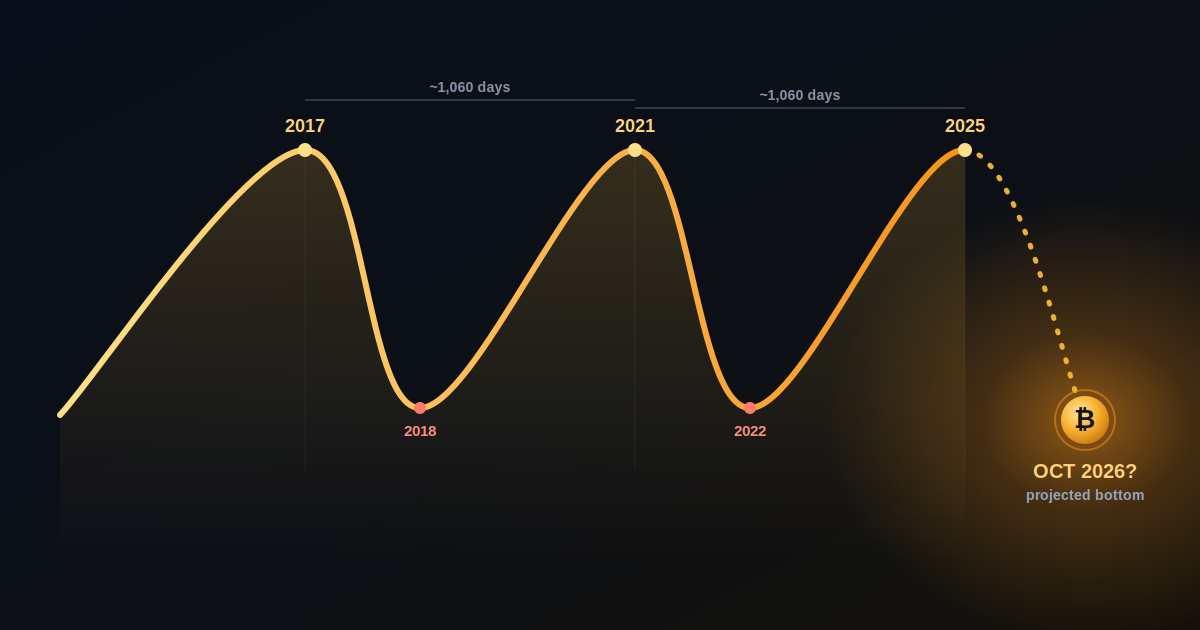
The first reference point is the rise in Bitcoin prices from its lowest level in 2015 to its peak in 2017.
This period spanned approximately 1,064 days (the number may vary slightly depending on the data of the platform used, but it is a very accurate estimate).
From this high, the bear market continued until the low on December 15, 2018, creating a 363-day high-low window.
The market then spent months recovering, but the major trough of capitulation had already formed.
The second reference point is the cycle that started after the December 2018 low and continued until the 2021 high on November 10.
This time, Bitcoin took 1062 days to complete the cycle (almost the same as the previous cycle).
From there, Bitcoin began to fall towards bear market territory, eventually hitting its lowest level on November 21, 2022.
This lasted 376 days, an increase of only 13 days from the previous cycle.
Despite the different general circumstances, different market participants and the breadth of the cryptocurrency ecosystem, the timing was surprisingly tight.
This is where it gets interesting.
From the 2022 trough to the peak reached on October 6, 2025, the difference is approximately 1,051 days, almost the same value.
Following this logic and using a historical average of 363 to 376 days from peak to trough, the current bear market could bottom between October 4 and 17, 2026.
A historical window, not a prediction:
This type of cycle analysis can be useful, but it should never be treated as a foolproof prediction: past results are no guarantee of future results.
Bitcoin’s future bottom will depend heavily on liquidity, interest rates, ETF flows, regulation, miner behavior, leverage, risk appetite, geopolitics, etc.
A major macroeconomic shock could accelerate the pace of decline, while strong institutional demand could easily shorten it.
However, this model is worth following, because it gives us a sort of framework.
If Bitcoin peaks around October 2025, history suggests that the all-important bottom may not be reached in the coming days or weeks, but rather it will take a few more months of correction and possibly capitulation before conditions return to square one.
Currently, the historical model points to a key window: October 2026.
Read also:
Be greedy when others are afraid: is it time for XRP to reverse?
bStock’s momentum gives Binance a new page in the face of its critics

