


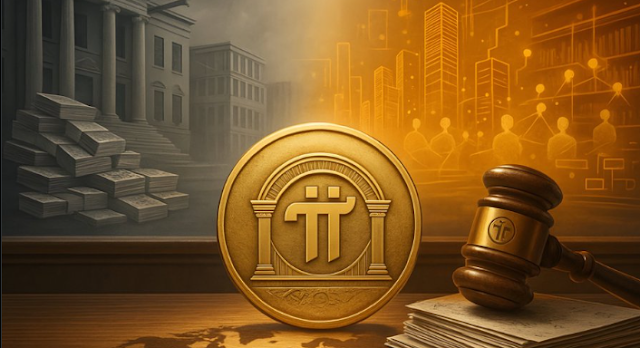
Cryptocurrency has always promised more than financial freedom: it has been framed for a long time as technology to interrupt, challenge and rebuild obsolete systems. But few projects have supported that promise with a deliberate structural change. Pi Network is distinguished. A tweet from @Sansticusman captures the essence: “Why did $ Pi happen for so much legal effort? Because it was never a currency, it is about creating a new world system.” That feeling encapsulates the widest purpose behind the development of Pi Network.
From regulatory compliance to digital identity frameworks, PI’s effort is based on more than market adoption, it is institutional legitimacy, socioeconomic accessibility and long -term resistance.
Why legal infrastructure is important in cryptography
Most cryptocurrencies have tried regulation as a late occurrence, often avoiding it completely in the name of decentralization. However, global adoption demands integration, not evasion. Pi Network has turned legal infrastructure into a pillar of its road map. By prioritizing, know your client (KYC), know your business (KYB) and compliance with money laundering guidelines (AML), PI does not position itself as a rebel, it positions itself as the future.
This legal basis allows PI to associate with institutions, governments on board and provide services that traditional finances cannot reach, without sacrificing decentralization.
The philosophy behind the currency
$ Pi is not simply a value utility or warehouse, it is a representation of a belief system. This belief includes financial inclusion, verified identity, peer trade and confidence without centralized control. Its mobile mining model allows anyone with a smartphone to participate in the network, regardless of location or economic status.
This design builds a non -investor user base, but of participants, actively involved in the joint creation of the system they use. PI Network is building a platform where the value is distributed through the contribution instead of capital.
Web3 with responsibility
Web3 promises decentralized property. Pi Network believes that the property must be responsible. Through verified identity, commercial legitimacy and transparency of the data, PI is building a responsible web3 ecosystem, one that can resist legal scrutiny and meet the expectations of public confidence.
Instead of waiting for regulators to update, PI is architeating a model that regulators can adopt. This proactive position is key to building a cryptographic system that endures.
Kyc and Kyb: Legal tools for trust
One of Pi Network’s most significant achievements is the scale of its incorporation of KYC. Millions of users around the world have been verified, not only to reduce fraud, but to allow compliance -based interaction. This transforms PI into an adequate platform for public disbursements, payroll, commercial services and even cross -border remittances.
For companies, Kyb ensures that entities that operate in the Pi ecosystem are legitimate, responsible and transparent. Together, these mechanisms create a space where cryptography is not shaded: it is safe, visible and scalable.
From the currency to the system: construction of global financial alternatives
Pi Network’s ambition reaches beyond peer payments. It is developing applications, markets, governance models and protocols designed for economic interconnectivity. Whether through trade tools, educational platforms or localized services, PI offers the infrastructure of what the tweet describes as a “new world system.”
This includes:
-
Market characteristics for direct trade using $ Pi
-
Commercial tools that accept Pi with Kyb compatible follow -up
-
Education Centers for Financial Education and the incorporation of cryptography
-
Identity solutions that integrate personal sovereignty with institutional transparency
Together, these components evolve PI in a system, not just a coin.
Resilience through regulation
Regulation often evokes resistance in cryptographic circles. But Pi Network sees it as resilience. When getting involved with the legal frames early, PI prevents interruption later. It is more likely that governments support platforms that honor transparency, user verification and ethical financial models. Pi is actively building all three.
This infrastructure compatible with regulation does not compromise its decentralized spirit, improves it. It means that users can enjoy Crypto’s benefits without risking the exclusion of formal systems.
SOLEGAN SOCIAL MEMORY AND IDENTITY
One of Pi’s most novel contributions is the concept of blockchain as a memory bank, not only for transactions, but for identity, contribution and participation. Its trusted graphic system records user participation in a way that builds reputation and reflects the value gained.
Because $ Pi go for so much legal effort? Because it was never just a coin, it’s about creating a new world system. pic.twitter.com/vtjriokpqt
– Saπastic (@sansticusman) July 19, 2025
Sovereign identity means that users possess their data, history and access. It is a step towards digital citizenship, where people move freely among digital services, verified and respected by default.
The legal challenges behind the scene
Establishing said system has required significant legal navigation. From data protection laws to financial license frameworks, Pi Network compliance work covers jurisdictions and disciplines. This effort reflects its global ambition. To become a truly international system, PI must honor local law while maintaining utility without borders.
Investment in legal structure is not only reactive, it is strategic. It positions the Pi network as a model for the development of responsible cryptography and the expansion to the proof of the future.
Community as a layer of government
Despite its legal rigor, PI is still driven by the community. Users shape the ecosystem through feedback, development contributions and consensus. Development governance models aim to reflect this dynamic, offering voting systems and community representation at scale.
Legal compliance does not deny the basic commitment, in the case of Pi, it strengthens it. Verified communities build legitimate networks.
The way ahead: towards a subsequent system to the monada
As the PI network prepares for the transition to open Mainnet, the question is no longer “What will the currency be worth?” But “what will the system enable?” PI offers a case of use in which cryptography becomes infrastructure, is used in everyday services, trusts institutions and governs by people.
With its established legal bases and its growing technical basis, PI is positioned to become not only to another web3 project, but the plan of what can become responsible cryptography and focused on the human being.
Conclusion
The tweet that inspired this article says a bigger truth: $ Pi was never just about the currency. It is about remodeling how systems work: how value is created, how identity is defined and how trust is constructed. By rejecting the chaos of speculation and adopting the precision of legal design, Pi Network is forging something strange in cryptography: a system created to last.
For those looking for more than short -term gains, PI offers a vision. And for a world questioning its existing financial architecture, that vision could be exactly what comes next.
Writer
@Ellena
Ellena is an experienced cryptographic writer who loves to explore the intersection of blockchain technology and financial markets. She regularly provides information about the latest trends and innovations in the currency space.
See other news and articles on Google News
Discharge of responsibility:
The articles published in Hokanews are intended to provide updated information on various topics, including cryptocurrency and technology news. The content on our site is not intended to be an invitation to buy, sell or invest in any asset. We encourage readers to conduct their own research and evaluation before making an investment or financial decision.
Hokanews is not responsible for any loss or damage that may arise from the use of the information provided on this site. Investment decisions must be based on an exhaustive investigation and advice of qualified financial advisors. Information about Hokanews can change without prior notice, and we do not guarantee the precision or integrity of the published content.

