


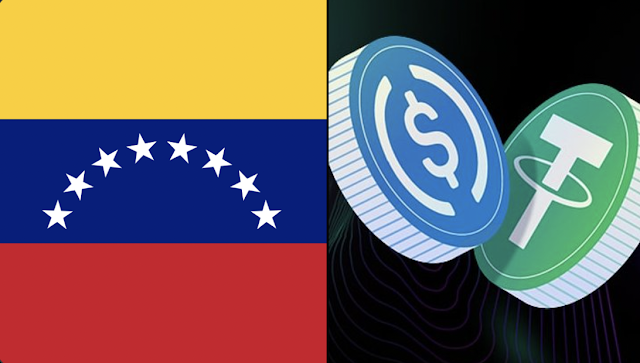
Venezuela turns to stablecoins as economic pressures deepen
As Venezuela continues to grapple with prolonged economic instability, a growing number of citizens are turning to stablecoins as a financial lifeline. What began as a marginal response to hyperinflation has quietly evolved into a widespread survival strategy, reshaping the way people save, spend and move money in one of Latin America’s most challenged economies.
Economists and blockchain analysts warn that if inflationary pressures and currency devaluation persist, stablecoins will play an even greater role in Venezuelan daily life. Pegged to stronger foreign currencies, particularly the US dollar, stablecoins are increasingly seen not as speculative cryptoassets but as practical tools to preserve value and facilitate everyday transactions.
 |
| Source: Xpost |
Recent reports confirmed by CoinBureau and cited by the hokanews editorial team indicate that the use of stablecoins in Venezuela is accelerating amid renewed concerns about monetary stability and access to traditional banking services.
A monetary crisis that has been brewing for years
Venezuela’s economic crisis did not arise overnight. Years of mismanagement, declining oil revenues, international sanctions and monetary expansion have eroded confidence in the national currency, the bolivar. Hyperinflation has repeatedly wiped out household savings, forcing citizens to look for alternatives to protect their purchasing power.
Although inflation rates have fluctuated in recent years, confidence in the bolivar remains fragile. Many Venezuelans have become accustomed to seeing prices change weekly or even daily. In this environment, holding local currency is widely considered a losing proposition.
The US dollar has filled part of the gap, becoming a common medium of exchange in major cities. However, shortages of physical cash, banking restrictions and unequal access to foreign currency have limited its reach. Stablecoins have emerged as a digital alternative, offering exposure to the dollar without the logistical obstacles of cash.
Why stablecoins are gaining ground
Stablecoins differ from volatile cryptocurrencies like Bitcoin or Ethereum. Its value is designed to track a stable asset, most commonly the US dollar. This feature makes them attractive in economies where local currencies lose value rapidly.
In Venezuela, stablecoins like USDT and USDC are increasingly used for savings, remittances, and daily payments. Unlike traditional bank accounts, stablecoin wallets can be accessed with a smartphone and an internet connection. For many Venezuelans, this accessibility is transformative.
Blockchain analysts note that stablecoins provide a rare combination of stability, speed and flexibility. Transactions can be completed in minutes, often with lower fees than traditional remittance services. Funds can be stored digitally without relying on national banks, which are often limited by capital controls and regulatory uncertainty.
Everyday use beyond speculation
While cryptocurrencies are often associated with trading and speculation, the use of stablecoins in Venezuela is largely utilitarian. Small business owners accept stablecoins as payment for goods and services. Freelancers receive compensation from international clients through blockchain-based transfers. Families use stablecoins to receive remittances from relatives abroad.
In some communities, stablecoins function as a parallel financial system. Payments for rent, food and transportation are increasingly made through digital wallets. For users, the attraction lies not in technological novelty but in financial predictability.
Experts emphasize that this shift represents a behavioral change rather than a trend driven by market cycles. Once users experience the convenience and stability of dollar-pegged digital assets, it is unlikely that they will completely return to dependence on the local currency.
A protection against inflation and control
Beyond inflation, stablecoins offer protection against capital controls and banking disruptions. Venezuelan authorities have historically imposed restrictions on currency exchange and international transfers. These measures, intended to stabilize the economy, have often limited individual financial freedom.
Stablecoins operate on decentralized networks that are difficult to restrict in the same way as traditional banking channels. While regulatory oversight still applies at exchange entry points, peer-to-peer transfers provide flexibility that many users consider essential.
This financial autonomy has become particularly important for younger Venezuelans and digital workers who rely on cross-border income. Stablecoins allow them to participate in the global economy without having to navigate complex banking barriers.
Risks and regulatory uncertainty
Despite their growing adoption, stablecoins are not without risks. Regulatory frameworks remain unclear in many countries, including Venezuela. Changes in government policy could affect access to exchanges or impose new compliance requirements.
There are also technological risks. Users should safeguard private keys and avoid scams, which remain prevalent in the crypto space. Additionally, stablecoins depend on issuers maintaining adequate reserves, a factor that has drawn scrutiny globally.
However, analysts maintain that for many Venezuelans, these risks are outweighed by the alternatives. In an environment where local currency depreciation is almost certain, stablecoins offer a comparatively stable option.
Global context and local reality
Venezuela’s adoption of stablecoins reflects a broader global trend. In countries facing inflation, currency controls, or limited banking access, alternatives to the digital dollar are gaining ground. From parts of Africa to Southeast Asia, stablecoins are increasingly used as financial inclusion tools.
However, Venezuela stands out for the scale and longevity of its crisis. Years of economic difficulties have conditioned citizens to quickly adapt to new financial tools. As a result, blockchain-based solutions have found fertile ground.
CoinBureau’s confirmation of the growing use of stablecoins underlines the credibility of this change. While adoption figures vary, on-chain data consistently points to growing transaction volumes linked to Venezuelan users. The hokanews team notes that this activity aligns with reports from exchanges and wallet providers operating in the region.
Implications for the future
If current trends continue, stablecoins could become deeply rooted in Venezuela’s financial ecosystem. Rather than serving as a temporary solution, they can evolve into a permanent parallel system alongside traditional currency and banking.
This raises important questions for policymakers. Regulating stablecoins without cutting off access will be a delicate balance. Excessive restrictions could push activity into informal channels, while thoughtful regulation could improve consumer protection without stifling innovation.
For citizens, the priority remains survival and stability. As long as economic uncertainty persists, there will continue to be demand for tools that deliver predictable value.
A silent financial change
The rise of stablecoins in Venezuela has largely occurred without fanfare. There are no radical political advertisements or official endorsements. Instead, adoption has spread organically, driven by necessity rather than ideology.
This quiet shift illustrates a broader truth about financial innovation: The most impactful changes often occur not in boardrooms or conference rooms, but in homes and small businesses that adapt to reality.
As Venezuela navigates its uncertain economic path, stablecoins are no longer a theoretical solution. For millions of people, they are becoming a practical means of preserving value, conducting business and maintaining some financial dignity.
hokanews.com – Not just cryptocurrency news. It’s cryptoculture.

