


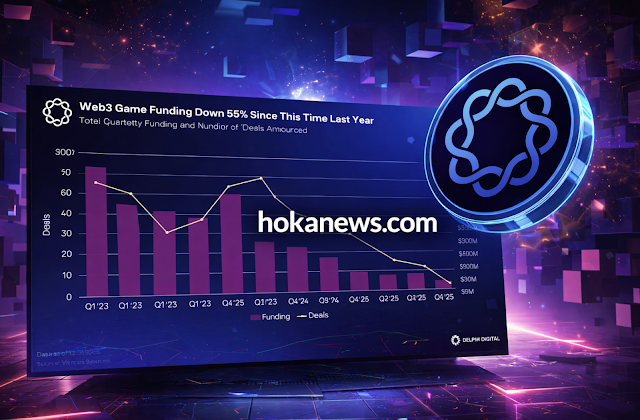
Web3 game funding drops 55% as GameFi performance drops in 2025
After years of bold promises and big investments, the Web3 gaming sector faced a harsh reality in 2025. Funding slowed dramatically, several high-profile game launches failed to live up to expectations, and player engagement in many blockchain-based titles weakened. According to a new industry report, the decline was not subtle. It was one of the steepest declines the Web3 ecosystem has seen since its rapid rise.
Data collected by Digital Delphi shows that GameFi’s performance deteriorated significantly throughout the year, with total funding falling by more than 55% year-over-year. The report paints a clear picture of investor caution, changing user behavior and a growing realization that early play-to-earn models may not be sustainable in their original form.
However, beneath the surface of dwindling numbers, a quieter transformation is taking place. While traditional GameFi struggled, a new generation of blockchain-enabled games is emerging with a very different approach.
Funding Data Confirms GameFi’s Falling Performance
The numbers tell a stark story. As of early 2023, Web3 games were still attracting substantial capital. Quarterly funding peaked at nearly $450 million, with more than 60 deals closed in a single quarter. Investors were eager to back new tokens, ambitious metaverse visions, and gaming ecosystems to win at scale.
By the end of 2025, that enthusiasm had largely faded. Delphi Digital estimates that quarterly funding was down to approximately $80 million to $90 million, and trading activity fell below 15 transactions. This represents a decline of over 55% compared to previous cycles and confirms that GameFi has lost its position as one of the most aggressively funded segments of crypto.
 |
| Source: Xpost |
Even temporary rallies in early 2024 failed to reverse the trend. Capital inflows slowed again as investors reassessed risk, questioned user metrics and demanded stronger evidence of long-term commitment.
Investor confidence weakens after disappointing launches
One of the key factors behind the funding slowdown was the performance of several highly anticipated Web3 game releases. Many projects entered the market with large marketing budgets, token incentives, and ambitious roadmaps. However, once the initial enthusiasm faded, user activity often decreased dramatically.
According to Delphi Digital’s report, some games generated respectable revenue figures on paper in 2025, occasionally reaching six or seven figure totals. However, these revenues were often concentrated among a small group of users. Wider adoption by players remained limited and retention rates failed to match those of successful traditional games.
For investors, this raised serious concerns. The strong token price performance and early activity were no longer enough. The market began to demand proof of sustainable gameplay, organic communities, and repeat engagement beyond financial rewards.
Why traditional Web3 games lost momentum
At the heart of GameFi’s performance decline is a structural problem. Many early Web3 games relied heavily on incentives to attract users. Money-making gaming models promised income, not entertainment, and this distinction became increasingly difficult to ignore.
Players often entered these ecosystems to obtain rewards rather than enjoy the game itself. When token issuances slowed or prices fell, participation fell rapidly. This pattern repeated itself across multiple projects, creating cycles of rapid growth followed by equally rapid collapse.
Another major issue was the prevalence of bot activity. On-chain metrics sometimes suggested heavy engagement, but closer analysis revealed that a significant portion of the activity came from automated wallets rather than real players. This artificial compromise distorted growth metrics and made it difficult for developers and investors to assess genuine demand.
As incentives weakened, bot-driven activity disappeared, exposing the lack of authentic user communities and accelerating the slowdown.
The rise of Web2.5 game models
Despite the difficulties of traditional GameFi, the broader blockchain gaming sector is not disappearing. Rather, it is evolving. Delphi Digital highlights the emergence of what many analysts now describe as Web2.5 games.
These projects quietly integrate blockchain technology into the backend rather than placing it at the center of the user experience. In many cases, players are not required to manage wallets, exchange tokens, or interact with complex on-chain systems. Some games do not issue any tokens.
Studies like mythical games, nonsense gamesand we did have shown that blockchain can improve ownership, reduce platform fees, and improve monetization without alienating mainstream players.
In these models, blockchain functions as infrastructure rather than a marketing hook. For players, the experience is closer to traditional games, with familiar interfaces and smoother onboarding.
Player experience is once again the priority
One of the biggest lessons of 2025 is that players ultimately care about gameplay. Token rewards may attract attention, but they are no substitute for attractive design, balanced mechanics, and long-term progression systems.
Web2.5 studios are focusing on entertainment first, using blockchain features only when they add real value. This change aligns more closely with the success that Web2 games have had for decades, and appears to resonate better with both players and investors.
Delphi Digital notes that the revenue generated by these studios is typically more stable, even if growth appears slower on the surface. Over time, this stability may prove far more valuable than the explosive but fragile growth seen in previous GameFi cycles.
Stablecoins and the future of Blockchain games
Another factor that could reshape the sector is the growing role of stablecoins. Volatile tokens have been a major barrier for players uncomfortable with fluctuating prices and speculative risk.
Stablecoins offer a potential solution. They enable low-cost microtransactions, predictable pricing, and global payments without exposing actors to market changes. For developers, they simplify monetization and reduce friction, especially in international markets.
As Web2.5 gaming models mature, stablecoins could become a standard component of backend payment systems, enabling blockchain benefits without forcing users to engage in cryptocurrency trading behavior.
A market reset, not an end
The sharp drop in GameFi funding during 2025 may seem alarming, but many analysts see it as a necessary reset. Excessive advertising, unsustainable incentives, and inflated expectations created conditions that were unlikely to last.
What remains is a more disciplined environment where funding flows to projects with clear value propositions, realistic growth strategies, and player-centric design. This transition may take time, but could ultimately lead to a healthier and more sustainable blockchain gaming industry.
Looking to the future
Data from Delphi Digital confirms that GameFi’s performance declined sharply in 2025. Funding fell, deal activity slowed, and many projects struggled to retain users. However, the underlying technology continues to evolve.
Blockchain games are not disappearing. It is moving away from speculative play-to-earn models toward quieter, infrastructure-driven applications that prioritize gameplay and user experience. If this transition continues, the next phase of crypto gaming may look very different from the last, but potentially much longer lasting.
hokanews will continue to monitor developments in the Web3 gaming sector and report on how funding, user behavior and technology trends will evolve in the coming years.
hokanews.com – Not just cryptocurrency news. It’s crypto culture.

