
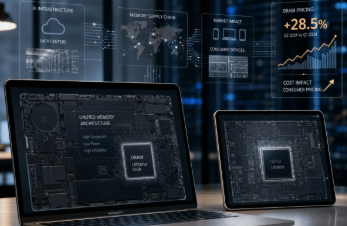
The AI memory crisis begins to affect everyday consumers
A growing shortage of high-performance memory chips used for artificial intelligence systems is spreading to the consumer market, forcing major technology companies to raise retail prices on key product lines.
What started as an infrastructure limitation within data centers is increasingly impacting consumer electronics, as rising demand for AI-related hardware continues to put pressure on global semiconductor supply chains.
The result is a widespread increase in component costs, which companies are now passing on to consumers through higher retail prices.
Microsoft increases Xbox prices worldwide
Microsoft has reportedly increased the price of its Xbox consoles by approximately $100 in global markets, marking one of the most notable consumer-facing price adjustments tied to the ongoing memory supply crisis.
The company’s decision reflects rising input costs for key components, particularly advanced memory and processing chips used in next-generation gaming hardware.
Gaming consoles have become increasingly reliant on high-bandwidth memory systems designed for AI workloads, further reducing supply availability across the semiconductor ecosystem.
The price increase indicates that even mass-market consumer electronics are no longer insulated from structural supply constraints driven by artificial intelligence demand.
Apple adjusts MacBook price amid component pressure
Apple has also begun raising prices across its entire MacBook lineup, citing rising production costs tied to advanced memory and semiconductor components.
The MacBook series, which relies heavily on high-performance chips and integrated memory systems, has been directly affected by global supply shortages.
As AI infrastructure continues to expand, manufacturers are competing for the same high-end memory chipset used in data centers, enterprise systems, and consumer devices.
This competition has raised costs throughout the supply chain, forcing Apple to adjust prices to preserve margins.
Stock market reaction reflects investor concerns
Following the announcements, both Microsoft and Apple experienced notable drops in their stock performance.
Microsoft shares closed nearly 5% lower, while Apple shares fell more than 6% in a strong market reaction that reflects investor concerns about rising costs and pressure on margins.
The sell-off highlights the tech sector’s growing sensitivity to supply chain disruptions linked to the expansion of AI infrastructure.
Investors are increasingly weighing the benefits of AI-driven revenue growth against the rising costs needed to support it.
AI rise drives global memory shortage
At the center of the disruption is the rapidly expanding demand for memory chips used in artificial intelligence systems.
AI data centers require large amounts of high-performance memory, including DRAM and HBM (high-bandwidth memory), which are essential for training and running advanced machine learning models.
As global investment in AI infrastructure accelerates, semiconductor manufacturers are struggling to keep pace with demand.
This imbalance between supply and demand has created a domino effect across multiple industries, from cloud computing and enterprise software to consumer electronics and gaming hardware.
Supply Chain Stress Extends Beyond Data Centers
The memory shortage, which was originally concentrated in enterprise AI infrastructure, is now spreading to the broader technology ecosystem.
Manufacturers of smartphones, laptops, game consoles and other consumer devices compete for a limited supply of advanced chips.
This cross-sector competition has intensified pressure on prices, resulting in higher production costs and less flexibility for hardware manufacturers.
Industry analysts warn that shortages could persist as AI adoption continues to accelerate globally.
 |
| Source: Xpost |

The impact on the consumer becomes more visible
The latest price increases mark a turning point in the cycle of AI-driven hardware, as consumers begin to directly feel the effects of demand at the infrastructure level.
Products that were previously considered price stable, such as gaming consoles and laptops, are now subject to upward price adjustments tied to the availability of semiconductors.
This shift represents a broader transition in which AI infrastructure is no longer limited to enterprise markets but actively influences everyday consumer goods.
Pressure on margins becomes a key market concern
For major technology companies, rising component costs are creating significant pressure on profit margins.
While AI is expected to drive long-term revenue growth, the immediate impact of supply shortages is increasing operating costs across product lines.
Companies are forced to choose between absorbing higher costs or passing them on to consumers through price increases.
This balancing act has become a central theme in the technology sector’s financial outlook.
The semiconductor industry at the center of the crisis
The semiconductor industry remains the critical bottleneck in the global AI expansion cycle.
Memory chip makers are operating at or near full capacity, with limited ability to quickly scale production in response to increased demand.
Expanding manufacturing facilities requires a significant investment of time and capital, meaning supply constraints are unlikely to be resolved any time soon.
As a result, pricing pressure is expected to remain elevated across multiple technology categories.
Long-term outlook for AI hardware costs
While the current shortage is causing short-term disruption, analysts believe it reflects a structural shift in global computing demand.
AI workloads are fundamentally more resource-intensive than traditional computing tasks and require significantly greater memory bandwidth and processing power.
This shift is likely to permanently alter pricing dynamics across the tech industry, particularly in hardware segments tied to AI infrastructure.

Over time, improvements in efficiency and increased production capacity can help stabilize costs, but near-term volatility is expected to persist.
Conclusion: The rise of AI infrastructure reshapes consumer technology pricing
The growing AI memory shortage is no longer limited to data centers and enterprise infrastructure, as its effects now extend directly to the consumer market.
With Microsoft raising Xbox prices and Apple increasing MacBook costs, the impact of global semiconductor limitations is becoming increasingly visible to everyday users.
As demand for AI continues to rise, the tech industry faces a new phase in which infrastructure limitations directly influence consumer prices, corporate margins, and market performance.
hoka.news – not just cryptocurrency news. It’s cryptoculture.
Writer @Victoria
Victoria Hale is a writer focused on blockchain and digital technology. It is known for its ability to simplify complex technological developments into clear, easy-to-understand and attractive-to-read content.
Through her writing, Victoria covers the latest trends, innovations and developments in the digital ecosystem, as well as their impact on the future of finance and technology. It also explores how new technologies are changing the way people interact in the digital world.
His writing style is simple, informative, and focuses on giving readers a clear understanding of the rapidly evolving world of technology.
Disclaimer:
HOKA.NEWS articles are here to keep you up to date on the latest rumors in crypto, technology, and more, but they are not financial advice. We share information, trends and knowledge, we don’t tell you to buy, sell or invest. Always do your own homework before making any money moves.
HOKA.NEWS is not responsible for any loss, profit or chaos that may occur if you act on what you read here. Investment decisions should arise from your own research and, ideally, the guidance of a qualified financial advisor. Remember: cryptocurrencies and technology move fast, information changes in the blink of an eye, and while we strive for accuracy, we cannot promise that it is 100% complete or up-to-date.