


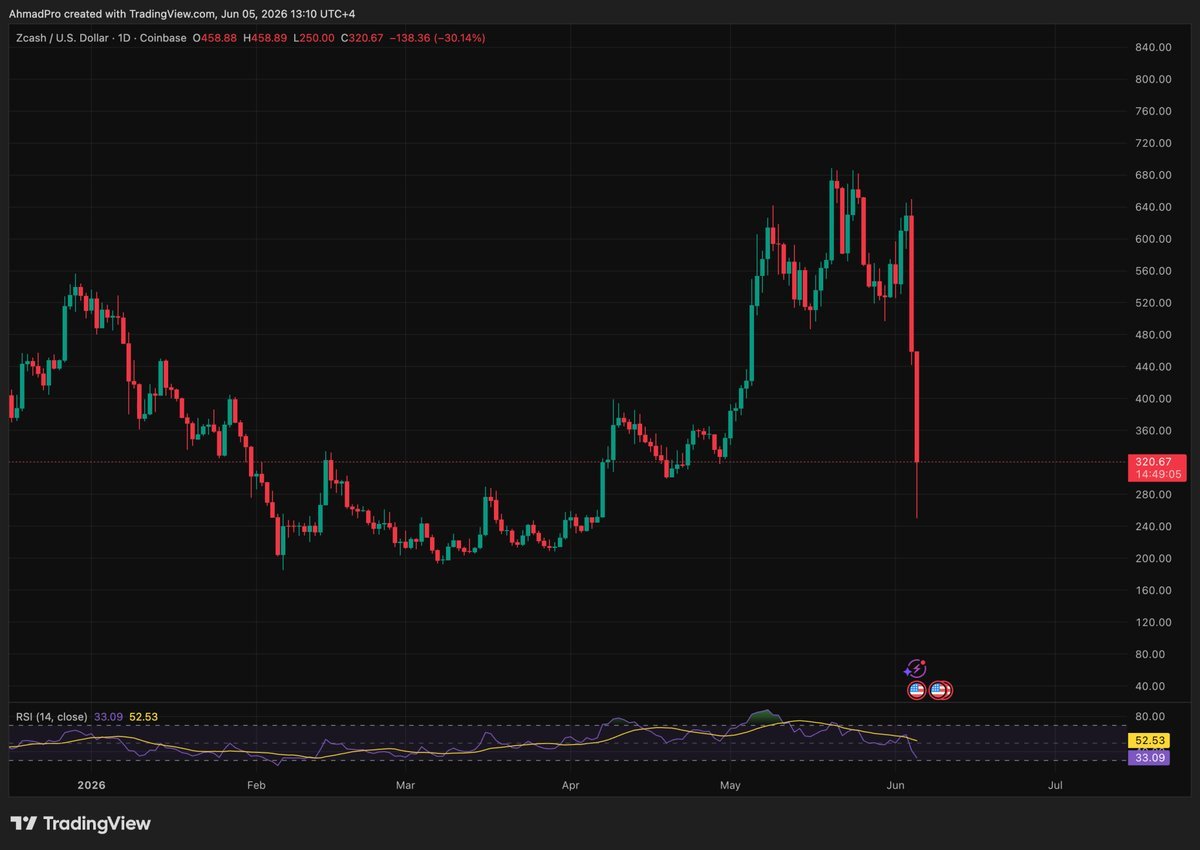
Arthur Hayes, co-founder of BitMEX, today confirmed the liquidation of his entire investment position in Zcash (ZEC) following the discovery of a software vulnerability in the Orchard Pool protocol. The public disclosure of this flaw in Zcash’s core protected transaction layer added to the suffering of the currency, which had already endured difficult weeks.
With this step, he completes the final release of his wallet, which he had previously described as the “holy trinity”, which included, in addition to ZEC, the HYPE and NEAR tokens.
The Holy Trinity is dead. Unfortunately, because of the Orchard Pool exploit, I had to empty our entire $ZEC bag.
– Although I think it is extremely unlikely that a strike will be carried out, it cannot be formally proven to be cryptographically impossible.
– Privacy in the face of AI, government and big tech requires perfection…– Arthur Hayes (@CryptoHayes) June 5, 2026
The central question facing the market right now is not whether Hayes was right to step down; The flaw is real and the risks are documented, but does this decision stem from a cold assessment of the risks of the protocol or is it a hasty reaction after its belief in the private currency category was shaken by this flaw?
The evidence points strongly toward the first possibility, which is a key distinction for anyone attempting to view this release as a strategic signal to the market.
Orchard Pool Vulnerability: What does the security breach mean for the future of ZEC?
Orchard Pool is Zcash’s next-generation protected transaction pool, introduced with the NU5 upgrade in May 2022.
This protocol replaced the old Sapling and brought zk-SNARKs that do not require reliable configuration on the Halo 2 system. The main goal of this pool is to allow completely private transfers, so its cryptographic integrity is not just a plus, it is the intrinsic value of the entire ZEC coin.
The vulnerability, discovered by security engineer Taylor Hornby of Shielded Labs on May 29, 2026, using formal AI-based methods (Claude Opus 4.8 from Anthropic), involved insufficient constraints in the multiplication of elliptic curves within a package. halo2_gadgets.
https://t.co/v7BiOdzU9E
-Zooko
ⓩ (@zooko) June 4, 2026
Simply put, a carefully crafted input could theoretically bypass circuit validity checks and successfully produce counterfeit ZEC coins that pass Orchard’s verification system.
Although an emergency hard fork was activated on June 3, 2026 to patch the flaw, the period from NU5 activation in 2022 until the June 2026 patch represents nearly four years during which the flaw remained undetected, despite being the subject of several expert audits.
Here’s the point that matters to coin holders: Due to Orchard’s privacy structure, it is cryptographically impossible to prove that no counterfeit ZEC coins were minted during this time. While there is no evidence that this flaw has been exploited, the failure to confirm the integrity of the total money supply represents a fundamental crack in the “sound money” discourse built around currency.
Hayes Exit: Risk Management or Pattern Repeat?
Hayes had publicly classified Zcash as a high-conviction stock, part of a “holy trinity” with HYPE and NEAR, a trio he considered his asymmetric alternative bets.
It had already liquidated HYPE and NEAR before turning to ZEC, a sequence that some interpret as a structured risk reduction process rather than a panic situation. ZEC’s release came after the public disclosure of the Orchard vulnerability and fork on June 3, meaning that Hayes acted after learning of the vulnerability and not before.
His rationale was simple: he wrote that “the probability of unauthorized instrumentation is very low, but its impossibility cannot be cryptographically proven.” He added: “The privacy narrative against artificial intelligence, governments and big tech companies demands perfection, a standard that has been undermined by this vulnerability. »
This proposition is not just an excuse for a trader, but rather a statement of an investment principle. Hayes was betting on ZEC because privacy coins occupy a unique ideological and technical position, one that requires cryptographic certainty that Orchard can no longer provide without reservations.
This pattern is familiar to anyone following Hayes’ public portfolio moves; A new conviction, public approval, then a clean exit when the basic premise collapses. Whether it’s disciplined risk management or part of the sales and sales cycle, the Orchard vulnerability gives this exit a fundamental rationale that’s hard to ignore. Note that he still holds Worldcoin (WLD), which was never part of the “Trinity” framework.
ZEC price and market structure: tangible damage
The price of ZEC fell between 30% and 36% from recent highs following the vulnerability disclosure, falling from over $600 to around $390, wiping out over $3 billion in market capitalization.
The move broke above the 20-day, 50-day, and 100-day exponential moving averages (EMA) respectively, and traders now view the 200-day EMA support near $367 as the next critical level.
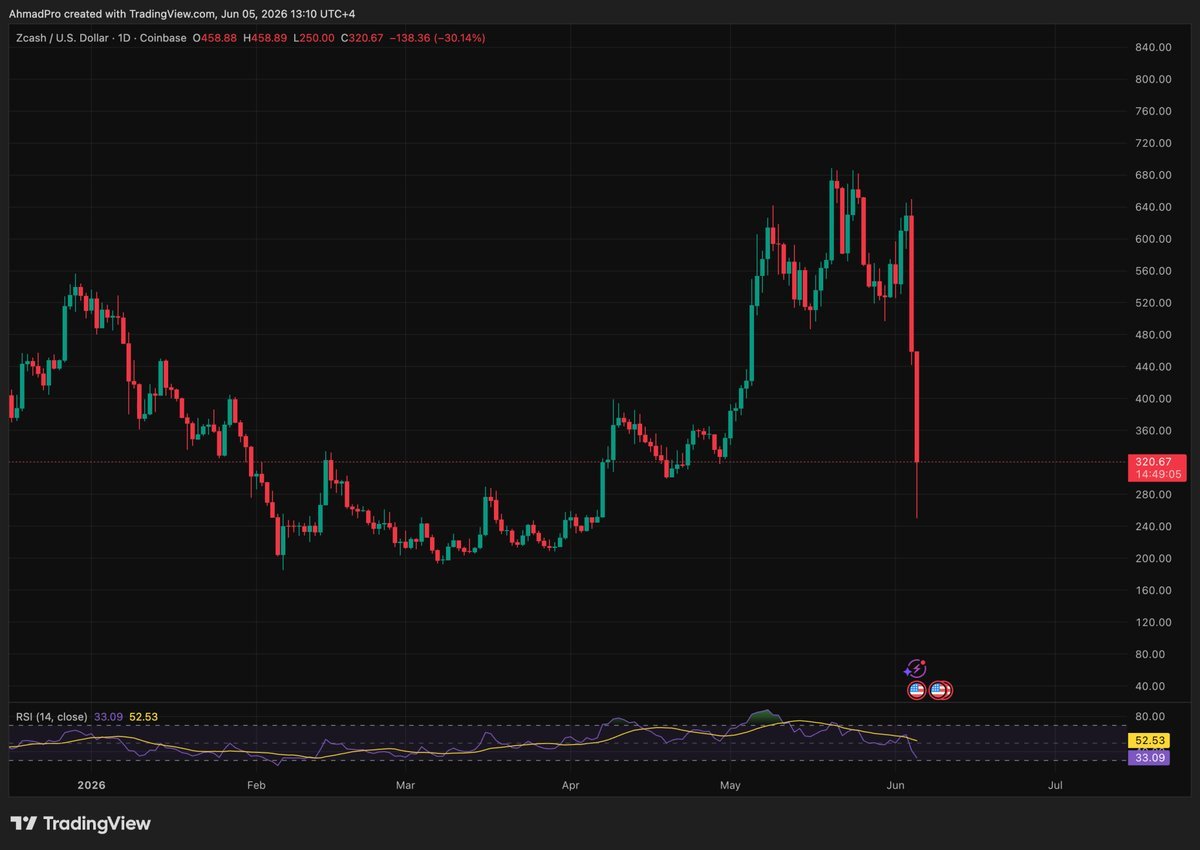
Hayes’ exit occurred in normal trading volumes, indicating that his position did not mechanically move the price; In fact, the market had already started assessing the risks of the protocol before its announcement.
The structural reading remains bearish until the $430-$450 zone is re-established at the close. Below $367, ZEC will enter uncharted technical territory with limited historical support to rely on.
The post Arthur Hayes Completely Liquidates Zcash Wallet Due to Orchard Vulnerability appeared first on Cryptonews Arabic.

