
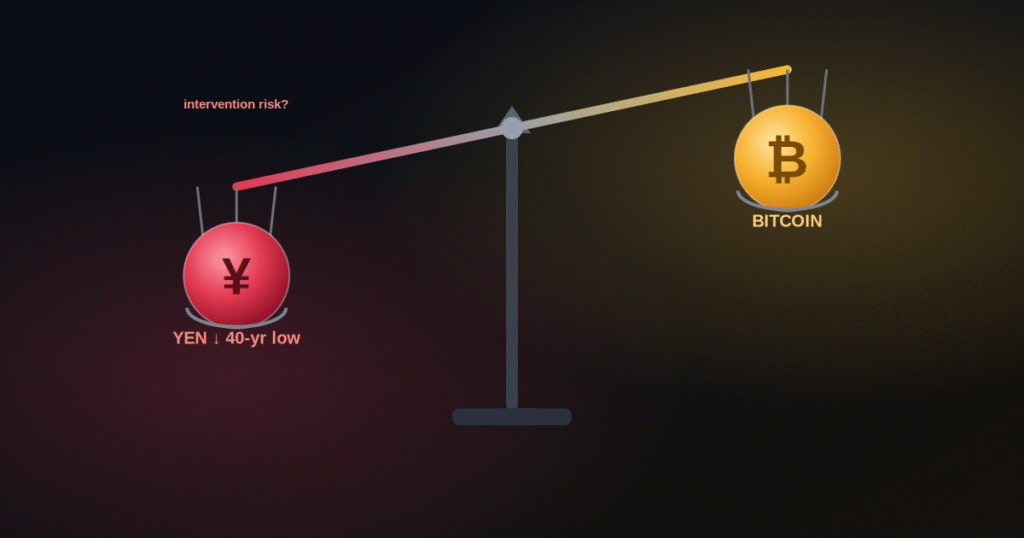
The Japanese yen fell to its lowest level against the U.S. dollar since 1986 on Tuesday, reigniting debate over whether a weaker yen could push more capital into cryptocurrencies, or whether potential intervention by Japanese authorities could trigger short-term volatility.
Crypto traders are divided on the significance of the yen weakness:
The yen fell to its lowest level against the dollar in nearly four decades, hurt by the widening gap between U.S. and Japanese interest rates.
As a result, Spot On Chain analyst “Hupzy” saw this move as having direct implications for cryptocurrency markets, with the yen’s prolonged weakness in the past having encouraged some investors to turn to Bitcoin and stablecoins as a hedge against the decline in the purchasing power of their local currency.
According to him, the more the Bank of Japan refrains from intervening, the more this trend strengthens.
But he warned that any attempt by Japan’s Finance Ministry to defend the yen could quickly reverse these flows and trigger liquidations of risky assets, including cryptocurrencies, explaining:
A strong rebound in the yen following intervention could put brief pressure on Bitcoin, but the macroeconomic tailwinds generated by the currency’s decline remain in place until the interest gap narrows.
His comments came despite financial markets’ positive reaction to easing geopolitical tensions earlier in the day, with the Nasdaq 100 index rising 2.3% after US President Donald Trump said the United States and Iran had agreed to end mutual strikes and return to the negotiating table.
Bitcoin had touched the $60,000 level during Asian trading hours, before giving up some of its gains and trading below the $59,000 level at the time of writing.
But not everyone thinks Bitcoin is the ideal choice for Japanese investors looking to protect themselves from the collapse of the yen, as economist Peter Schiff believes gold could offer better protection against the currency’s decline.
Japan’s crypto reforms add another dimension:
The yen’s weakness coincides with Japan’s rewriting of its rules regarding digital currencies, as it plans to move from the Payment Services Act to the Financial Instruments and Commerce Act.
According to CryptoQuant shareholder XWIN Japan, the proposed framework would classify cryptocurrencies as financial products and introduce stricter rules on disclosure, market manipulation and insider trading.
Earlier this month, lawmakers also passed a bill that could reduce the country’s cryptocurrency tax rate and could later open the door to tracking of cryptocurrency-traded funds.
However, investors’ immediate attention remains on Japan’s next move:
If authorities leave the yen under pressure, some believe Bitcoin could continue to attract defensive capital, but if they implement interventions, markets could face further short-term selling before the trend becomes clear.
Read also:
In response to the storm of criticism: this is how “Strategie” strengthens its exposure to Bitcoin
Between routine maintenance and European crisis: a busy day for Binance on July 1