


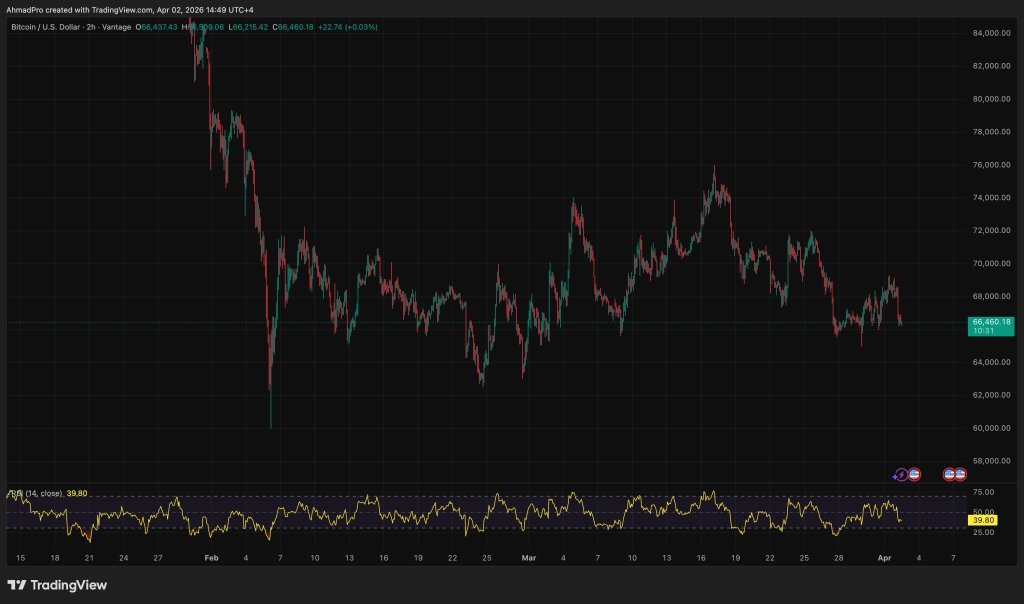
Bitcoin’s price fell to nearly $66,500, losing about 6% of its value in a matter of hours, after President Trump’s April 1 speech foreshadowed more forceful military strikes against Iran in the coming weeks, shattering the fragile optimism that had briefly wiped out risk assets.
The S&P 500 Index followed the decline, while the MSCI Asia Pacific Index reversed the previous session’s gains to fall 1.7%. In contrast, Brent crude jumped more than 5% to above $106 a barrel, as traders began to anticipate long-term disruption in the Strait of Hormuz. It is precisely this market turbulence that keeps risky assets limited.
Trump’s comments reflect the positive sentiment born earlier this week when he expressed a desire to end the conflict before reopening the Strait of Hormuz, a vital waterway for global trade.
However, the April 1 speech moved away from this idea entirely, using language that indicated escalation rather than negotiation. Investors were given no timetable for resolution, only prospects of intensified operations.
SUMMARY OF PRESIDENT TRUMP’S ADDRESS TO THE NATION:
1. The war in Iran will last yet another "two to three weeks"
2. US will hit Iranian power plants if no deal is reached
3. The main strategic objectives are "close to completion" in Iran
4.The United States "will bring Iran back to…– Kobeissi Letter (@KobeissiLetter) April 2, 2026
The narrative of Bitcoin as “digital gold” has taken another hit; As Bitcoin’s 30-day correlation with the S&P 500 index hits 0.75 – its highest level in months – institutional desks have begun treating Bitcoin as a high-risk technical asset rather than a geopolitical hedge. The safe haven discourse is already crumbling.
Bitcoin Price Forecast: Will the $65,000 Support Hold or Will We See Another Drop?
Bitcoin currently sits at $66,500, stuck in a downtrend from March’s high at $76,000, as each recovery attempt weakens and selling pressure limits each rebound before it begins to gain momentum.
The support level between $64,000 and $65,000 is currently the most important, as it has withstood several tests, but a clear break below opens the way directly to a return to $60,000, which is the level reached by the tail of the candle in February.
On the positive side, the $68,000 and then $70,000 levels represent the hurdles that need to be overcome to build a true recovery narrative, and neither looks easy given the amount of selling pressure with each recent rebound.
Until one of these two scenarios occurs, the map remains in “damage control” mode.
The broadest downtrend in recent Bitcoin price history makes this inflection point more important than it seems. Bitcoin finished March up just 2%, breaking a five-month losing streak, but it’s still down about 45% from its October high of over $126,000. According to data from CryptoQuant, virtual demand was already negative, at around 63,000 Bitcoins at the end of last month.
“Stock and commodity markets continue to fluctuate based on Trump’s latest comments on geopolitical developments,” said Caroline Morrone, co-founder of Orbit Markets. “Bitcoin largely follows the trend of stocks, although in recent weeks it has shown reduced sensitivity to good and bad news,” she added. This lower sensitivity may be the only positive, but it did not prevent a drop of $6,500 in a single session.
It’s worth noting that gold’s worst monthly performance in 17 years in March – when it fell more than 11% – eliminates the easy narrative of a “safe-haven rotation.” Instead, Treasuries and cash absorb the flight to safety flows. The 10-year U.S. Treasury yield has risen as markets price in persistent inflation driven by energy supply disruptions, creating direct headwinds for non-yielding assets like Bitcoin. Until the Iranian situation is clearly resolved, Bitcoin is unlikely to deviate from this path.
The post Bitcoin Falls to $66,500 as Tensions Heighten between Trump and Iran appeared first on Cryptonews Arabic.

