
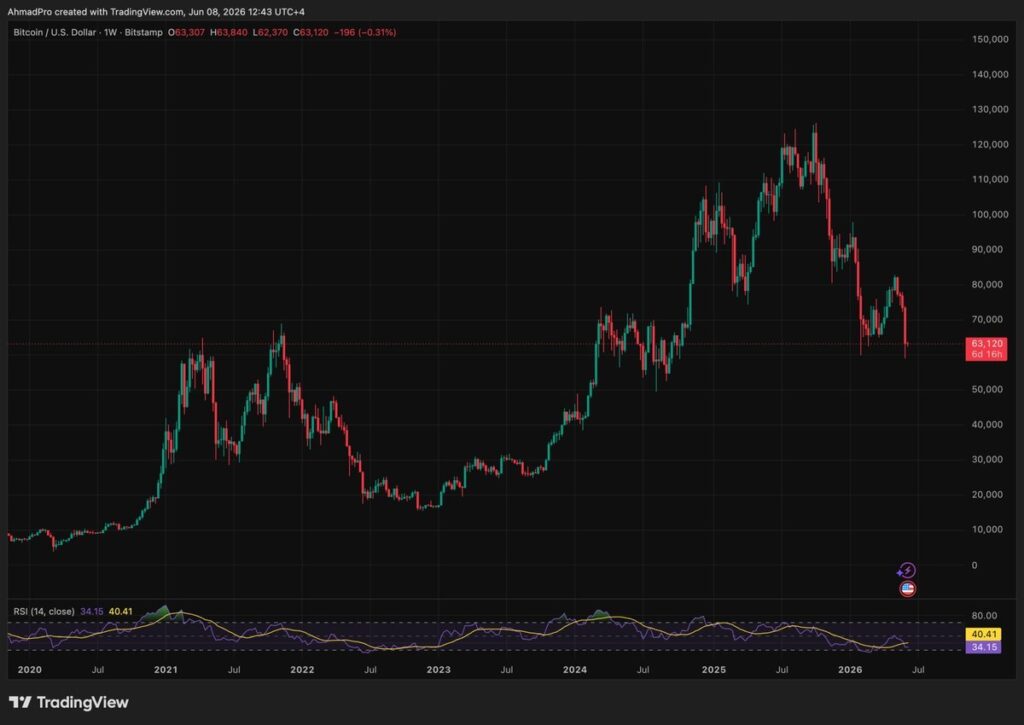
President Trump said Israeli Prime Minister Benjamin Netanyahu would have “no choice” but to accept a U.S.-brokered deal with Iran, news that sent the price of Bitcoin up 5% to $64,000 on Sunday, June 8, marking the biggest single-session rally in weeks.
However, the price of the cryptocurrency (BTC) fell to $63,000 within hours, reflecting low structural conviction behind moves driven by fleeting headlines.
This rebound came immediately after the June 5 trading day’s low of $59,100, Bitcoin’s weakest level since February, and now represents the range that traders are watching closely.
Why did the news of the Iran deal send the price of Bitcoin up by 5%?
The influence mechanism here depends on specific data; The emergence of a reliable de-escalation signal between the United States and Iran reduces the pricing of catastrophic risks associated with the Middle East conflict and reduces the geopolitical war premium embedded in oil prices, spurring the trend toward higher-risk assets.
Bitcoin being the most liquid asset among high-risk assets in global markets, it responds to this transformation first and at the fastest possible pace.
This framework shows that Bitcoin in such cases is not traded as digital gold, but rather as a measure of macroeconomic dynamics with high leverage. When fears of regional conflict rise, the currency falls faster than stocks, and when signs of calm appear, it rises faster, as Sunday’s rally clearly demonstrated.
Trump called the Iran deal “almost done” and pointed to an expected announcement at the start of the new work week, which traders read as more assertive language than speculation about a ceasefire that has been circulating for months.
Earlier in 2026, Bitcoin topped $77,000 as Trump weighed his options on Iran, while markets’ forward bets on a peace deal reached hundreds of millions of dollars. Each incremental signal in this file causes movements of between 3% and 5% in the currency’s price, often occurring within minutes.
The same geopolitical risks that drove Bitcoin’s rally were previously pressures; Tension-linked high oil prices have fueled inflation fears and complicated the Federal Reserve’s interest rate moves, with some officials refusing to rule out another rate hike while postponing expected cuts. This scene, which was reported in an analysis of how Bitcoin will be revalued in 2026 based on inflation data and Fed decisions, helped drag the crypto market lower ahead of Sunday’s rebound.
Bitcoin chart after the jump: levels that will determine the next path
Bitcoin stabilized near $63,000 after failing to hold the session high at $64,000, a level that now represents immediate resistance. The $62,500 to $63,000 area is the current pivot zone, where the price is going through a consolidation phase while waiting for the next geopolitical or macro catalyst.
The main support point is the $59,100 level. During the June 5 low, more than 50% of all bitcoins were in unrealized loss, a state that has historically coincided with major market lows and preceded a wave of short covering once the Iranian news provided the necessary catalyst.
Hundreds of thousands of leveraged trading positions were liquidated during the recession, amplifying the subsequent rally due to forced covering of short positions. The recovery scenario remains valid if the daily close is above $63,000, which opens the door to testing the $64,000 resistance, while a close below $61,500 will once again activate downward pressures and put the $59,100 bottom under the microscope once again.
The post Bitcoin Price Rises 5% After Trump’s Statements on Iran Deal appeared first on Cryptonews Arabic.