


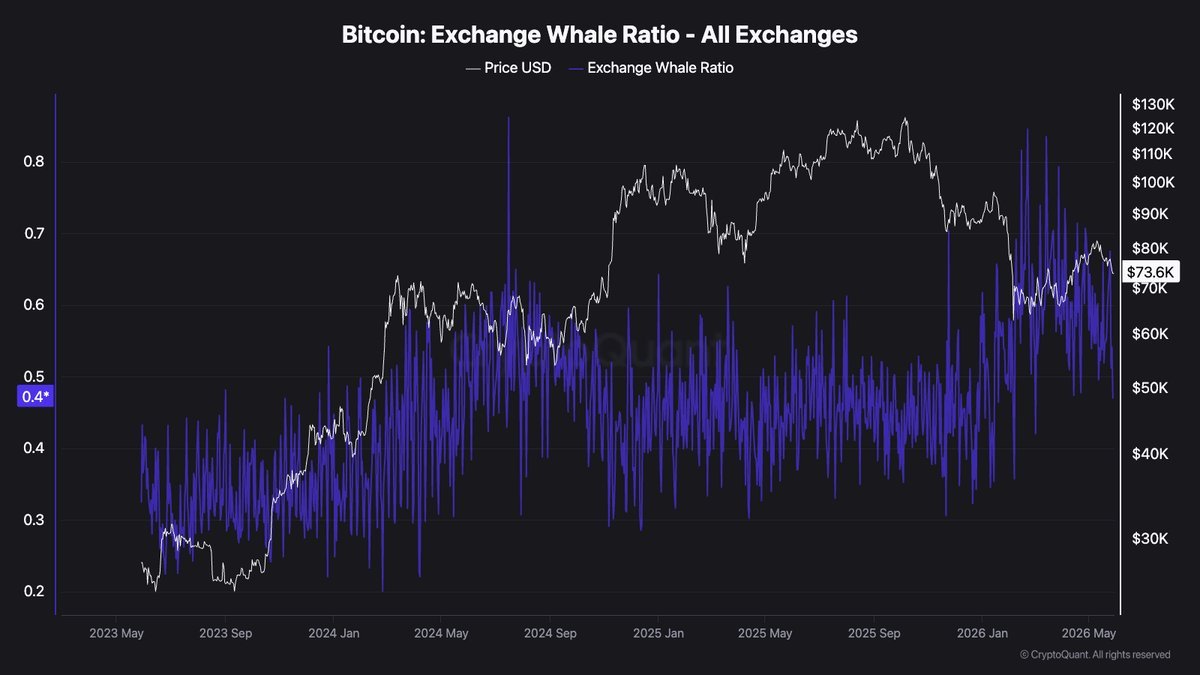
“Whale” and “dolphin” balances in the Bitcoin network are beginning to send signals associated with bear markets, as holding structures appear to be weakening across major investor categories, according to a recent analysis by CryptoQuant.
A sudden halt to accumulation by large holders removes a key pillar of demand that has historically absorbed selling pressures and supported spot prices.
At the same time, supply among long-term holders has reached an all-time high, a combination that suggests potential distribution pressures rather than evidence of conviction to hold. When whales stop buying as permanent holders reach their maximum supply, the burden of the marginal buyer shifts entirely to flows from exchange-traded funds (ETFs) and new entrants from retail investors.
CryptoQuant Data Shows Percentage of Platform Whales Reaching Highest Level in a Decade
The Exchange Whale Ratio Index, which measures the share of the 10 largest deposits of the total Bitcoin sent to exchanges, recently recorded a reading of 0.67, the highest since October 2015.
This means that 64% of all bitcoins flowing to exchanges during this period came from a limited number of large addresses.
A certified analyst at CryptoQuant has identified a three-phase trend near recent highs; Whales accumulated near local lows around $78,000, then split between around $77,000 and $81,000, with Bitcoin reserves on exchanges increasing from around 2.677 million to 2.696 million BTC, the highest level of the month.
The increase in rig reserves, combined with the whale ratio of 0.67, indicates an exit from investment positions rather than a replenishment of long-term storage operations.
Although the 7-day average BTC inflows on exchanges have decreased to around 23,000 BTC (or 60% below peak levels), this decrease in gross inflow volume does not eliminate the negative directional signal when remaining inflows are largely controlled by whales.
Will Bitcoin Price Hold Above Key Support Levels?
The structural reading here is clear: a halt in whale buying weakens spot demand, making the price more sensitive to shocks to ETF flows and high-risk macroeconomic events.
Indeed, Bitcoin broke the $73,000 barrier due to ETF outflows and geopolitical risks, a move that is entirely consistent with current on-chain data.
Analysts at CryptoQuant have identified the $55,000 zone as a benchmark for the bear market bottom, an area that could attract structural demand if visited again due to previous capitulations and realized losses. This is not so much a price prediction as a framework that shows the extent of the real spectrum of risks.
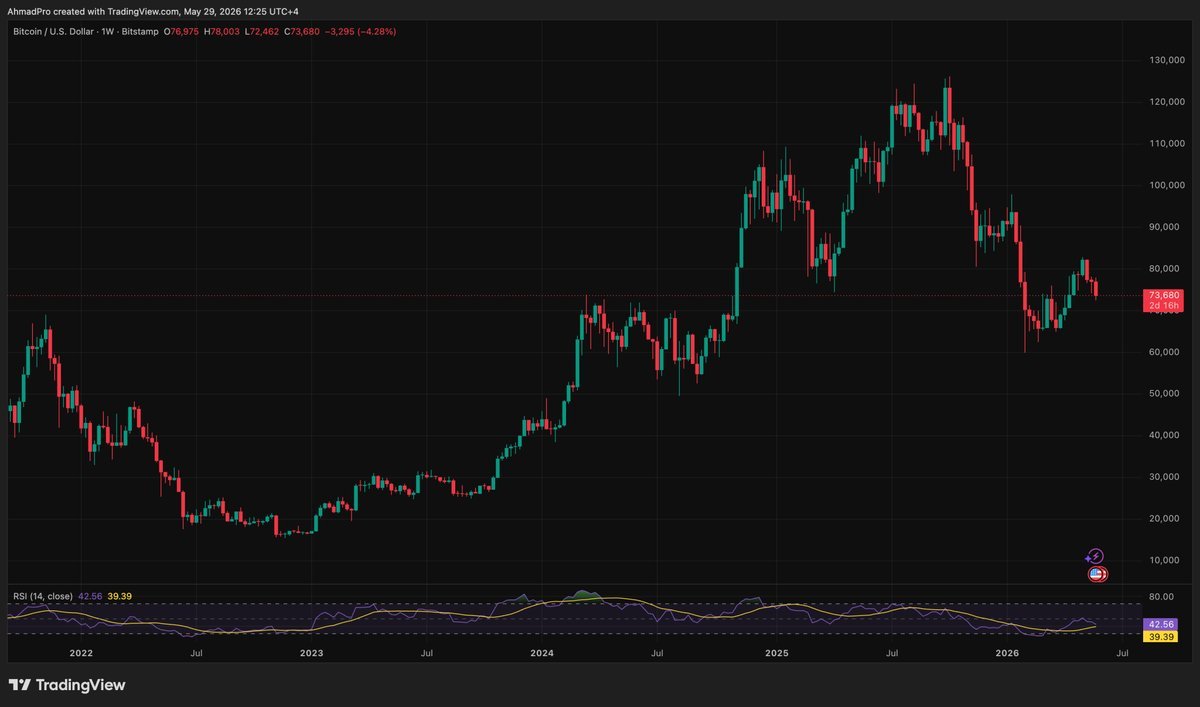
If the whale ratio falls below 0.55, foreign exchange reserves fall from their current levels and Bitcoin rises back to the $81,000 level with heavy trading volume, then distribution pressures end and accumulation resumes.
However, if the whale percentage remains high and platforms maintain their reserves near the peak, Bitcoin will likely enter a consolidation phase between $73,000 and $79,000 as ETF demand partially offsets sales from large holders.
In light of weak stablecoin flows and continued outflow from ETF funds, the loss of the $73,000 area opens a technical path towards the support belt between $65,000 and $68,000, reaching the $55,000 level reported by CryptoQuant.
It is reported that expert analysis already indicates the possibility of a further decline, which the on-chain data structure now supports rather than opposes.
The post Bitcoin whales emit bearish signals as accumulation rates decline appeared first on Cryptonews Arabic.

