
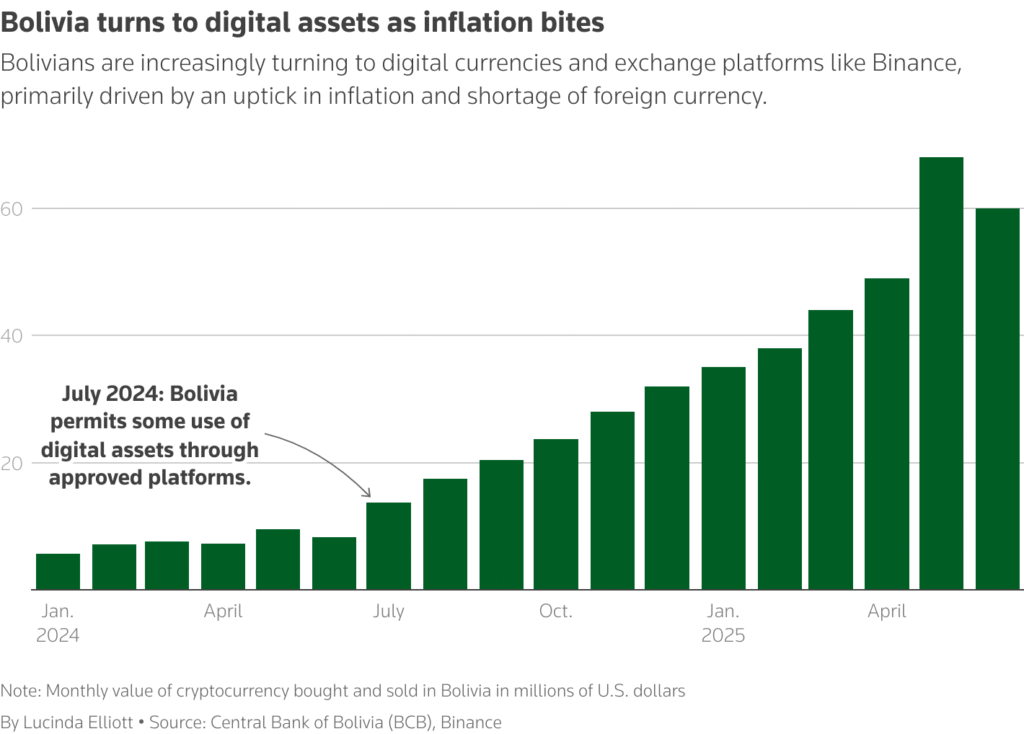
Bolivia describes digital currencies as reliable when signing a cooperation agreement with El Salvador, with the use of virtual assets in the country of 532%, at a value of $ 294 million per year.
The central bank in Bolivia has signed a memorandum of understanding with the National Committee for Digital Assets (CNAD) in Salvador in order to improve the development of digital currencies, in a decision which represents a fundamental change in the policy of a country which had previously prohibited virtual assets, describing it today as “A reliable alternative“Traditional currencies. For its part, this cooperation agreement allows the exchange of information and knowledge between the two institutions on smart tools on blockchain, risk analysis and organizational expertise.


Increased use of virtual assets in Bolivia of 532% in one year
The use of virtual assets in Bolivia increased from $ 46.5 million to $ 294 million between June 2024 and the same month of 2025 after the country’s organizational changes start.
The agreement immediately enters the implementation for an unlimited period, which allows Bolivia to benefit from the leading organizational framework and the practical experiences of Salvador, which is the first country in the world to adopt Bitcoin-BTC as legal currency, and the National Committee of Digital Assets of El Salvador (CNAD) has become one of the important players in the technical assets in the world.
Bolivia adopting digital currencies is greatly incompatible with its historical approach, after having previously imposed a strict prohibition on virtual assets, before issuing the 082/2024 resolution in June 2024.
This change in the policy allows the legal use of virtual assets in international transactions and online trade, and this agreement improves the progress made to improve the position of digital assets as an important alternative to families and young business leaders.
The Bolivian Central Bank also wishes to develop policies seeking to update the financial system and improve financial inclusion through technological technological systems that comply with regulatory laws.
El Salvador’s experience provides valuable directives despite the recent restrictions imposed by the International Monetary Fund, which has limited Bitcoin purchases by the country, and called for the privatization of the government of government chero by July 2025.
The digital currency revolution in Bolivia wins an increased momentum
At the start of the current year, the Bolivia Central Bank allowed the YPFB to use digital currencies to buy crude oil and diesel from international suppliers in March 2025, in a stage seeking to deal with the lack of foreign currency which caused disturbances in fuel supplies across the country; The cabinet, led by President Luis Arce, has granted the YPFB to authorize fuel import transactions using the US dollar (USD) or digital currencies, knowing that Bolivia needs at least $ 60 million per week to import fuel.
The decision stipulates that YPFB will make the budgetary adjustments necessary to cover financial costs in applicable regulatory frameworks. The pace of adoption of digital currencies in Bolivia has accepted, the number of virtual asset transactions exceeding 1.1 million transactions during the period between July and September 2024, against 932,000 transactions in the previous six months.
6 Financial institutions began to work with virtual assets, registered with operations of 40% between July and August. The central bank has launched educational initiatives, because more than 33 workshops have been organized throughout the country, and the number of participants reached more than 3,000 people, in order to educate the public on the advantages and risks of virtual assets.
This legal framework for Bolivians allows the use of digital currencies in international transactions and online exchange payments, and the cooperation agreement with El Salvador provides technical expertise to develop safe technical systems that respect regulatory laws.


Thus, Bolivia joins an increasing number of countries that use digital currencies in international trade, in particular those looking for alternatives to traditional banking systems in order to deal with sanctions or political tensions.
Al Salvador approach to Bitcoin faces restrictions from the International Monetary Fund
El Salvador holds around 6,244 Bitcoin currencies of $ 742 million, despite the restrictions imposed by the international monetary fundraising agreement, which prevents the government of the country from any new purchase of this currency from February 2025.
The loan program – which is worth $ 1.4 billion – is forced to maintain the Bitcoin currencies it has unchanged, in addition to the privatization of Chivo’s Chevo. The previous allegations of President Nayib Bukele contradicts Bitcoin daily purchases with the documents of the international IMF which confirm the absence of new purchases since the loan agreement, and the Bluechen data indicate that the Bitcoin currencies between the governor are internal transfer operations and are not new purchases.
For its part, the International Monetary Fund welcomed Silvador’s policy to speak in Bitcoin to reduce financial risks and improve transparency, noting that these stages help control inflation rates and restore macroeconomic stability. However, the Convention must abandon the compulsory legal currency of Bitcoin.
The application of the Bitcoin experience of El Salvador women who lack the weight of an imprecision and a drop in public commitment.#IMF #Salvadorhttps://t.co/65ladrixoh – cryptonews.com (@cryptonews) July 26, 2025


It should be noted that the National Currency Currense Committee (CNAD) in Salvador has strengthened its leading regional agency position in the organization of digital currencies, supporting innovation and promoting security and organizational compliance in the digital asset sector. The country’s organizational framework is one of the most advanced systems in terms of promoting virtual assets in the world. On this subject, the first Bitcoin said that the education and adoption efforts supported by the government have decreased since the International Monetary Fund Agreement, in addition to the drop in public participation in digital education programs; This change has raised questions about the feasibility of the original Salvador approach on long -term bitcoin.
The post-Bolivia describes digital currencies as “a reliable alternative” as part of a new cooperation agreement with El Salvador appeared first on Arab Cryptonews.