
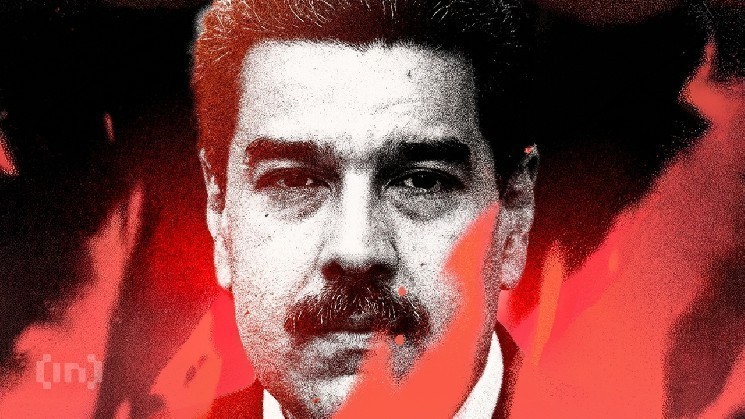
Speculation about Venezuela’s alleged Bitcoin holdings increased after US forces captured President Nicolas Maduro and brought him to the United States.
Some claims suggest that the United States could now seize a massive, hidden stash of Bitcoin, often estimated at 600,000 BTC, or worth around $60 billion at current prices. But legal reality and on-chain data tell a much more limited story.
Venezuela’s secret stash of 600,000 Bitcoins: reality or fiction?
The rumor is based on the idea that Venezuela has quietly accumulated Bitcoin for several years to circumvent sanctions.
Proponents cite informal oil trading, gold sales, and crypto use within the country as evidence of a large “phantom reserve.”
VENEZUELA BITCOIN SHADOW RESERVE 🟧
1) The Shadow Reserve
– Intelligence reports claim Venezuela quietly amassed a stash of more than $60 billion in Bitcoin and USDT starting in 2018 to evade sanctions. (HUMINT)
2) Gold → Oil → Crypto
– 2018: Venezuela exported 73.2 tons of gold ($2.7 billion).… pic.twitter.com/eKrwspcacD
– Bitcoin Archive (@BitcoinArchive) January 5, 2026
However, there is no on-chain evidence to support claims that the Venezuelan state holds hundreds of thousands of Bitcoins.
No wallet has been identified and no custodian has been named. There is no verifiable on-chain proof for this claim.
In short, the $60 billion figure remains speculation, not proof.
WATCH: Coinbase’s John D’Agostino explains why Bitcoin is climbing amid US action in Venezuela 🇻🇪
He says the move is not about politics, but a rebound in liquidity, growing institutional dynamics and Bitcoin reclaiming its role as a long-term store of value. pic.twitter.com/4xtXM9fFKu
– BeInCrypto (@beincrypto) January 6, 2026
What Venezuela Really Holds
The only amount that consistently appears in public trackers and analyst estimates is around 240 BTC. Even this figure is controversial and modest by global standards.
Importantly, this small amount is not clearly linked to the wallets that the United States can access. It may be kept in cold storage, under the custody of a third party, or in structures located outside of U.S. jurisdiction.
Ownership matters too. State-owned assets face much higher legal hurdles than those associated with personal property.
Can the US legally seize Maduro’s Bitcoin reserves?
Under US law, the answer is probably yes. Once Nicolás Maduro is physically in the United States and indicted, federal courts generally assert jurisdiction.
The long-standing Ker–Frisbie Doctrine Allows prosecution even if a defendant is brought in by irregular means.
The United States also does not recognize Maduro as the legitimate leader of Venezuela. This weakens any claim to immunity of heads of state in American courts.
But personal custody is not the same as control of assets.
1990 Manuel Noriega 2026 Nicolas Maduro and the Ker-Frisbie doctrine
Twisted laws
The Ker-Frisbie doctrine is applied in the context of jurisdiction and generally holds that courts have jurisdiction over criminal defendants in the United States, whether their… pic.twitter.com/0BOpkWZed7
– Ryan Milton (@1860rm) January 5, 2026
Seizing Bitcoin requires two things – legal authority and physical access.
First, prosecutors must prove that Bitcoin is directly linked to the criminal activities charged in court. Estimates, intelligence claims or geopolitical narratives are not enough.
Second, authorities must be able to access assets. This means private keys, compliant clients or exchanges within range of the United States. Without keys or cooperation, Bitcoin cannot be seized, no matter who is in custody.
This applies to both the supposed reserve and the smaller figure of 240 BTC.
What is realistic for the future
The United States can freeze assets if it identifies them. This can put pressure on intermediaries or monitor suspicious wallets. He can also use threats of confiscation as leverage during legal proceedings.
But the outright seizure of a $60 billion Bitcoin reserve remains legally and practically implausible.
The arrest of Donald Trump’s most high-profile opponent will not unlock Venezuela’s Bitcoin, real or perceived.
Without evidence, jurisdiction and keys, even the boldest claims remain out of reach.
The post Can Trump Seize Venezuela’s $60 Billion Bitcoin Reserve, If It Exists? appeared first on BeInCrypto.