
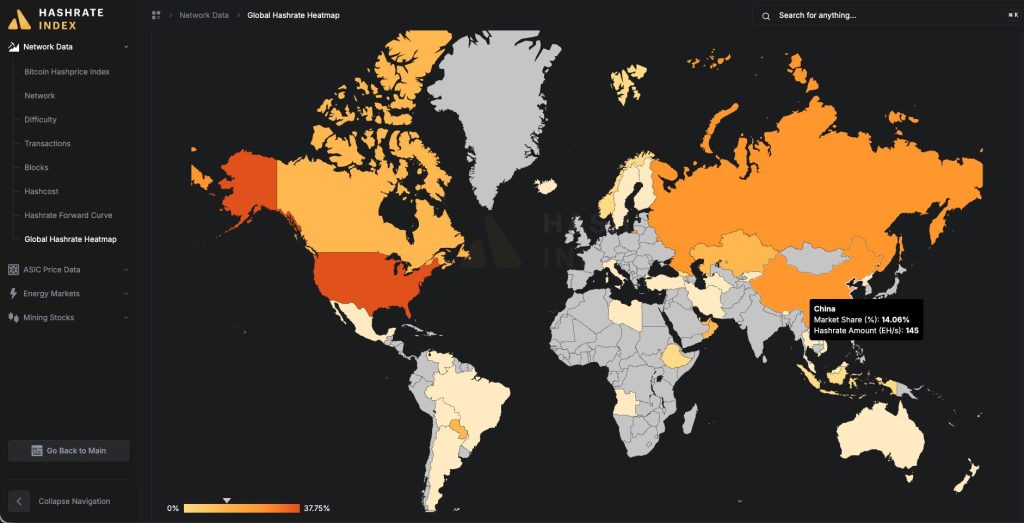
China was once arguably the most important center for Bitcoin mining, with cheap energy and easy access to major hardware manufacturers allowing it to solidify its position as a global mining leader. However, the situation changed dramatically when the Chinese government imposed a complete ban on mining operations in 2021. In late September of the same year, the People’s Bank of China (PBOC) issued an additional decision banning all digital currency transactions, justifying the move with its role in facilitating financial crime and the growing risks it poses to China’s financial system.
Today, despite intense efforts by the government to completely ban mining activities, many miners have managed to continue their activities in different ways. According to Luxor’s updated map of global hash rates for the final quarter of 2025, China currently accounts for approximately 14.05% of the total computing power of the Bitcoin blockchain, or approximately 145 exahashes per second (EH/s), which is a slight increase from 13.8% recorded in the third quarter.
China is at the forefront of the global Bitcoin mining scene
Kaan Farahani, a research associate at Luxor, said in a statement to Cryptonews that the map of global hash rates published by the company gives an estimate of the geographic distribution of Bitcoin mining activity in various parts of the world. “The map draws on a combination of mining pool data, ASIC mining hardware sales and purchases, and firmware adoption trends, to provide a weighted estimate of the level of hash rate concentration in each region,” Farahani added.
Based on the latest data, China ranks third in the world for Bitcoin mining contributions, behind the United States and Russia.
Luxor’s findings indicate that its data cannot identify the exact location of the distribution of retail power in China. However, the Miner Weekly report cites several sources within the ASIC mining hardware supply chain, suggesting that the Xinjiang region is the likely destination for these activities. Thanks to its geographic isolation and abundant energy resources, this region represented a major center for Bitcoin mining before the government ban in 2021.
China Reveals Continued Secret Bitcoin Mining Operations
While continued mining in China is not entirely surprising, it highlights the mysterious and hidden nature of the country’s mining sector. Against this backdrop, Kent Halliburton, CEO and co-founder of Bitcoin mining platform Sazmining, spoke in a statement to Cryptonews, saying:
“It doesn’t surprise me that mining continues in China. That’s one of the core features of Bitcoin, it’s a cyberpunk – decentralized and privacy-friendly – way of generating currency. As long as there is electricity and the necessary equipment, anyone can mine it themselves, and it’s hard to stop mining in remote areas, which is why I think the fragmentation rates we’re seeing in China will continue to exist later. “
Halliburton pointed out that other regions where mining is illegal are also experiencing increasing growth in this regard. For example, Farahani said a map published by Luxor shows that Iran has an estimated mining capacity of around 8 exahesh per second (EH/s) in the last quarter of 2025, or around 0.75% of the global market share.
Halliburton added that Iran is another example of a country that carries out mining activities despite it being officially banned. It imposed its first ban on Bitcoin mining in May 2021 for four months, then a second ban in December of the same year. Before these restrictions, mining operations in Iran represented between 4% and 8% of the total global mining operations on the Bitcoin Blockchain.
Halliburton concludes by saying: “In fact, any country that places strict restrictions on the movement of investments will likely seek to restrict or ban Bitcoin mining. However, the fact remains that as long as the appropriate energy and equipment are available, anyone can mine the currency themselves, meaning that countries seeking to prevent the outflow of funds may find themselves in direct confrontation with a force powerful. “Mining itself.
China’s Troubling Empire in Bitcoin Mining Infrastructure
Aside from the mining activities themselves, the latest results from Auradine, a company specializing in Bitcoin mining technologies and services, revealed that more than 95% of mining hardware is manufactured by Chinese companies such as Bitmain, MicroBT and Canaan. The Auradine report states that China’s dominance in manufacturing these devices poses a major threat to U.S. national security and critical infrastructure.
Speaking to Cryptonews, Sanjay Gupta, head of strategy at Auradine, explained that China’s infrastructure for Bitcoin mining raises concerns for several reasons, including the presence of more than a million Chinese-made mining rigs equipped with foreign software currently connected to the network. American electricity.
“This situation poses a serious cybersecurity risk to the power grid in a number of states,” Gupta said. “If Chinese mining rigs contain implanted software that could be activated in a coordinated cyberattack, running massive numbers of machines simultaneously at excessive or severely reduced capacity could lead to a catastrophic collapse of the U.S. power grid.”
And they would have gotten away with it too without President Xi and President Putin.
China, Russia and the cooperative countries within BRICS have enough control over BTC mining repositories to bring Bitcoin to ZERO.
The United States will not get away with this. pic.twitter.com/Ylx81nBFw0– Inevitable China (@InevitableChina) September 8, 2025
Gupta added that the focus on the Bitcoin mining hardware supply chain represents a major strategic risk, as it could lead, under hostile geopolitical circumstances, to an attempt to control 51% of the Bitcoin protocol itself. The severity of this possibility has increased after President Donald Trump’s recent tariffs on China, which could reach 155% in the coming weeks.
Gupta highlighted in his speech: “This could have a significant impact on the value of Bitcoin, with cascading repercussions across global financial markets. »
Is China a Threat to Bitcoin Miners?
It is clear that Bitcoin mining and hardware manufacturing activities continue in China despite the official ban. But what does this mean for miners operating in countries where mining is legal? Luxor’s Farahani says the company has seen no signs of direct threat from Chinese mining operations.
On the other hand, Gupta believes that Chinese companies supplying mining equipment will further complicate the situation in other parts of the world. In this regard, he said: “To address this, local US Bitcoin mining technology providers should be empowered to promote continuous innovation and increase operational performance efficiency in this vital sector. »
The current trade tensions between the United States and China are having a significant and costly impact on the Bitcoin mining industry. Rising tariffs on mining equipment have exposed U.S. companies to significant financial liabilities, according to a new report from The Miner Mag.…
– Dr. Martin Hiesboeck (@MHiesboeck) August 21, 2025
Gupta added that – in the next step – Bitcoin miners should rely on technologies to adapt to energy demand, so that they can quickly increase or decrease electricity consumption in response to the needs of each state or region’s energy networks.
At the same time, it appears that China’s architecture and mining heritage will continue to cast a heavy shadow over the global network. In the ever-changing world of digital currencies, China has not disappeared from the scene, but rather has quietly repositioned itself on its margins.
China ranks third in the world for Bitcoin (Bitcoin-BTC) mining activities. How important is this? appeared first on Cryptonews Arabic.