


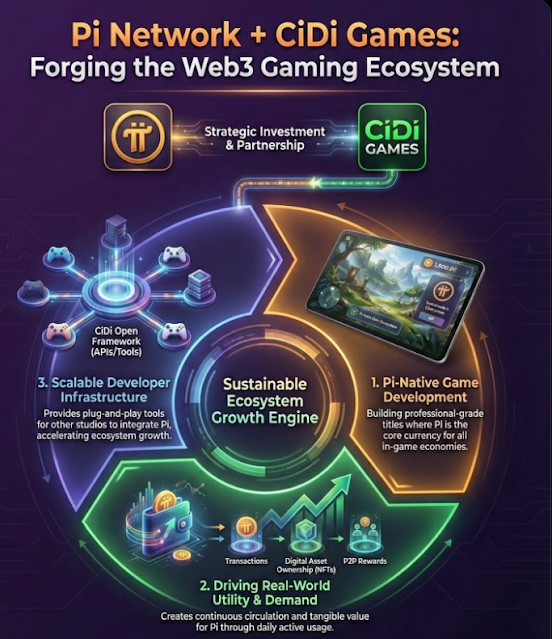
The collaboration announcement between Pi Network and CiDi Games has sparked renewed debate in the crypto and Web3 gaming communities. While partnerships in blockchain are common, this development stands out for its potential implications for real-world utility, sustainable demand, and large-scale incorporation within the Pi ecosystem. Rather than functioning as a symbolic alliance, the collaboration points toward a structural integration that could redefine how Pi is used in everyday digital experiences.
At the core of this collaboration is the concept of Pi-native professional gaming. These are games designed from the ground up to operate within the Pi Network ecosystem, using Pi as the only in-game currency. This approach fundamentally differs from many blockchain games that simply add a token as an optional payment layer. By making Pi an integral part of gameplay, rewards and progression, the collaboration introduces a closed-loop economy where utility is directly linked to user activity.
One of the most significant results of this model is the creation of real daily demand. In traditional crypto ecosystems, demand often relies heavily on speculation. In contrast, native Pi games introduce transactional demand generated by players participating in a normal game. In-game purchases, peer-to-peer rewards, NFT trading, and staking incentives all require Pi, encouraging continued circulation rather than passive holding.
This daily transactional use case has important implications for network activity. Millions of players interacting with Pi through games can drive consistent transactions on-chain and at the ecosystem level. Such activity strengthens the network by validating its ability to support frequent microtransactions, a critical requirement for mass adoption.
The collaboration also emphasizes openness for developers. By providing open development tools that allow any game studio to easily integrate Pi, the Pi Network and CiDi Games initiative lowers the barrier to entry for creators. This strategy aligns with broader Web3 principles, where open access and composability are key drivers of ecosystem growth.
For independent studios, the ability to connect the Pi directly to games without creating custom blockchain infrastructure can be a huge advantage. Reduces development costs and accelerates time to market. As more studios adopt these tools, the Pi gaming ecosystem could expand rapidly, creating a diverse range of experiences that appeal to different audiences.
Another critical element is the participation of Pi Ventures’ investment. Long-term financial support suggests that this collaboration is designed to be long-lasting and not for short-term experimentation. Investment support provides resources for infrastructure development, marketing and ecosystem incentives, all of which are necessary to sustain growth in competitive gaming markets.
The strategic importance of games within Web3 cannot be underestimated. Historically, games have served as an entry point for new technologies, from mobile apps to virtual economies. By focusing on gaming as a primary utility driver, Pi Network positions itself at the intersection of entertainment and decentralized finance.
This approach also addresses one of the most persistent challenges in cryptocurrency adoption: the onboarding of non-technical users. Games naturally abstract complexity. Players interact with digital assets as part of the game and not as financial instruments. This reduces psychological and technical barriers, making it easier for new users to interact with the Pi without prior crypto experience.
 |
| Source: X publication |
The integration of NFTs further expands the economic layer of the ecosystem. Game assets represented as NFTs allow players to own, exchange, and transfer value across the Pi ecosystem. When combined with Pi-based transactions, NFTs contribute to a multidimensional economy that extends beyond individual games.
The peer-to-peer reward systems mentioned in the collaboration scheme also reinforce community participation. Rewarding players directly on the Pi for their achievements, collaboration, or competition aligns incentives between users, developers, and the network itself. These systems encourage long-term retention and engagement.
From a macro perspective, the Pi Network x CiDi Games collaboration reflects a shift from speculative narratives to usage-based value creation. Sustainable profit depends on constant demand driven by real activity. Gaming offers a scalable environment where such demand can emerge organically.
The reference to the 2026 gaming season suggests a forward-looking roadmap rather than an immediate rollout. This schedule allows for iterative development, testing, and refinement. It also indicates confidence in the long-term vision rather than relying on short-term hype cycles.
Industry observers often point out that ecosystems succeed when they create feedback loops. In this case, more games generate more players, which increases Pi usage, attracts more developers, and further expands the ecosystem. This flywheel effect can be powerful if executed effectively.
For Pi Network, this collaboration complements its broader goal of building a functional Web3 ecosystem accessible to millions. The games serve as a practical demonstration of how Pi can function as a medium of exchange rather than a purely speculative asset.
The potential magnitude of the impact is significant. If even a fraction of the global Pi user base interacts with native Pi games daily, transaction volume and ecosystem activity could increase substantially. Such growth would provide valuable data and experience for future applications beyond gaming.
Fundamentally, success will depend on execution. Game quality, user experience and economic balance are essential. Web3 games must compete with traditional games in terms of engagement while offering added value through ownership and rewards.
However, the structural design outlined in the collaboration suggests a thoughtful approach. By combining the use of Pi’s native currency, open access to developers, investment support, and a focus on real demand, the initiative addresses many of the shortcomings seen in previous blockchain gaming experiments.
As the Web3 landscape evolves, collaborations that integrate the utility at the protocol level and not as an afterthought are likely to come to the fore. Pi Network and CiDi Games seem to aim precisely at this integration.
In the coming years, the focus is likely to be on how this collaboration translates from concept to adoption. Metrics such as active players, transaction frequency, and developer engagement will be key indicators of success.
For now, the Pi Network x CiDi Games collaboration represents more than a partnership announcement. It signals a strategic move toward integrating Pi into everyday digital activity, with gaming as a catalyst. If successful, it could mark a turning point where the game becomes a significant driver of real-world Pi demand within a growing Web3 ecosystem.
hokanews.com – Not just cryptocurrency news. It’s cryptoculture.

