
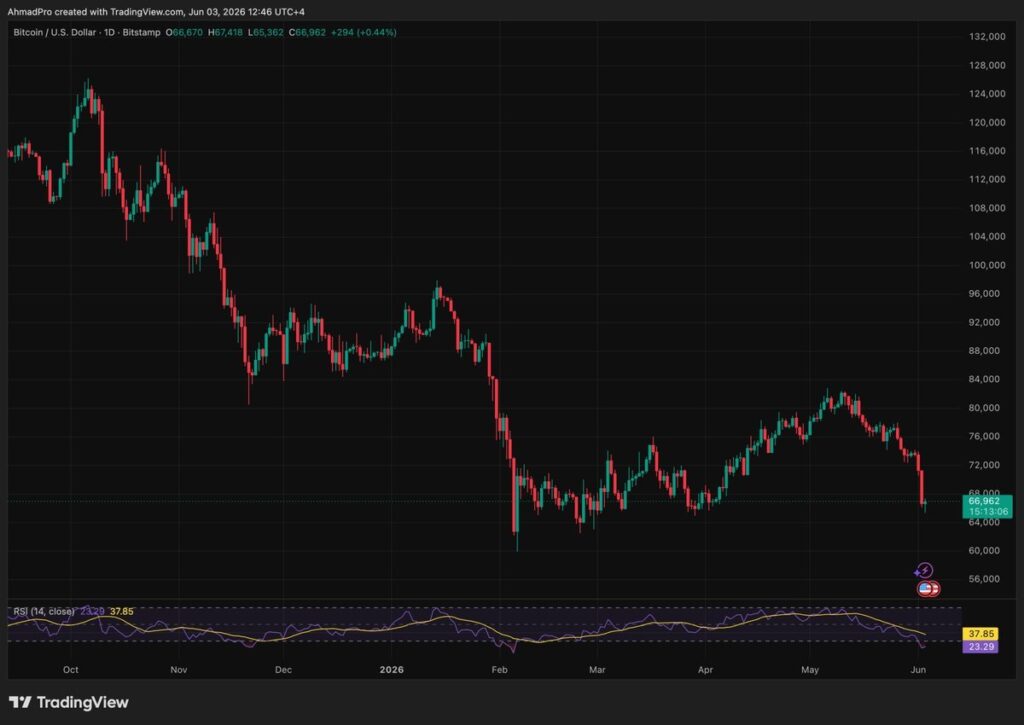
The cryptocurrency market suffered a sudden collapse overnight as Iranian strikes on Kuwait’s international airport and escalating conflict in the Strait of Hormuz sent risky assets tumbling. The market witnessed the forced closing of leveraged buy trades worth over $700 million in a span of no more than 12 hours.
Bitcoin fell sharply towards critical support levels, dragging the crypto’s total market value to $2.31 trillion. For traders wondering what caused this violent decline, the answer comes down to two parts: a sudden geopolitical shock and excess financial leverage that was already ready to explode.
The combined factors were not subtle; Open contracts on perpetual futures markets have been accumulating for weeks, structurally weakening the market. The Iranian bombing of the Kuwait airport and the subsequent US military response, targeting the island of Qeshm in the Strait of Hormuz, was the external catalyst that transformed the anxious centers into a successive wave of liquidations. Bitcoin was already suffering from the pressures of tensions and leverage in previous sessions, so these events were the match that ignited the fuel.
Why is crypto falling? Tensions in the Strait of Hormuz and bombing of Kuwait airport push people to flee dangers
The flashpoint was the Iranian drone attack on Kuwait International Airport, which caused severe building damage, injuries and a suspension of air traffic on Wednesday morning. Kuwaiti Defense Ministry spokesman Brigadier General Saud Abdulaziz Al-Otaibi called the attack “an Iranian criminal aggression.” In response, US Central Command launched strikes against an Iranian military ground control station on the island of Qeshm, in the heart of the Strait of Hormuz.
For their part, the Iranian Revolutionary Guards warned that “destabilizing the security of the Strait of Hormuz will cost the aggressor American army a heavy price.” Markets became aware of this threat and immediately reassessed the risks.
Around 20-30% of the world’s maritime oil trade passes through the Strait of Hormuz, so any ongoing disruption in that strait is more than a regional story to become a global event affecting energy prices. Oil prices jumped as the news intensified, the US dollar strengthened on safe-haven demand, and bonds saw notable demand.
This trio – rising oil, a stronger dollar and a rush into bonds – represents the classic risk-aversion rotation, which typically withdraws liquidity from speculative assets. Despite years of promoting the “digital gold” scenario, cryptocurrencies still trade as high-risk assets in moments of real geopolitical tension. The correlation between Bitcoin and the Nasdaq index dominated the scene, while there was no significant correlation between Bitcoin and gold.
It is worth noting that the US naval blockade of the Strait of Hormuz, which began on April 13, has already disabled six commercial ships and diverted 122 other ships. The latest measure of the blockade was the firing of a Hellfire missile into the engine room of the Botswana-flagged tanker M/T Lexi after its crew ignored warnings for 24 hours, indicating that Washington had no intention of backing down.
As ceasefire negotiations between the United States and Iran failed over the weekend, Iranian Foreign Ministry spokesperson Esmail Baghaei accused Washington of “constantly changing its mind.” Despite Secretary of State Marco Rubio’s explicit declaration to Congress that “the war is over,” the strikes indicate the exact opposite. We are not in a calm environment, and this pattern of events reinforces fears among some of a broader scenario of crypto market collapse in 2026.
Can Bitcoin Price Rebound or Does $68,000 Represent a Deeper Breakout?
The technical damage resulting from these events is real and tangible. Bitcoin has lost its “check price support for short-term holders,” a level that has historically represented the dividing line between a healthy correction and a sustained decline. The $70,000 psychological barrier was also broken during the selloff, and the total cryptocurrency market capitalization is now testing the $2 trillion level, a limit that derivatives desks will defend fiercely but without guarantees.
If behind-the-scenes negotiations between the United States and Iran resume in a meaningful way, Hormuz shipping risk premiums fade, and exchange-traded fund (ETF) flows return within 48 to 72 hours, Bitcoin could regain the $70,000 level. In this scenario, short positions could occur with the price moving back towards the $74,000 to $75,000 levels. But this requires calming signals that are not currently visible.
However, if the geopolitical noise continues without further direct escalation, the crypto could enter a consolidation phase in the $66,000-$70,000 range as leverage positions are reset and traders wait for the next US inflation data. However, the Fed’s policy of keeping rates higher for longer limits the rise even in this scenario.
But new Iranian strikes, a major maritime accident in Hormuz involving a massive oil tanker, or another rising inflation surprise could push Bitcoin past the $65,000 level. This would break the range structure that has existed since the first quarter of 2026 and open the door for a decline towards $60,000 to $62,000, a scenario that traders are currently quietly testing.
The structural figure remains bearish unless the $70,000 level is reclaimed at the close; Everything below falls within the scope of damage control attempts.
The article Crypto Market Collapse: Iranian Strikes on Kuwait, Hormuz Tensions Trigger Liquidation appeared first on Cryptonews Arabic.