
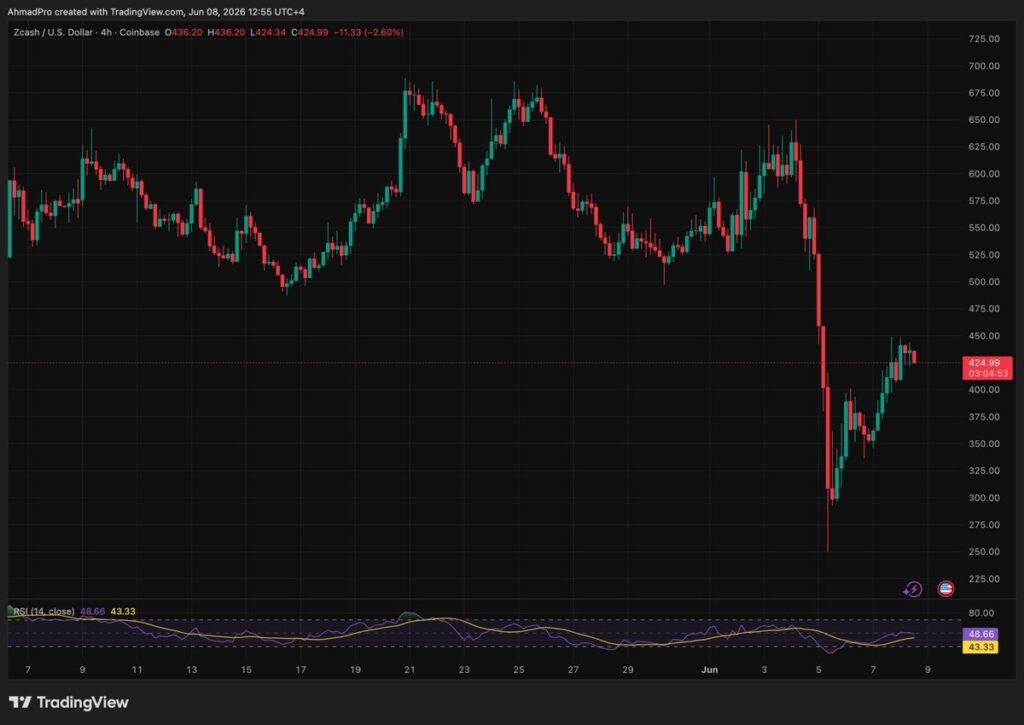
Ripple CTO Emeritus David Schwartz intervened in the Zcash crisis on June 7, offering thoughtful reassurance to disoriented ZEC holders following the revelation of a critical zero-knowledge proof vulnerability within the Orchard security pool.
Schwartz believes that passive holders who do not move their coins will not lose their funds, provided the vulnerability has not already been exploited. This condition represents the cornerstone of a sentence that seems reassuring, but which carries with it great structural complexities.
The crucial irony here is that the Orchard vulnerability, which was patched via an emergency hard fork (NU6.2) on June 2, would have theoretically allowed unlimited amounts of counterfeit ZEC to be generated undetected for almost four years.
Zcash developers cannot prove that no exploitation of the vulnerability took place, because the privacy structure that gives ZEC its value makes cryptographic auditing of the liquidity pool impossible. Therefore, Schwartz’s assurances are accurate according to his data, but they cannot constitute a sure guarantee.
This paragraph alone has huge implications for Zcash. It’s no surprise that the price has dropped.
"The vulnerability could have been exploited to undetectably create an unlimited amount of counterfeit zcash:native in Orchard. Due to Orchard’s privacy properties,… https://t.co/72v9Zafneu– Gareth Jenkinson (@gazza_jenks) June 5, 2026
ZEC saw a drop of more than 30% in a single session after the vulnerability was disclosed on May 29, briefly touching its lowest levels in over a month.
The market was not pricing a confirmed exploitation of the vulnerability, but rather an unverifiable risk, which is a different and perhaps more difficult challenge to resolve.
What Schwartz’s comments actually mean for investors, and whether they change anything at a structural level, is the subject of the rest of this article.
Orchard Pool vulnerability: what does a security breach really mean for ZEC?
The Orchard pool was introduced to the Zcash network with the network’s fifth upgrade (NU5) in May 2022, as the network’s most advanced privacy layer, based on Halo 2-based zk-SNARKs, designed to eliminate trust configuration requirements that existed in previous Sapling circuits.
The vulnerability was due to an insufficiently constrained element in a package’s elliptic curve multiplier. halo2_gadgets. In simpler terms, carefully crafted entries could have bypassed validity checks and produced counterfeit ZEC coins that would have passed the verification process.
Zcash engineer Taylor Hornby discovered the flaw on May 29, 2026, apparently using formal AI-based methods. Hornby confirmed the successful exploitation of the vulnerability in a local test environment, explaining that implementing the same exploit on the mainnet would have resulted in the generation of real, unlimited, untraceable ZEC coins.
The period of exposure to this risk lasted from the activation of Orchard on the mainnet in May 2022 until June 1, 2026, or for approximately 4 years. Affected software included all versions halo2_gadgets Pre-v0.5.0, orchard Versions prior to v0.14.0 and zcashd v5.0.0 to v6.12.3.
Direct from Zooko
"We would like to emphasize that we believe that prior exploitation of the Orchard vulnerability is unlikely. But users shouldn’t have to rely on our assessment, or anyone else’s, regarding the integrity of Zcash’s offering."
MUCH LOWER https://t.co/tlTRSWY1cH–Roger (@degendeez) June 6, 2026
Shielded Labs and developers responded quickly, releasing the Zebra 4.5.3 update as an emergency “soft fork” to temporarily disable Orchard transactions, then enabling the NU6.2 hard fork through Zebra 5.0 at block 3,364,600 on June 2.
The software circuit has now been patched, but the most important point for investors remains: the patch closes the loophole in the future, but it cannot retroactively prove security of supply over the past four years. This period will forever remain a mystery.
Schwartz’s reassurance: what does it mean and what can’t it prove?
The discussion came after tech commenter Nate, known as @satorinakamoto on X, asked whether Zcash could prove the vulnerability was never activated, given the nature of the darknet.
“They will feel a little alone in the abandoned pool in the future, but their coins will still be safe and available,” responded Schwartz, co-founder of XRP Ledger and one of the trusted technical voices in the industry.
His broader point is that consensus rules protect each ZEC holder and that protocol designers can specify backward compatibility so that passive holders retain valid, spendable coins even when the Orchard pool moves to a legacy layer.
If there was no exploitation, everyone is safe whether they move their pieces or not. They’ll end up feeling a little lonely in the outdated pool, but they’ll still be safe and accessible.
— David ‘JoelKatz’ Schwartz (@JoelKatz) June 7, 2026
The aforementioned assurance is that the holders will not lose their assets, and this is true on one condition: if no exploitation takes place, the real estate funds of the old complexes remain intact. However, this condition itself is the crux of the problem.
Shielded Labs clearly stated in its disclosure: “There is no conclusive way to determine whether such exploitation has occurred using encryption alone. Schwartz’s statements carry real weight given his stature as a scholar, but they do not provide certainty about what happened in the darkest layer of a private room over a four-year period.
This is not to diminish Schwartz’s vision; Its framework that passive carriers are safe in the absence of proven exploitation is technically consistent. But the reality is that “no confirmed exploitation” is a condition that no one can verify, including the Zcash developers themselves. Both things are true at the same time, and the market is currently pricing in the gap between them.
Post David Schwartz reassures Zcash holders after Orchard security vulnerability first appeared on Cryptonews Arabic.