
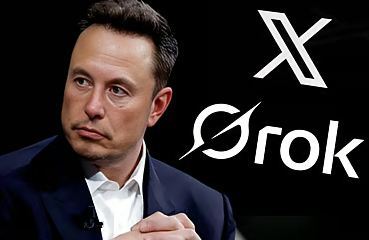
A new development in the artificial intelligence sector has drawn global attention after Elon Musk reportedly confirmed that Grok 4.5, the latest version of xAI’s big language model, is currently in private beta testing within the SpaceX and Tesla environments. The move marks another important step in the rapid evolution of xAI’s artificial intelligence systems, which are increasingly integrated into real-world engineering and industrial workflows.
According to information circulating within the tech community, Grok 4.5 is being tested internally under controlled conditions, allowing SpaceX and Tesla engineers to evaluate its performance in high-demand environments. These environments include aerospace simulations, autonomous driving systems, robotics development, and large-scale manufacturing processes.
Industry observers note that internal deployment at this level typically indicates a high degree of confidence in the stability of the model, although it also suggests that the system remains in an experimental phase. Results are believed to be closely monitored and performance data is continually evaluated by internal engineering teams.
Reports further suggest that Grok 4.5 is built on a base V9 model with an estimated 1.5 trillion parameters. This represents a significant increase compared to the previous version of Grok 4.4, which was estimated at around 1 billion parameters. If accurate, this would place Grok 4.5 among the largest AI models currently in development worldwide.
Expanding model size is expected to improve a wide range of capabilities, including reasoning, contextual understanding, and task execution in complex domains. However, experts emphasize that parameter counting alone does not guarantee better performance, as data quality, training methods, and architecture efficiency also play a critical role.
 |
| Source: Xpost |

One of the most notable improvements reported in Grok 4.5 is its improved capabilities in coding and agent workflows. The model is said to incorporate “cursor data,” suggesting optimization for modern AI-assisted development environments. This could allow the system to perform more advanced programming tasks, including multi-step debugging, code generation, and autonomous workflow execution.
Agent AI refers to systems capable of completing tasks independently with minimal human intervention. If Grok 4.5 demonstrates strong performance in this area, it could significantly change the way software engineering and development workflows are structured, potentially allowing AI systems to act as semi-autonomous collaborators.
Early reactions from the AI community have been a mix of enthusiasm and caution. While the reported advances suggest significant progress in large-scale AI development, many experts emphasize that independent verification is still required before drawing firm conclusions. At this stage, most of the information available is based on initial reports and insights from internal testing rather than publicly published benchmarks.
The participation of SpaceX and Tesla as test environments has further intensified interest in the model. Both companies operate in highly complex engineering fields, where AI systems must meet strict standards for accuracy, reliability and security. This makes them ideal environments for testing advanced AI models in real-world conditions.
xAI’s broader strategy appears to focus on integrating artificial intelligence directly into industrial and scientific applications, rather than limiting it to consumer-facing chatbot tools. This approach aligns with Elon Musk’s long-term vision for AI systems to directly contribute to engineering, automation, and scientific discoveries.
Some of the initial discussion around Grok 4.5 has been amplified on social media platforms, including posts referencing AI-focused accounts like CoinBureauini. However, these remain informal indicators and have not been officially confirmed through technical documentation.

If Grok 4.5’s reported capabilities prove accurate, the model could have significant implications across multiple industries, including software engineering, aerospace design, and autonomous systems development. Greater automation and better coding support could reduce development cycles and improve productivity in complex technical environments.
At the same time, the rise of more autonomous AI systems raises important questions about oversight, security, and responsible deployment. As models become more capable of acting independently, ensuring controlled and predictable behavior becomes increasingly critical.
For now, Grok 4.5 remains in private beta testing and its full capabilities have yet to be independently verified. However, early reports highlight the continued acceleration of AI development and growing competition among major players in the artificial intelligence industry.
hoka.news – not just cryptocurrency news. It’s cryptoculture.
Writer @Victoria
Victoria Hale is a writer focused on blockchain and digital technology. It is known for its ability to simplify complex technological developments into clear, easy-to-understand and engaging-to-read content.
Through her writing, Victoria covers the latest trends, innovations and developments in the digital ecosystem, as well as their impact on the future of finance and technology. It also explores how new technologies are changing the way people interact in the digital world.
His writing style is simple, informative, and focuses on giving readers a clear understanding of the rapidly evolving world of technology.
Disclaimer:
HOKA.NEWS articles are here to keep you up to date on the latest rumors in crypto, technology, and more, but they are not financial advice. We share information, trends and knowledge, we don’t tell you to buy, sell or invest. Always do your own homework before making any money moves.
HOKA.NEWS is not responsible for any loss, profit or chaos that may occur if you act on what you read here. Investment decisions should arise from your own research and, ideally, the guidance of a qualified financial advisor. Remember: cryptocurrencies and technology move fast, information changes in the blink of an eye, and while we strive for accuracy, we cannot promise that it is 100% complete or up-to-date.