
The Ethereum Foundation is facing the most vocal internal criticism in years, with eight high-profile resignations since January 2026, amid a heated public debate over whether the Switzerland-based nonprofit still serves a clear purpose within the ecosystem it helped build. This conflict is no longer just a whisper behind the scenes, but has now morphed into a governance crisis that is taking center stage for a network that holds billions of dollars in assets.
What marks this moment is not just the departure of executives, but rather the clash of conflicting visions about the supposed role of the Ethereum Foundation and what the network itself should become in the future.
The Ethereum Foundation: Beyond the Fight for Governance
The immediate flashpoint was the “mandate” document published by the Foundation on March 13, 2026, which was described internally as “part constitution, part declaration, part guidelines”. This document explicitly redefines the role of the Foundation as a custodian and not as the “parent, governor or ultimate authority” of the Ethereum network.
This paper has carved out an old fault line: should the organization remain narrowly focused on public goods research, or evolve into an implementation-focused organization capable of competing in an increasingly commercialized blockchain landscape?
The successive resignations accelerated the criticism that had been accumulating for months. In a scathing statement on the Unchained with Laura Chen podcast, longtime Ethereum contributor Zach Cole said, “The organization is completely out of touch with reality. They fund hippo projects in Asia and do things that no one in the world cares about except Vitalik and his little gang. Cole explained the risks simply: “Ethereum is no longer a startup, it is a mature and robust ecosystem. Billions, if not trillions, of dollars are at stake, and people’s livelihoods depend on it.
Dankrad Fest, a former Foundation researcher, went further, publicly floating the idea of creating a separate $1 billion Ethereum-enabled organization to improve execution and value capture, which would represent a direct challenge to the Foundation’s public goods model. Meanwhile, the organization’s internal agenda was also changing, as leadership of the new protocol team was tasked with increasing the gas limit to 200 million, advancing the proposed vendor split, and pushing zkEVMs toward proven 128-bit security.
For his part, Vitalik Buterin responded last week in a lengthy message, arguing that critics had misunderstood the foundation’s intended role. “The organization is not an ‘Ethereum hub,’ but rather ‘a single node, with a specific purpose, with other nodes,'” Buterin wrote. He described the Foundation’s current focus around its core values – Surveillance Resistance, Openness, Privacy and Security (known internally as CROPS) – as a deliberate strategic choice, stating: “The Foundation chooses to use its remaining resources to pursue continuity rather than expansion.
Why Ethereum Foundation Governance Impacts ETH Investors
The mechanism for transferring conflicts from the corporate level to that of influencing the market is indirect but real. The opinion of developers is what determines the credibility of the protocol, and it is this credibility that builds institutional trust, which in turn shapes ETH’s position as a financial asset and infrastructure bet.
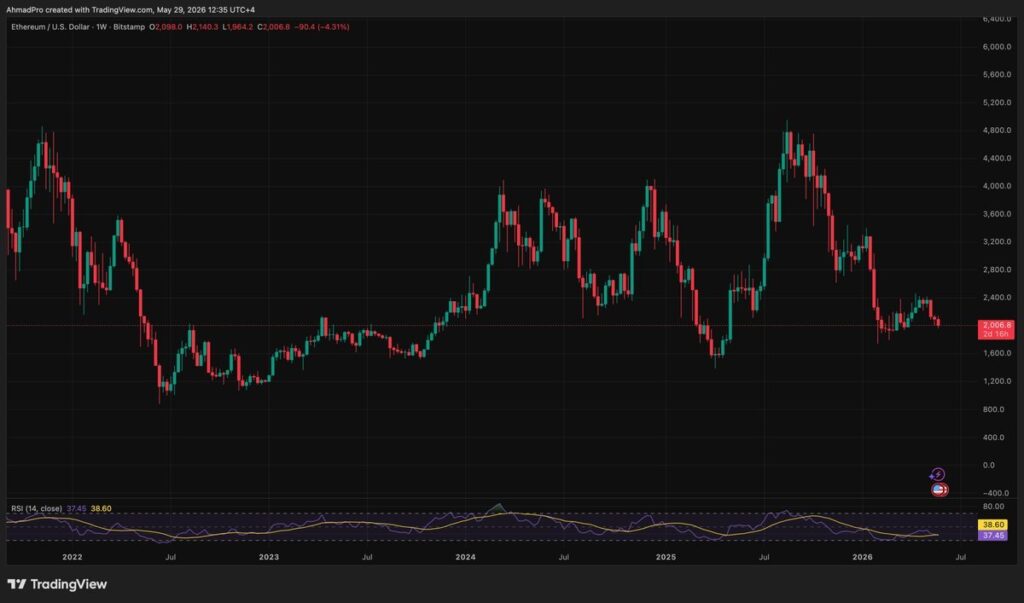
ETH is already suffering from price pressures, and governance uncertainty adds a credibility burden that is difficult to quantify but easy to feel in the dynamics of the ecosystem.
Chris Poulos, president of Dromos Labs – the lead developer of the Aerodrome decentralized platform on the core network (the second layer of Ethereum) – acknowledged merit of the criticism while defending the residual value of the foundation, saying: “The fundamental criticism that management was unclear and unnecessary and that the application layer was a secondary concern is a fair criticism. The foundation tried to be several things at once for several parties. His defense of the organization focused on its neutrality: “Having a neutral party when competing teams have to agree on best practices deserves more credit than sometimes gets.” »
This development is not as directly negotiable as ETF approval or enforcement action, but continued uncertainty in enterprise-level governance remains vital for a network where competitive advantages depend on update coordination, roadmap credibility, and developer retention, especially as competing layer one (L1) networks aggressively seek to capture Ethereum’s developer base.
The article Ethereum Foundation Crisis: Internal Divisions Threaten Network’s Future appeared first on Cryptonews Arabic.