
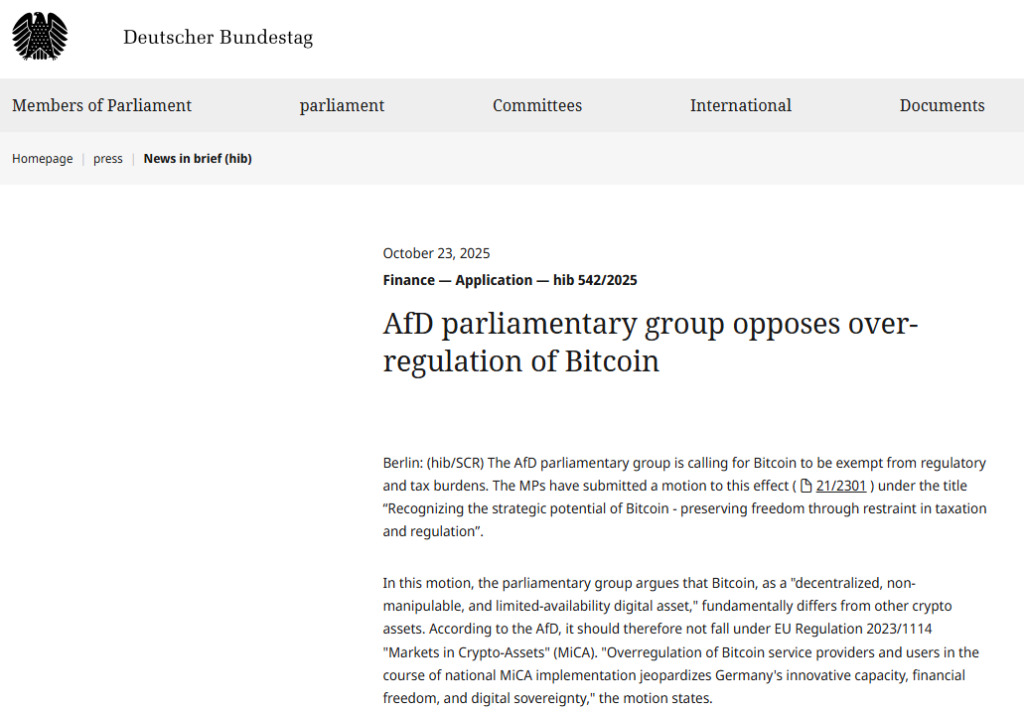
Controversy around Bitcoin is intensifying in Germany, with lawmakers questioning whether the country’s strict adherence to EU regulatory measures could hinder innovation and financial independence. A recent proposal from the Alternative for Germany (AfD) party urges the government to exempt BTC from the regulatory measures and heavy taxes imposed on it under the European Digital Asset Market (MiCA) regulation, a move that could redefine Berlin’s approach to digital currency.
The Alternative for Germany (AfD) proposal, titled “Recognizing Bitcoin’s strategic potential to preserve freedom through taxation and regulation,” argues that BTC is essentially an entirely different asset class, describing it as “decentralized, non-manipulable, and limited in quantity.”
The proposal argues that Bitcoin should not be subject to the European Digital Asset Market Regulatory Framework (MiCA), warning that excessive oversight could drive capital and businesses abroad, weaken Germany’s competitiveness and threaten its digital sovereignty.
Is Germany preparing to treat Bitcoin as currency and not as a speculative asset?
According to the proposal, Bitcoin stands out from other currencies thanks to its technical and monetary properties, which brings it closer to digital gold than to speculative currencies.
The representatives also called on the federal government to maintain a 12-month tax-free holding period for Bitcoin and to classify private mining and Lightning Network node operations as non-commercial activities.
Likewise, representatives called for the release of a policy statement recognizing Bitcoin as “free digital currency in the 21st century,” taking into account its implications for energy policy, digital freedom and monetary sovereignty. Germany is one of the most digital currency-friendly European countries, as it combines its national laws with a unified MiCA framework at the European Union level.
For its part, the country’s Federal Financial Supervisory Authority (BaFin) supervises all digital asset service providers (CASPs) and ensures the implementation of anti-money laundering (AML) standards and customer identity verification (KYC) policies.
Since the MiCA measures came into force in December 2024, the Federal Financial Supervisory Authority (BaFin) has been responsible for licensing digital currency custodians, trading platforms and exchanges under the single EU system. The transition period will remain in effect until December 30, 2025, giving existing providers sufficient time to obtain the full license.
To date, BaFin has issued nine licenses under MiCA, the most ever issued by a European regulator, including approvals for Boerse Stuttgart Digital Custody and Fintech Trade Republic. This clear regulatory approach has made Germany a major hub for regulated digital assets within the EEA.
German Bitcoin debate reflects French stance against digital euro
The call from Alternative for Germany (AfD) coincides with the French National Assembly’s adoption of a resolution opposing the European Central Bank’s digital euro plan, while supporting the use of Bitcoin and euro-linked stablecoins as more independent financial alternatives.
France adopts Bitcoin: The French National Assembly adopted a resolution opposing the digital euro and approving Bitcoin.#France #Bitcoin #EuroDigitalhttps://t.co/2evgXL5KFL – Cryptonews.com (@cryptonews) October 28, 2025


French lawmakers have also warned that a centralized digital currency could threaten privacy and financial freedom, instead calling for a national strategy to accumulate Bitcoin reserves.
As Germany moves to move away from European Union oversight, Bundesbank President Joachim Nagel has defended the digital euro as necessary to preserve Europe’s financial sovereignty, warning that its absence could leave the continent dependent on payment systems controlled by foreign parties.
At the same time, some – like Joana Cotar, a member of the German Bundestag – have argued that Bitcoin represents “the financial sovereignty of individuals,” offering them a way to protect their savings from inflation and government abuse.
Additionally, Germany’s checkered history with Bitcoin fuels this heated debate. In mid-2024, the government sold around 50,000 BTC seized in criminal cases for around $2.9 billion, in line with legal requirements for liquidating volatile assets.


By August 2025, the price of Bitcoin had more than doubled, meaning its current holdings could have exceeded $6 billion, meaning the loss in profits exceeded $3 billion. Cotard has since called on the government to consider BTC as a strategic reserve asset rather than selling it.
However, Germany’s crypto economy has remained strong, with data from Chainalysis showing that crypto trading volumes in the country reached $219 billion between July 2024 and June 2025, placing it among the largest markets in Europe.
The pace of adoption of digital currencies has also accelerated, with expectations of 27 million users by the end of 2025, almost half of whom are Millennials or Generation Z. At the same time, institutional participation in this sector is increasing, with Deutsche Bank preparing to launch a digital asset custody service in 2026.
Germany seeks to adopt Bitcoin (BTC); Is Berlin the next to officially adopt this currency? appeared first on Cryptonews Arabic.