
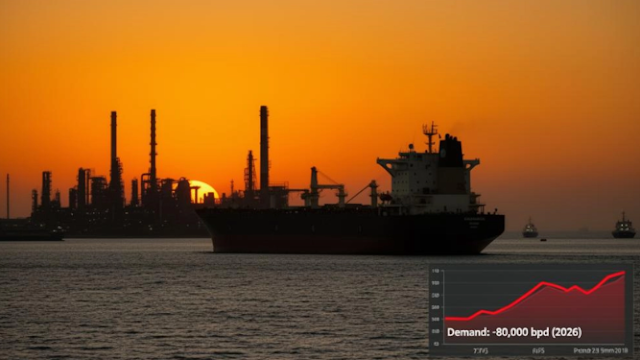
The International Energy Agency (IEA) has dramatically revised its outlook for global oil demand, warning that global oil consumption is now expected to decline this year for the first time since the COVID-19 pandemic. The unexpected change comes amid rising geopolitical tensions involving Iran, which has sparked renewed concerns about the outlook for the global economy and energy market.
According to the IEA’s latest monthly oil market report, the agency has withdrawn its previous forecast of 850,000 barrels per day (bpd) of global demand growth. Instead, it now projects that oil demand will decline by about one million barrels per day over the course of the year.
The revision marks one of the most significant changes to the agency’s forecast in recent years and underlines the growing uncertainty facing the international energy sector.
The latest report indicates that the conflict involving Iran has altered expectations for both economic activity and energy consumption. Although geopolitical conflicts often raise concerns about tight oil supplies and rising crude oil prices, prolonged instability can also weigh heavily on economic growth by reducing industrial production, weakening business confidence and slowing global trade.
Ultimately, those factors translate into lower demand for transportation fuels, industrial energy, and petroleum products.
The IEA noted that weakening economic momentum in several major economies has also contributed to the revised forecast. Manufacturing activity has remained subdued in some parts of Europe and Asia, while consumer spending and freight transportation have softened compared to previous projections.
In addition to geopolitical pressures, structural changes within the global energy sector continue to reshape oil demand. The rapid adoption of electric vehicles, improvements in fuel efficiency, and increased investment in renewable energy have gradually slowed the growth rate of oil consumption in many developed economies.
These long-term trends have become increasingly influential as governments continue to implement policies designed to reduce greenhouse gas emissions and accelerate the transition to cleaner energy sources.
Energy analysts say the revised forecast reflects a combination of short-term geopolitical uncertainty and long-term structural changes within the global economy.
Oil-producing countries are expected to monitor the situation closely as weaker demand projections could influence future production decisions. Several major producers have already adjusted production levels in recent months in an effort to support international crude prices amid fluctuating market conditions.
If demand continues to weaken beyond current expectations, producers could face additional pressures to consider further production adjustments to maintain market balance.
Financial markets reacted cautiously following the release of the updated report. Energy stocks were mixed as investors balanced concerns about slowing oil demand with the possibility of continued supply disruptions linked to geopolitical tensions.
Commodity traders remain divided over the outlook for crude oil prices. While supply risks generally put upward pressure on prices, expectations of weaker demand tend to limit profits by reducing overall market consumption.
Economists believe that the combination of a slowdown in demand and geopolitical instability creates a challenging environment for policymakers around the world. Volatile energy prices can affect inflation, transportation costs, manufacturing expenses and household spending, ultimately influencing broader economic growth.
Central banks are also expected to closely monitor developments in the energy sector, as oil prices remain an important factor in inflation forecasts and future monetary policy decisions.
 |
| Source: Xpost |

The IEA highlighted that the outlook remains largely dependent on future geopolitical developments. Any improvement in regional stability or diplomatic negotiations could alter current demand projections. Conversely, further escalation could create new disruptions that would affect both supply chains and global economic activity.
Beyond the immediate impact of geopolitical developments, the report also highlights the ongoing transformation of the global energy landscape.
Governments in North America, Europe and Asia continue to invest heavily in renewable energy infrastructure, battery technology, hydrogen development and electrified transportation systems. These investments are expected to gradually reduce dependence on fossil fuels in the coming years.
At the same time, companies are increasingly improving energy efficiency in their manufacturing and logistics operations, contributing to slower growth in oil consumption.
Although oil remains essential for aviation, shipping, heavy industry and petrochemical production, experts believe future demand growth will likely be more moderate than previously anticipated.
Emerging economies continue to support global energy demand through industrialization and population growth. However, that expansion is increasingly offset by declining oil consumption growth in advanced economies where clean energy adoption continues to accelerate.
Market watchers say the IEA’s latest assessment reflects a broader shift taking place across the international energy sector.
The updated forecast has also attracted significant attention in financial markets after information was confirmed via Coin Bureau’s X account, which highlighted the IEA’s latest findings on the sharp reversal in global oil demand expectations. The report has since been widely discussed among investors who follow macroeconomic trends and commodity markets.
Analysts warn that oil market forecasts remain subject to change as new economic data becomes available. Unexpected geopolitical events, changes in government policy, fluctuations in consumer demand or changes in industrial production could influence future reviews.
Historically, global oil markets have responded quickly to military conflicts, economic downturns, supply disruptions, and political decisions by major oil-producing nations.
The IEA is expected to continue updating its outlook throughout the year as additional economic indicators emerge and geopolitical conditions evolve.
For governments, businesses, investors and consumers, the latest forecast serves as a reminder that the global energy market is entering an increasingly complex period. Balancing energy security, economic stability and environmental sustainability remains one of the world’s most important challenges.

Despite the projected decline, oil will continue to play a central role in the global economy for years to come. However, changing technology, evolving consumer behavior and international climate policies are constantly reshaping long-term demand patterns.
Financial markets, policymakers and energy companies will closely monitor the coming months as they assess whether geopolitical tensions ease or intensify and whether the global economy can regain further momentum.
While the IEA’s revised forecast represents a notable change from its previous outlook, it also reflects the growing uncertainty surrounding today’s interconnected global economy. As geopolitical risks, economic conditions and the energy transition continue to evolve, oil demand is expected to remain one of the most monitored indicators in international markets.
hoka.news – not just cryptocurrency news. It’s cryptoculture.
Writer @Victoria
Victoria Hale is a writer focused on blockchain and digital technology. It is known for its ability to simplify complex technological developments into clear, easy-to-understand and engaging-to-read content.
Through her writing, Victoria covers the latest trends, innovations and developments in the digital ecosystem, as well as their impact on the future of finance and technology. It also explores how new technologies are changing the way people interact in the digital world.
His writing style is simple, informative, and focuses on giving readers a clear understanding of the rapidly evolving world of technology.
Disclaimer:
HOKA.NEWS articles are here to keep you up to date on the latest rumors in crypto, technology, and more, but they are not financial advice. We share information, trends and knowledge, we don’t tell you to buy, sell or invest. Always do your own homework before making any money moves.
HOKA.NEWS is not responsible for any loss, profit or chaos that may occur if you act on what you read here. Investment decisions should arise from your own research and, ideally, the guidance of a qualified financial advisor. Remember: cryptocurrencies and technology move fast, information changes in the blink of an eye, and while we strive for accuracy, we cannot promise that it is 100% complete or up-to-date.