
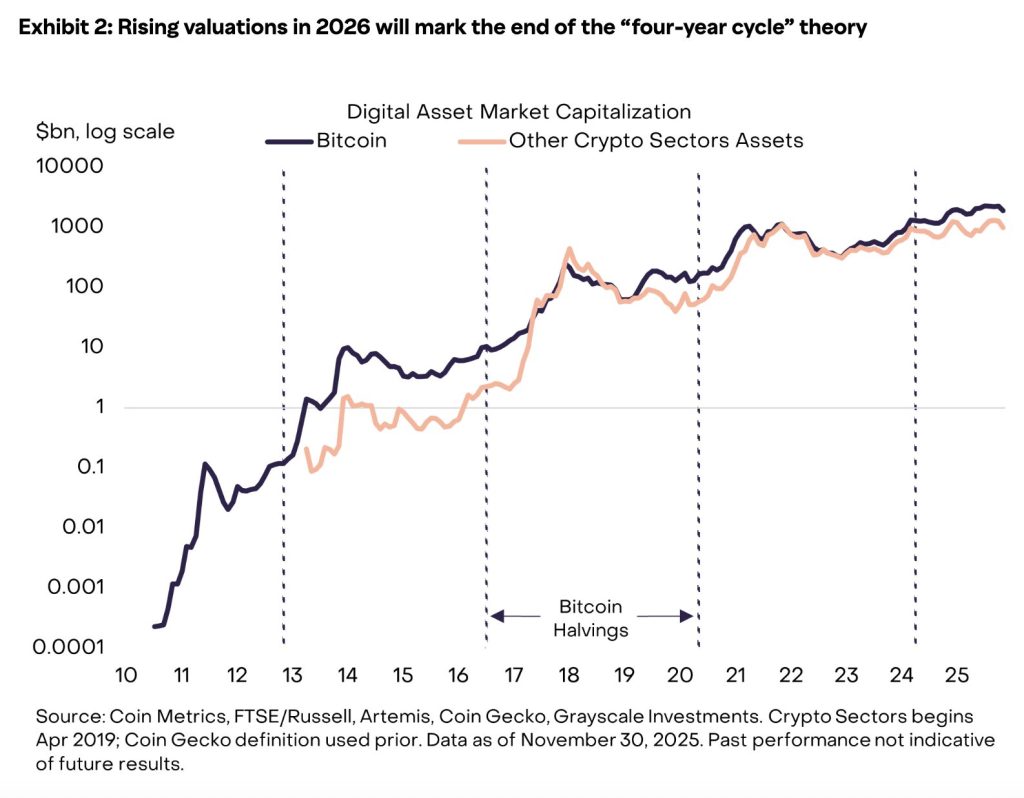
Grayscale emphasizes that the current Bitcoin cycle is not yet over. In its 2026 forecast, the asset management firm predicts that the price of Bitcoin will record unprecedented levels in the first half of next year, indicating that the market is moving towards a more mature stage among major institutions.
The company expects 2026 to witness an acceleration of what it calls structural transformations in terms of investment in digital assets, after macroeconomic conditions led to an increase in demand for alternatives to preserve value with the escalation of risks associated with public debt and official currencies.
On the other hand, we currently find clearer regulatory laws, since the company finally confirms the start of the integration of digital currencies into the traditional financial infrastructure, instead of marginalizing them. According to Grayscale, these combined forces will attract new capital, expand adoption among wealth managers and institutions, and deepen the integration of public blockchain networks into traditional markets.
The company believes that this backdrop will improve prices in the crypto sector and mark the end of the so-called four-year cycle, which is the common idea that the fate of Bitcoin is linked to a rise and fall cycle driven by the halving process every 4 years.
Source: Grayscale
Rising Debt, Inflation Fears Drive Demand for Scarce Digital Assets
The crypto sector has already grown from a small-scale experiment to a mid-sized alternative asset class – as the company describes it – containing millions of cryptocurrencies with a total market capitalization of almost $3 trillion.
Bitcoin and Ethereum-ETH are at the heart of this system as rare digital commodities and alternative monetary assets. Grayscale confirms that growing concerns over debt and inflation will continue to improve demand for these assets within investment portfolios, as investors seek to find hedging tools against the deterioration in the value of official currencies.
Additionally, limited supply is part of this equation; Bitcoin’s issuance rate has fallen below 1% and the 20 millionth coin is expected to be mined in March 2026. The company sees this type of limited and transparent supply becoming increasingly attractive as financial imbalances increase and expects investors to treat Bitcoin and Ethereum as strategic holdings rather than short-term transactions.
2026 could be the year digital assets enter their institutional era.
Grayscale believes macroeconomic tailwinds and regulatory clarity will drive demand for scarce assets like $BTC & $ETH.https://t.co/ReaqqGksni – Grayscale (@Grayscale) December 15, 2025


Additionally, regulatory laws are another aspect of this problem; The company notes that in recent years, U.S. authorities have begun investigating or taking legal action against many large crypto companies, but it believes this approach has started to see a gradual shift.
Bipartisan legislation creates a clear basis for regulating cryptocurrencies in the United States
The court victories paved the way for the launch of spot ETPs, with the Bitcoin and Ethereum exchange-traded products launching in 2024, and the GENIUS Stablecoin Act passing in 2025. Grayscale now expects a bipartisan bill regulating the structure of the cryptocurrency market to become law in 2020. 2026, giving the industry a clearer regulatory framework and broader access to capital markets.
Spot ETPs have already begun to attract investment, and since the launch of Bitcoin products on US exchanges in January 2024, globally listed crypto products have seen net new investments amounting to approximately $87 billion, according to the report.
Still, Grayscale estimates that less than 0.5% of funds managed by individual and institutional financial advisors in the United States are invested in cryptocurrencies, leaving plenty of room for slower institutional investments as platforms perform their due diligence and add currencies to traditional investment portfolios. Harvard Management Company and Mubadala of Abu Dhabi were early adopters.
This institutional trend has also changed the way Bitcoin is traded, since previous bull cycles saw gains exceeding 1,000% in one year, while the maximum annual increase in this cycle reached around 240% through March 2024, meaning it has become more moderate.
Grayscale sees this as a sign of more stable buying by large pools of capital, rather than a sudden, isolated buying frenzy by small investors, and the likelihood of a sharp and prolonged downturn in 2026 is relatively low.
Grayscale identifies 10 factors that will shape the future of digital assets in the coming year
It is worth noting that macroeconomic policies could provide further momentum, with the last two major increases of the session coinciding with the Federal Reserve raising interest rates. This time, the Federal Reserve has cut interest rates three times in 2025 and is expected to continue its easing policy over the next year.
For his part, Kevin Hassett, considered a potential candidate to succeed Jerome Powell as head of the Federal Reserve, recently said that President Trump would choose someone who would help Americans get cheaper auto loans and give them access to mortgages at lower interest rates. Grayscale says economic growth and the Federal Reserve’s generally favorable stance will coincide with a stronger appetite for risk assets, including cryptocurrencies.
The company identifies 10 key factors that it believes will impact digital assets in 2026, including: the decline in the value of the dollar, the clarity of regulatory laws, the expansion of stablecoins under the Genius Code, the digital representation of assets and privacy tools, the intersection of artificial intelligence with blockchain technology, the acceleration of lending in the decentralized financial system (DeFi) and next generation infrastructure, and virtual mortgage in networks based on the mechanism of proof of mortgage.
The company expects investors to prefer currencies with clear uses, measurable revenue, and access to regulated platforms.
Two important topics that do not appear in Grayscale’s main list are worth noting, as the report believes that despite the risks of quantum computing, they are still far enough away to not affect price movements over the next year. It also confirms that digital asset vaults are unlikely to see large waves of forced sales or generate strong new demand in 2026, despite their holding of Bitcoin, Ethereum and Solana-SOL shares.
Looking at the bigger picture, 2026 marks the start of what Grayscale calls the “institutional era of cryptocurrencies,” with less attachment to halving myths and a greater focus on regulation, hedging macroeconomic conditions, and stable investments from traditional portfolios.
According to what the company indicates, Bitcoin price reaching all-time highs is considered a likely scenario and not an unattainable goal.
The article Grayscale Expects Bitcoin (BTC) Price to Record All-Time Highs in Early 2026 appeared first on Cryptonews Arabic.