



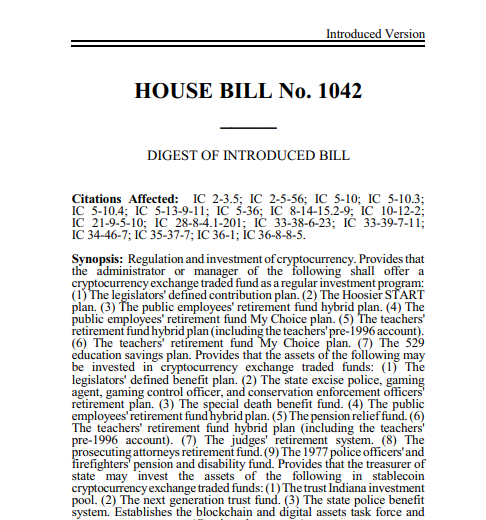
A new bill in Indiana would require public retirement programs to offer investment options linked to Bitcoin, and limit the ability of local governments to restrict the use of digital assets. The proposal was introduced last Thursday by State Rep. Kyle Pierce, a Republican member representing the city of Anderson. The bill is known as House Bill 1042 and was introduced during a meeting of the House Financial Institutions Committee.
The bill aims to give officials access to crypto investments while setting clear legal limits regarding digital asset use, custody, payment operations and mining.
The state of Indiana aims to satisfy the first local requirement to include Bitcoin in public retirement investment plans.
Under the bill, trustees of many state-run retirement and savings plans would be required to include crypto ETFs among traditional investment options, which could also allow some state pension funds to invest directly in cryptocurrency ETFs, as well as giving the state treasurer the authority to place specific account investments in stablecoin ETFs.
For his part, Pierce said the bill aims to give Indiana residents greater financial flexibility as the role of digital assets increases in the broader economy. He added that the bill aims to balance investment options and regulatory protections, while allowing the state to explore potential government use of blockchain technology through pilot programs.
Thus, this bill goes beyond investments in retirement programs and targets local regulation, as it would prevent cities and counties from passing laws imposing “unreasonable” restrictions on digital assets if similar rules do not apply to traditional financial activities.
This protection will extend to payments using digital currencies, private ownership of digital wallets and mining activities, and the bill adds clear safeguards regarding self-custody, as it stipulates that access keys to crypto balances can only be claimed by a court order and only when there is no other legal way to access them.
The bill would also prevent local governments from excluding mining facilities from industrial zones and protect properly zoned residential mining operations. In other words, if this law passes, Indiana will become the first state in the country to require publicly managed retirement programs to offer Bitcoin as traditional investment options, while some other states offer limited flexibility when it comes to crypto investments, but none of them impose this requirement.
US states expand access to digital assets with retirement, payment and ownership laws
Other states have taken similar steps, but on a smaller scale. In 2024, Oklahoma passed a law protecting residents’ rights to hold digital currencies in self-custodial wallets and banning taxes on Bitcoin-related transactions.
In 2025, Kentucky caught up and officially recognized self-custody as a form of legal property rights, and Wyoming approved laws allowing public pension funds to invest in digital assets.
Additionally, the state of Arizona passed a law allowing investments in Bitcoin exchange-traded funds (Bitcoin ETFs) in retirement accounts, while the state of Florida established legal pathways for certain state funds to hold digital assets through ETFs.
However, the Indiana state bill differs from all of these laws in that it makes access to Crypto ETF investment products mandatory rather than optional, amid growing momentum for the inclusion of digital assets in retirement plans nationwide. In August, the Michigan State Retirement System tripled its Bitcoin ETF holdings to 300,000 shares, worth $11.4 million according to regulatory filings.
The Michigan State Retirement System has increased its exposure to Bitcoin, tripling its holdings in the @ARKInvestissement 21Parts Bitcoin ETF.#Michigan #Bitcoinhttps://t.co/lUxWycmp4A
– Cryptonews.com (@cryptonews) August 6, 2025
Additionally, the fund holds approximately $13.6 million worth of Ethereum-ETH through its Grayscale investment fund, and the Wisconsin Investment Board has disclosed holdings of more than $387 million in Bitcoin ETFs.
Additionally, states are expanding their use of digital assets beyond investment; In September, Ohio finalized plans to accept Bitcoin and other digital currencies as official state payment methods. In October, California updated its unclaimed property law to ensure that dormant cryptocurrencies do not automatically convert to cash balances when transferred into state possession.
California has become the first US state to officially protect unclaimed cryptocurrencies from forced conversion to cash.#California #Bitcoinhttps://t.co/PoV40lmZi9
– Cryptonews.com (@cryptonews) October 14, 2025
In the same context, New York City took its own steps by creating a municipal office for digital assets and blockchain, after Mayor Eric Adams issued an executive order to coordinate digital currency policies and encourage the development of blockchain.
Bitcoin NYC Mayor Adams created the country’s “first-ever” municipal office for crypto and blockchain to position the city as the global crypto hub.#EricAdams #NYCMayor #CryptoOfficehttps://t.co/oVEBRTRp5y
– Cryptonews.com (@cryptonews) October 15, 2025
At the federal level, broader regulatory efforts are also underway, as lawmakers continue to prepare new legislation that could reshape how states manage digital asset policies, including updated guidance on investment exposure to cryptocurrencies in 401(k) retirement plans expected in 2026.
Indiana State Bill Requires Retirement Plan Programs to Provide Bitcoin (BTC) as Investment Options and Protects Self-Guardianship Rights appeared first on Cryptonews Arabic.

