


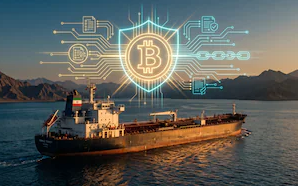
According to reports attributed to Fars News Agency, Iran’s Ministry of Economy has explored a proposal for a Bitcoin-settled marine insurance framework for shipping activities passing through the Strait of Hormuz, a global energy and trade hotspot.
The proposal suggests the initiative could generate more than $10 billion in value, highlighting the growing intersection between cryptocurrency settlement systems and international trade infrastructure. The development has raised eyebrows across global financial and cryptocurrency markets, particularly after discussions surrounding the report circulated on industry channels and were later referenced through updates associated with the CoinMarketCap-linked X account.
The Strait of Hormuz is one of the world’s most strategically important maritime passages, responsible for a significant portion of global oil and liquefied natural gas shipments. Any financial innovation linked to shipping activity in this region carries important geopolitical and economic implications.
According to the report, Iranian officials are evaluating the use of bitcoin as a settlement layer for marine insurance contracts linked to ships passing through the strait.
The proposed system would allow shipping and insurance companies to conduct insurance transactions using Bitcoin-based settlement mechanisms, potentially bypassing traditional financial intermediaries and reducing dependence on conventional banking infrastructure.
If implemented, the model could represent one of the most important real-world applications of cryptocurrency in international trade and maritime logistics to date.
Industry analysts say the proposal reflects a broader global trend toward exploring blockchain-based financial systems for cross-border trading, insurance and settlement processes.
Marine insurance is a critical component of global maritime operations, providing coverage against risks such as geopolitical instability, piracy, accidents and cargo loss.
Traditionally, these insurance systems depend on complex international financial networks, involving banks, insurers and regulatory bodies in multiple jurisdictions.
By introducing Bitcoin-based settlement mechanisms, the proposed framework aims to streamline payment processes, reduce friction in transactions, and potentially increase transparency in insurance operations.
However, the concept also raises important questions about regulatory compliance, volatility risk and integration with existing global financial systems.
Bitcoin price volatility remains one of the key challenges to any large-scale adoption of structured financial products such as insurance and trade settlements.
Despite these challenges, proponents of blockchain-based settlement systems argue that cryptocurrencies can offer faster, more transparent and efficient cross-border payment solutions compared to traditional banking systems.
The proposed initiative aligns with a growing trend among governments and institutions exploring digital assets for real-world financial applications.
In recent years, blockchain technology has been increasingly tested in areas such as trade finance, supply chain tracking, and international remittances.
The use of Bitcoin in marine insurance would mark a significant expansion of this trend into high-value global commercial infrastructure.
The Strait of Hormuz, which connects the Persian Gulf with the Gulf of Oman, is a vital artery for global energy transportation. Any disruption or inefficiency in marine insurance mechanisms in this region can have wide-ranging implications for global markets.
By introducing a cryptographic insurance system, the proposal suggests an attempt to modernize financial operations within one of the world’s most sensitive shipping corridors.
Financial analysts note that if the system were adopted at scale, it could reshape the way maritime risk is valued and managed in the region.
The estimated $10 billion figure referenced in the reports highlights the scale of shipping activity and insurance flows associated with the corridor.
 |
| Source: Xpost |
However, experts warn that implementing a Bitcoin-based insurance system would require overcoming significant regulatory, technical and geopolitical barriers.
International marine insurance is governed by complex legal frameworks that vary across jurisdictions, and integrating a decentralized digital asset into this system would require extensive coordination.
Additionally, concerns over sanctions compliance, currency volatility, and transaction traceability could pose additional challenges.
Despite these obstacles, the exploration of blockchain-based settlement systems reflects a broader shift in global financial experimentation.
Governments and institutions in various regions are increasingly testing digital assets as tools to improve efficiency in cross-border finance.
The proposed Iranian initiative adds to a growing list of state-level interest in cryptocurrency applications beyond speculative trading and investment use cases.
Some analysts believe that, if successful, that model could inspire similar experiments in other shipping hubs and international trade corridors.
The shipping industry has long been considered a prime candidate for blockchain adoption due to its reliance on complex documentation, multi-party coordination, and cross-border financial settlement.
Blockchain-based systems could potentially reduce administrative costs, improve transparency, and streamline payment workflows across the supply chain.
However, widespread adoption has been slow due to regulatory uncertainty and the conservative nature of global maritime finance.
The introduction of Bitcoin settlement in marine insurance would represent a significant departure from traditional industry practices.
It could also raise new questions about risk management, particularly in relation to asset volatility and liquidity during the processing of high-value claims.
Market watchers say that while the proposal is still in an exploratory phase, it reflects a growing interest in leveraging digital assets for large-scale financial infrastructure projects.
The global financial system has been gradually experimenting with blockchain integration, including central bank digital currencies, tokenized assets, and smart contract-based settlement systems.
Bitcoin, as the most established cryptocurrency, continues to play a symbolic and functional role in discussions about decentralized financial infrastructure.
If adopted in some form, a Bitcoin-based insurance framework in the Strait of Hormuz would likely attract significant international attention from regulators, financial institutions, and geopolitical analysts.
This fact underlines how digital assets are increasingly seen not only as investment vehicles, but as potential components of the global economic infrastructure.
However, the success of such initiatives will largely depend on regulatory acceptance, technological readiness, and the ability to manage financial and geopolitical risks effectively.
For now, the proposal remains under exploration, with no confirmed implementation schedule.
However, it highlights the growing role of blockchain technology in discussions about the future of global trade, finance and insurance systems.
hoka.news – not just cryptocurrency news. It’s cryptoculture.
Writer @Victoria
Victoria Hale is a writer focused on blockchain and digital technology. It is known for its ability to simplify complex technological developments into clear, easy-to-understand and engaging-to-read content.
Through her writing, Victoria covers the latest trends, innovations and developments in the digital ecosystem, as well as their impact on the future of finance and technology. It also explores how new technologies are changing the way people interact in the digital world.
His writing style is simple, informative, and focuses on giving readers a clear understanding of the rapidly evolving world of technology.
Disclaimer:
HOKA.NEWS articles are here to keep you up to date on the latest rumors in crypto, technology, and more, but they are not financial advice. We share information, trends and knowledge, we don’t tell you to buy, sell or invest. Always do your own homework before making any money moves.
HOKA.NEWS is not responsible for any loss, profit or chaos that may occur if you act on what you read here. Investment decisions should arise from your own research and, ideally, the guidance of a qualified financial advisor. Remember: cryptocurrencies and technology move fast, information changes in the blink of an eye, and while we strive for accuracy, we cannot promise that it is 100% complete or up-to-date.

