



Japan’s emerging stablecoin sector could soon reshape the country’s sovereign debt landscape, in a way that could alter the Bank of Japan’s (BOJ) influence over the $9 trillion Japanese Government Bond (JGB) market.
JPYC, the Tokyo-based issuer of the first stablecoin linked to the Japanese yen, said digital asset companies could become significant holders of government bonds as their reserves grow. JPYC launched its Japanese yen-backed stablecoin on October 27, in accordance with Japan’s amended Payment Services Act, which is the first legal framework for regulating stablecoins in the country.
The JPYC startup has also issued stablecoins worth around $930,000 and aims to grow to 10 trillion yen ($66 billion) in the next three years. In turn, these currencies will be fully convertible to yen, backed by bank deposits and Japanese government bonds, and designed to trade transparently on blockchain networks.
JPYC plans to invest 80% of stablecoin yields in government bonds
Noritaka Okabe, founder and CEO of JPYC, told Reuters that stablecoin issuers could take over the role traditionally assigned to Japan’s central bank, after it gradually reduced its bond purchases following years of significant monetary easing.
“With the Bank of Japan scaling back its bond-buying program, stablecoin issuers could become the largest holders of Japanese government bonds in the coming years,” Okabe said, adding that authorities might be able to adjust the duration of the bonds, but it would be difficult to control their entire holdings.
The Bank of Japan is currently the dominant player in the Japanese government bond market, accounting for about 50% of the 1.055 trillion yen bond market, followed by insurance companies and domestic banks, while foreign investors and public pension funds hold smaller shares.
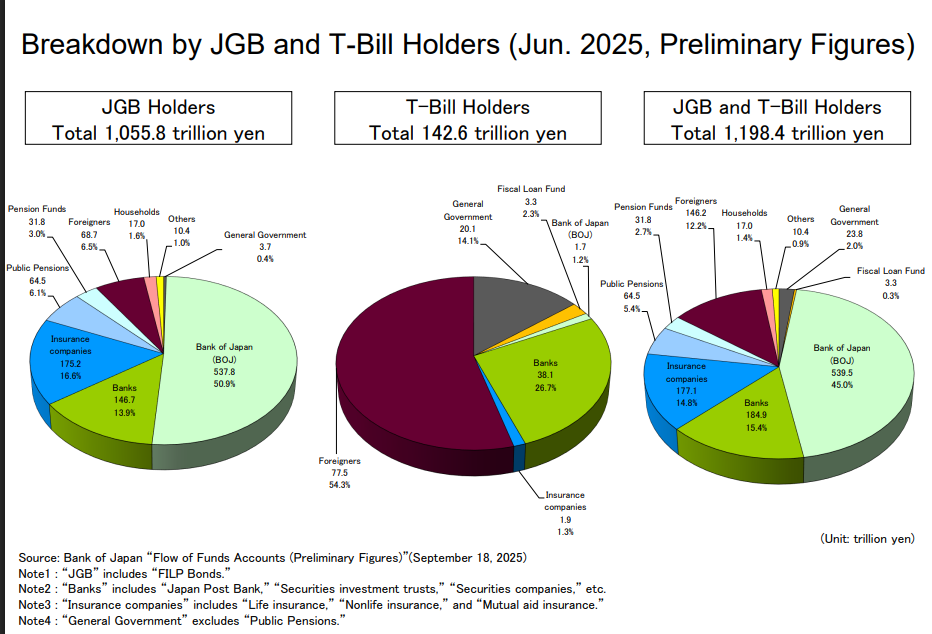
As the Bank of Japan reduces its bond purchases, uncertainties remain over the ability of domestic financial institutions – which reduced their holdings during the period of ultra-easy monetary policy – to absorb this new supply, especially as the government issues more bonds to finance its spending plans.
Okabe also noted that stablecoin issuers could fill this gap, as JPYC plans to invest 80% of its proceeds in Japanese government bonds and 20% in bank deposits.
In this context, the launch of the JPYC initiative comes at a time when Japan is increasingly adopting digital finance, with the percentage of non-cash payments reaching 42.8% in 2024, up from 13.2% in 2010, and the Financial Services Authority (FSA) has approved several initiatives aimed at introducing stablecoins to the traditional financial sector.
On November 7, the Financial Services Authority officially supported a pilot program under the Payment Innovation Project, which includes Japan’s three largest banks, namely Mitsubishi UFJ, Sumitomo Mitsui and Mizuho Financial.
Japan’s FSA said it would support a joint yen-backed stablecoin pilot project led by three major Japanese banks.#JapanFSA #YenStablecoin #StablecoinProjecthttps://t.co/kNuZ28y1mV
– Cryptonews.com (@cryptonews) November 7, 2025
The pilot aims to develop a common framework for the issuance of Japanese yen-backed stablecoins, initially targeting corporate clients, with the possibility of issuing US dollar-backed stablecoins in the future.
JPYC Strengthens Yen’s Role in Digital Finance by Launching Free Stablecoin
Globally, stablecoins are mostly pegged to the US dollar, and this category represents over 99% of the market.
Okabe said dependence on the dollar increases hedging and transaction costs for Japanese companies, emphasizing that JPYC can provide a local alternative that supports the yen’s role in global digital finance. Additionally, JPYC will offer fee-free trading at launch and derive its revenue primarily from interest on Japanese government bonds, as part of an approach to attract real-time adoption and test the feasibility of a regulated digital yen.
The move came alongside similar regional trends, with South Korea and Hong Kong also launching their pilot programs for local stablecoins and regulated crypto products.
In this context, major Japanese banks are also moving towards issuing stablecoins, and three major banks – with the support of the Financial Services Authority (FSA) – plan to launch pilot programs for currencies that will be pegged to the yen and the dollar, create infrastructure to settle corporate transactions and perhaps challenge the dominance of US-backed stablecoins such as Tether-USDT and USD Coin-USDC.
– Cryptonews.com (@cryptonews) October 17, 2025
However, Japanese authorities remain cautious, with lawmakers warning that poorly designed stablecoins could funnel money out of regulated banking systems and weaken the role of commercial banks in payment services. Therefore, any expansion of stablecoin issuance should be subject to scrutiny with regard to asset support, redemption rights and reserve segregation.
Japanese stablecoins could replace central bank in Japan’s $9 trillion bond market appeared first on Cryptonews Arabic.

