
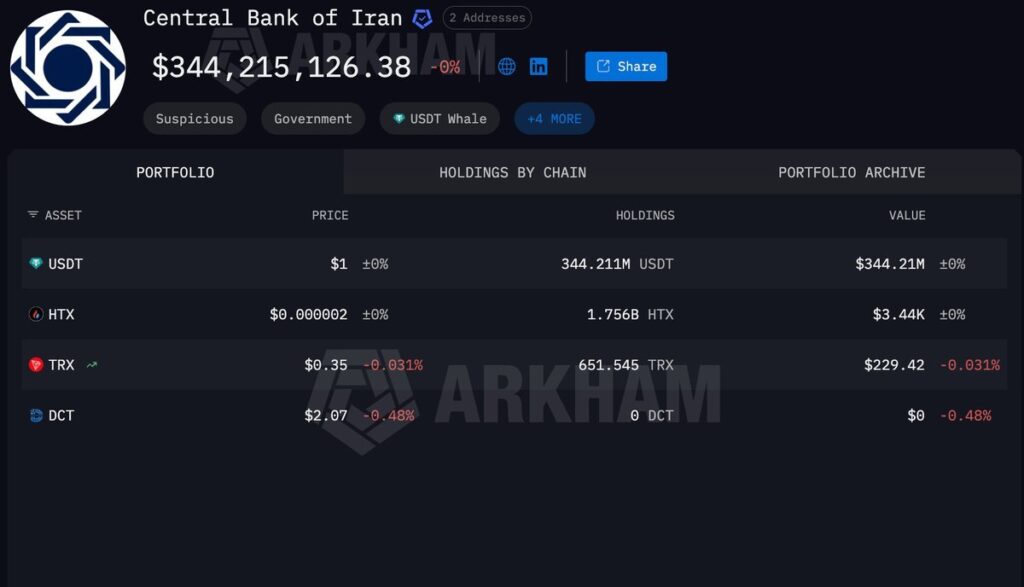
Attorney Charles Gerstein filed a lawsuit in Manhattan federal court on Thursday, seeking to force Tether to transfer 344,149,759 USDT, the equivalent of approximately $344 million. These funds are currently frozen in two wallet addresses on the Tron network, which the Office of Foreign Assets Control (OFAC) has designated as belonging to the Iranian Revolutionary Guard.
The plaintiffs are asking the Southern District of New York court to force Tether to liquidate the blocked wallets and reissue an equal amount of USDT into a wallet controlled by their legal agents. The move is a direct extension of legal disputes led by Gerstein, which previously targeted frozen funds in the North Korea-related Arbitrum case, as well as separate claims against Railgun DAO.
This decision represents a negative signal in favor of confidence in stablecoin issuers; If courts accept this theory of liability, Tether’s administrative freeze controls, designed to comply with sanctions, would become the target of litigation in all jurisdictions where judgment creditors have unpaid claims related to terrorism cases.
Liability Theory Mechanism: Why is Tether’s Freeze System a Substrate?
It is necessary to fully understand the mechanism followed here; Unlike Bitcoin or Ethereum, USDT includes administrative controls at the issuer level, where Tether has the ability to freeze wallets, blacklist addresses, zero balances, and reissue tokens to a new destination address.
Gerstein’s lawsuit documents state that because Tether has already frozen funds in response to OFAC sanctions for two Tron addresses, the company demonstrated that it had the technical ability and practical willingness to unilaterally dispose of those assets.
The sequence of events is as follows: OFAC identified two Tron wallet addresses as assets belonging to the Iranian Revolutionary Guard, and Tether thus froze the 344,149,759 USDT contained in them. Today, the plaintiffs, who hold billions of dollars in unpaid U.S. judgments related to Iran-backed terrorism, argue that the frozen USDT coins constitute prohibited assets of a state sponsor of terrorism, making them enforceable under federal law.
This claim is not intended to confiscate Tether’s own reserves, but rather a request for an injunction forcing the company to use the controls it has already used, but direct the funds to a different destination. This distinction is analytically important; Tether has already frozen $4.2 billion in USDT across more than 5,000 wallets linked to criminal activity and also helped the Department of Justice seize more than $6 million linked to a fraud scheme in Southeast Asia.
The plaintiffs say they are not asking Tether to do something unprecedented, but simply to direct the current freeze to benefit judgment creditors rather than leaving funds hanging. The legal precedent created here is that administrative control over property is functionally equivalent to its possession, and that such possession creates liability to judgment creditors under the appropriate legislative framework.
The post Lawsuit Demanding Transfer of $344 Million in Frozen Tether appeared first on Cryptonews Arabic.