
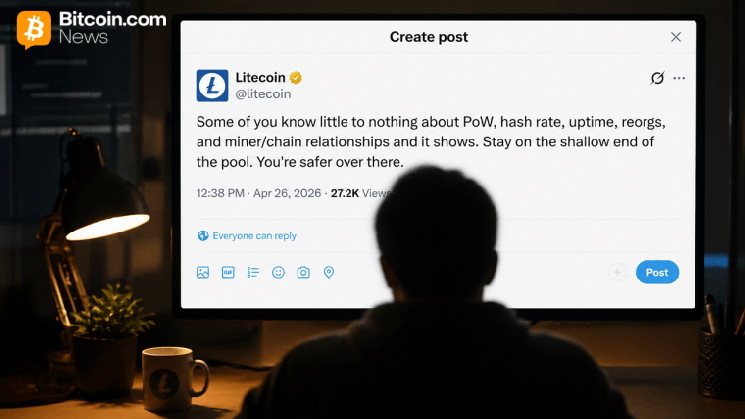
Litecoin Official
Key points to remember:
- Litecoin’s network underwent a 13-block reorganization on April 25, 2026, due to a reported MWEB zero-day bug exploit, according to the team’s testimony.
- Github commits show that Litecoin developers patched the MWEB flaw privately in March 2026, 37 days before the exploit was exploited.
- @litecoin from Litecoin
Litecoin X account mocks criticism after network revamp
The reorganization covered approximately 32 minutes of channel history. According to the Litecoin team, there was an exploitation of a zero-day bug in the MWEB layer to launch a denial of service attack against major mining pools. Non-updated nodes accepted invalid MWEB transactions, allowing attackers to peg the coins to third-party decentralized exchanges (DEXs).
Mining pools reportedly coordinated a defensive reorganization for approximately three hours to reverse these invalid transactions. No valid transactions were lost. The official Litecoin account posted this summary on April 25:
“A zero-day bug caused a DoS attack that disrupted major mining pools. Non-updated mining nodes allowed an invalid MWEB transaction, allowing them to peg coins to third-party DEXs. A 13-block reorg rolled back these invalid transactions – they will not be included in the main chain. All valid transactions during this period are unaffected. The bug is now fully fixed and the network continues to operate normally.”
Cross-chain bridge NEAR Intents reported exposure of around $600,000, but if Litecoin’s statement is correct, actual losses may have been mitigated by the reorganization. The network stabilized once miners adopted the patched client.
The “zero day” label immediately attracted scrutiny. Coindesk reporter Shaurya Malwa examined the litecoin project’s Github repository and found that core developers privately discovered and patched the MWEB consensus vulnerability between March 19 and 26, 2026, more than five weeks before the April 25 exploit. The patch was never widely required on miners and nodes, leaving the attack window open.
Blame the Social Media Intern
Onchain analysts and developers have resisted strongly. Some presented the incident as a known vulnerability that was not fully communicated. Others questioned whether the timing, precisely after a private patch, indicated responsible misdisclosure or worse. The technical dispute has not dampened the tone of the official version. On April 26, @litecoin posted:
“Some of you don’t know much about PoW, hash rate, availability, reorgs, and miner-chain relationships, and it shows. Stay in the shallow end of the pool. You’re safer there.”
The answers hit hard. Users called the post “salty,” “childish,” and “unprofessional.” One user wrote: “I’ve saved your piece for years…this is the shit you post? So childish.” Another said: “Maybe you need a new social media person. » The backlash fits a pattern that precedes growth by several years.
In September 2025, the account sarcastically posted that it had fired the “abrasive intern” after previous complaints. The style has never changed. The account regularly traded jabs with critics, rival channels and influencers through fart jokes, bear market taunts and pointed retorts.
Solana’s official account added at the moment. Replying to a discussion related to the reorganization on April 25, @solana wrote: “How’s your weekend going little buddy? The community interpreted this as a direct reward for months of Litecoin jabs aimed at Solana’s past outage history.
The fundamentals of Litecoin remain intact according to the team. The team insists that the MWEB is fixed, the canonical chain is stable, and no funds have been permanently lost on the main chain. The incident exposed coordination gaps between core developers and the broader base of miners and node operators, a known sticking point in PoW networks where upgrades are not mandatory.
What the incident made clear is that Litecoin’s communications strategy carries its own risk. Holders and observers who watched the account respond to a serious security event with a phrase urging critics to stay in the shallow end came away with a clear picture of how the project handles pressure. Or at least the newly hired intern.