


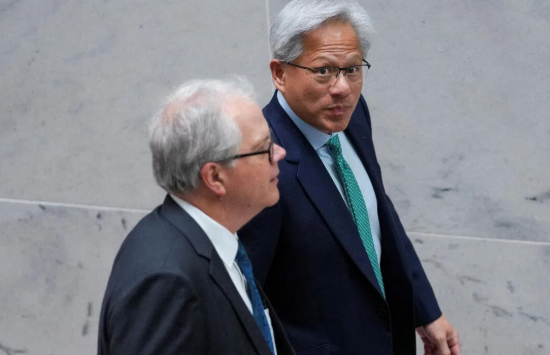
Nvidia CEO Jensen Huang met with US Commerce Secretary Howard Lutnick as Washington continues to examine the future of artificial intelligence, semiconductor production and the US’s position in the global technology race, according to reports from Axios.
The meeting comes at a critical time for the artificial intelligence industry, as governments and technology companies race to secure leadership in AI development while addressing concerns about supply chains, national security and competition with China.
Huang reportedly discussed Nvidia’s ambitious $500 billion U.S. technology production strategy, a plan focused on expanding domestic manufacturing capacity and strengthening the United States’ role in the global AI ecosystem.
The Nvidia CEO also emphasized the importance of maintaining an open approach to the development of artificial intelligence, including support for open-weight AI models that allow researchers and developers greater access to advanced technology.
The discussions highlight Nvidia’s growing influence in the AI industry and the company’s growing role in national technology policy.
Information about the meeting has also received attention among tech communities, including discussions shared by the Coin Bureau account on X. The development reflects broader debates around AI infrastructure, semiconductor independence, and the future direction of artificial intelligence development.
Nvidia has become one of the most important companies in the global AI revolution due to its dominance in advanced graphics processing units (GPUs), which are essential for training and operating large AI models.
The company’s chips power many of the world’s leading AI systems, including technologies developed by leading cloud providers, research institutions and AI companies.
As demand for AI computing continues to rise, Nvidia has gone beyond its traditional role as a semiconductor manufacturer and has become a central player in discussions about technology policy and national competitiveness.
The meeting between Huang and Lutnick reflects growing cooperation between government officials and technology executives as the United States seeks to maintain its lead in artificial intelligence.
AI has become a strategic priority for governments around the world due to its potential impact on economic growth, scientific research, defense capabilities and industrial development.
The United States and China are currently engaged in a major technological competition involving artificial intelligence, semiconductors, and advanced computing systems.
US officials have expressed concerns about protecting critical technologies and reducing vulnerabilities in global supply chains.
At the same time, technology companies have emphasized the need for innovation, international collaboration and access to global markets.
Nvidia has been going through a difficult environment due to restrictions on exports of advanced semiconductors to China.
The company has faced challenges balancing government regulations with business opportunities in one of the world’s largest technology markets.
 |
| Source: Xpost |
Washington has imposed restrictions on certain advanced artificial intelligence chips and semiconductor technologies exported to China, citing national security concerns.
Officials argue that limiting access to cutting-edge computer technology is necessary to prevent potential military or strategic advantages from reaching foreign competitors.
However, technology companies have warned that excessive restrictions could hurt global competitiveness and create opportunities for other countries to develop alternative technologies.
Huang has previously argued that maintaining American leadership in AI requires a strong technology ecosystem, including research, manufacturing, software development and global partnerships.
The $500 billion U.S. technology production plan discussed during the meeting represents Nvidia’s broader effort to expand domestic capabilities.
Increasing production of semiconductor and artificial intelligence infrastructure in the United States has become a major policy goal.
For years, much of the world’s semiconductor manufacturing has been concentrated in Asia, raising concerns about supply chain risks.
Recent disruptions have highlighted the importance of developing more resilient technology production networks.
The expansion of the national AI infrastructure could include semiconductor manufacturing, data centers, advanced computing facilities and related technology industries.
Supporters of more domestic production argue that strengthening American manufacturing will create jobs, improve economic security and reduce dependence on foreign suppliers.
The AI industry requires enormous amounts of computing power and access to advanced chips has become one of the most important factors determining technological competitiveness.
Nvidia’s position in the AI hardware market has made the company a key supplier for organizations developing next-generation AI systems.
The company’s GPUs are widely used because they can perform complex calculations needed to train large language models and other AI applications.
However, the future of AI development is not just about hardware.
Software ecosystems, research capabilities and access to AI models are also becoming increasingly important.
That’s why Huang’s support for open-weight AI models has attracted attention.
Open models allow developers and researchers to access the underlying parameters of AI systems, making it easier to study, modify, and create new applications.
Supporters argue that open AI models encourage innovation by allowing more organizations to participate in AI development.
They believe openness can speed up research, improve transparency and help smaller companies compete with major technology companies.
However, critics have raised concerns that widely available AI models could also create security risks if used for harmful purposes.
The debate over open AI models has become one of the biggest discussions in the technology industry.
Some companies have opted for more closed approaches, limiting access to their most advanced systems.
Others have promoted open development models that encourage broader participation.
Huang’s comments suggest that Nvidia sees open AI ecosystems as an important part of maintaining innovation and competitiveness.
The discussion comes as the AI industry enters a new phase of rapid expansion.
Companies around the world are investing billions of dollars in AI research, data centers and computing infrastructure.
Cloud providers, semiconductor companies and software developers are competing to take advantage of the opportunities created by artificial intelligence.
Governments are also increasing investments and introducing policies designed to support domestic AI industries.
The United States has largely focused on expanding semiconductor manufacturing and strengthening technology partnerships.
The meeting between Huang and Lutnick demonstrates how closely connected government policy and technological development have become.
AI companies no longer operate solely in commercial markets.
Their decisions can influence national security, economic strategy and international relations.
For Nvidia, maintaining access to global markets while complying with government regulations remains a major challenge.
The company must continue to expand AI infrastructure while navigating restrictions on technology exports and geopolitical tensions.
The future of the AI industry will likely depend on how governments and companies balance security concerns with the need for innovation.
Overly restrictive policies could slow development, while insufficient oversight could create new risks.
Finding the right balance has become an important priority for policymakers.
The United States is trying to strengthen its leadership in AI by investing in infrastructure, supporting research and encouraging domestic production.
Companies like Nvidia are expected to play a central role in these efforts due to their importance to the AI supply chain.
The meeting between Jensen Huang and Howard Lutnick represents another example of the growing relationship between Silicon Valley and government leaders.
As artificial intelligence continues to transform industries, decisions made today could shape the global technology landscape for decades.
Competition for AI leadership is expected to remain intense, with computing power, semiconductor production and software innovation becoming key areas of focus.
Nvidia’s continued expansion and its role in American technology strategy demonstrate how artificial intelligence has become one of the most important economic and geopolitical issues of the modern era.
Hokanews will continue to monitor developments involving Nvidia, artificial intelligence policy, semiconductor markets and global technology competition as new verified information becomes available.
hoka.news – not just cryptocurrency news. It’s cryptoculture.
Writer @Victoria
Victoria Hale is a writer focused on blockchain and digital technology. It is known for its ability to simplify complex technological developments into clear, easy-to-understand and engaging-to-read content.
Through her writing, Victoria covers the latest trends, innovations and developments in the digital ecosystem, as well as their impact on the future of finance and technology. It also explores how new technologies are changing the way people interact in the digital world.
His writing style is simple, informative, and focuses on giving readers a clear understanding of the rapidly evolving world of technology.
Check out other news and articles on Google News
Disclaimer:
HOKA.NEWS articles are here to keep you up to date on the latest rumors in crypto, technology, and more, but they are not financial advice. We share information, trends and knowledge, we don’t tell you to buy, sell or invest. Always do your own homework before making any money moves.
HOKA.NEWS is not responsible for any loss, profit or chaos that may occur if you act on what you read here. Investment decisions should arise from your own research and, ideally, the guidance of a qualified financial advisor. Remember: cryptocurrencies and technology move fast, information changes in the blink of an eye, and while we strive for accuracy, we cannot promise that it is 100% complete or up-to-date.

