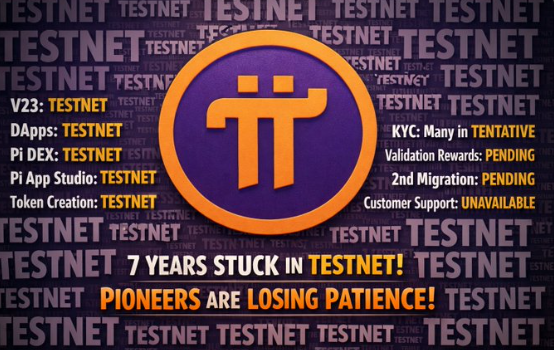
The Pi Network was once celebrated as one of the most ambitious crypto experiments of its generation, promising to bring blockchain technology to the masses through mobile mining and community-driven growth. However, seven years after its launch, a growing number of pioneers are questioning whether the project is fulfilling its original vision. According to observations shared by Twitter user @Mahidhar_Crypto, many of the Pi Network’s core utilities and long-promised updates remain locked in the Testnet phase, raising serious concerns about progress, transparency, and long-term viability.
In the fast-paced world of cryptocurrencies and Web3, time is a critical factor. While patience is often required for complex blockchain development, prolonged delays can erode trust and weaken community momentum. The Pi Network’s prolonged Testnet status has become a focal point of criticism, especially as competing Web3 platforms continue to release functional mainnet products at a rapid pace.
One of the most discussed topics is the V23 update, which remains limited to Testnet. This update was expected to improve network performance and functionality, but has not moved to a fully operational core network version. For many pioneers, this symbolizes a broader pattern of unfinished development and shifting timelines.
Decentralized applications, once promoted as the cornerstone of the Pi Network ecosystem, also largely remain on the Testnet. While several DApps have been introduced in development environments, their limited implementation restricts real-world use and economic activity. In a Web3 context, DApps are not simply features, but essential components that drive utility, engagement, and value creation. Its continued Testnet status limits Pi Coin’s role beyond experimentation.
The situation extends to the Pi DEX, which was expected to provide decentralized exchange functionality within the Pi ecosystem. A native DEX could enable peer-to-peer trading, liquidity discovery, and ecosystem self-sufficiency. However, with Pi DEX still on Testnet, pioneers lack a clear path to decentralized trading within the network, further delaying practical use cases.
Pi App Studio, another highly anticipated tool designed to empower both developers and non-technical users, has yet to go beyond Testnet. The platform was positioned as a gateway for rapid application creation, which could accelerate the growth of the ecosystem. However, its limited availability has restricted innovation and discouraged builders unwilling to commit resources to tooling without a clear production schedule.
Token creation capabilities are also reportedly blocked on Testnet. In modern Web3 ecosystems, tokenization plays a vital role in enabling decentralized finance, governance, and digital ownership. Without a live token creation framework, the Pi Network remains limited in its ability to support advanced Web3 use cases.
Beyond technical updates, operational challenges continue to frustrate the community. The Know Your Customer process, which is essential for migration and ecosystem integrity, remains incomplete for many users. A significant number of pioneers report that they are stuck in a tentative state of KYC, with little clarity on resolution timelines. This uncertainty prevents full participation in the network and fuels dissatisfaction.
Validation rewards represent another unresolved issue. Validators are a critical component of the Pi Network’s security and decentralization model, however, many participants report pending rewards without clear communication regarding distribution. In crypto ecosystems, delayed or unclear incentives can quickly undermine participation and trust.
The second migration is also pending, a milestone eagerly awaited by the pioneers. The migration is critical to transitioning users from Testnet balances to mainnet-ready assets. The lack of a defined timeline has left many users wondering if the migration process can be scaled effectively for the Pi Network’s huge user base.
  |
| Source: Xpost |
Customer service has become a growing point of contention. Reports of unanswered support requests and limited communication channels have amplified frustration. In a project with millions of users, responsive and transparent support is not optional; It is a necessity to maintain the credibility and trust of the community.
Adding to these problems is the current confusion around the value of global consensus and anti-GCV narratives. Conflicting claims about Pi Coin’s valuation have created divisions within the community. Without official, consistent messaging, pioneers must navigate a landscape filled with speculation, misinformation, and unrealistic expectations.
Merchants, once highlighted as key drivers of real-world Pi Network adoption, are reportedly facing a lack of direction. Without clear guidelines on pricing, settlement and integration, merchant adoption remains fragmented. This undermines one of the main promises of the Pi Network: enabling day trading through Pi Coin.
Even Pi domains, which were introduced as part of the ecosystem’s digital identity strategy, lack clear hosting information. Domains without hosting or functional integration limit their usefulness and reinforce the perception of incomplete execution.
The cumulative effect of these unresolved problems is a growing sense of fatigue within the community. As highlighted by @Mahidhar_Crypto, many pioneers are losing patience and some have already gone completely offline. For a project that relies heavily on community participation, declining morale presents a serious risk.
From a broader crypto perspective, the Pi Network situation illustrates the challenges of managing expectations at scale. Early success in user acquisition generated immense anticipation, but maintaining momentum requires consistent delivery. In Web3, trust is based not only on vision but also on execution.
Supporters argue that the Pi Network’s cautious approach prioritizes long-term security and stability. Critics respond that a prolonged dependence on Testnet indicates deeper structural or organizational challenges. Both perspectives underscore the need for clearer communication and more transparent progress reporting.
The crypto industry has seen numerous projects fail due to development delays and unfulfilled promises. The Pi Network’s unique position as an experiment in mass adoption makes its result particularly significant. Success could validate a new model for incorporating users into Web3. The failure could serve as a warning about the limits of hype-driven growth.
In conclusion, seven years into its existence, the Pi Network finds itself at a critical crossroads. While its vision for accessible crypto and community-driven Web3 adoption remains compelling, unresolved Testnet dependencies and operational delays threaten to overshadow that vision. As pioneers increasingly demand clarity, accountability and progress, the Pi Network’s next steps will determine whether it can regain momentum or risk losing relevance in an increasingly competitive crypto landscape.
For pioneers, investors and observers alike, the coming period may be decisive in defining whether the Pi Network evolves into a fully realized Web3 ecosystem or remains an ambitious project stalled by its own complexity.