
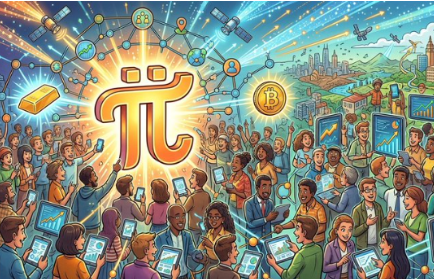
In online crypto communities, strong narratives often emerge that frame blockchain projects as part of a broader transformation of the global financial system. One such narrative surrounding the Pi Network describes it as a symbolic alternative to traditional banking structures, suggesting a shift from centralized financial systems toward decentralized, user-driven networks. These interpretations reflect a broader sentiment within parts of the crypto space that see digital assets as tools to redefine economic participation.
According to this perspective, the traditional financial system is often presented as outdated or inefficient, while blockchain-based ecosystems are considered more inclusive and accessible. In this narrative, the Pi Network is described as a large-scale staking model where users participate through mobile mining and contribute to the growth of the network outside of conventional banking frameworks.
It is important to distinguish between community-driven interpretation and official project positioning. Pi Network is a blockchain project focused on building a digital ecosystem with user participation at its core. While it has attracted a large user base globally, its full integration into open financial markets and broader economic systems is still under development.
The idea that millions of users are participating in a new form of financial structure reflects a broader trend in web discourse3. Decentralized technologies are often associated with concepts such as financial inclusion, user empowerment, and less dependence on traditional intermediaries. These themes resonate strongly with communities that are actively exploring alternatives to conventional financial models.
However, the interpretation that such systems directly replace traditional banking structures is a matter of opinion rather than established fact. In reality, financial systems are complex and evolve gradually over time through the integration of new technologies rather than complete replacement. Blockchain technology is more commonly considered a complementary innovation than a full replacement for existing financial infrastructure.
The concept of users working for money versus networks working for users is a philosophical framework often used in crypto debates. It reflects the idea that decentralized systems can enable new forms of value creation where participants are rewarded based on network contribution rather than traditional employment structures. However, in practice, these models are still evolving and are highly dependent on technological maturity, adoption and regulatory frameworks.
The Pi Network’s large user base has contributed to its visibility in these types of discussions. With millions of participants participating in its ecosystem, it naturally becomes a focal point for broader interpretations about the future of digital finance. This scale of participation is often highlighted as a key factor in its potential long-term impact within the web landscape3.
At the same time, it is essential to approach these narratives with an analytical perspective. The crypto industry is known for its strong storytelling culture, where projects are often framed in transformative or revolutionary terms. While these narratives can be powerful in driving community engagement and growth, they don’t always reflect immediate technical or economic realities.
 |
| Source: Xpost |

The transition from traditional finance to decentralized systems is not a sudden event but a gradual process. It involves regulatory adaptation, infrastructure development, user education and market integration. Projects like the Pi Network exist within this broader transition phase, where experimentation and development occur alongside evolving expectations.
From a technological point of view, blockchain networks introduce new models of trust, verification and value transfer. These innovations can influence the functioning of financial systems in the long term, but their integration into global economies requires careful alignment with existing structures. This includes compliance, scalability and interoperability with traditional financial systems.
The narrative of being a pioneer versus a passive participant reflects the motivational language often used in crypto communities. It emphasizes early adoption, commitment, and belief in long-term potential. While that framework may encourage participation, it is ultimately a subjective interpretation of participation in emerging technologies.
In web3 ecosystems, user participation is indeed a critical factor in network growth. Early adopters often play an important role in shaping ecosystem development, testing functionality, and generating community momentum. However, the long-term sustainability of any project depends on real-world utility, technological execution, and adoption beyond speculative interest.
Pi Network continues to develop within this broader context of blockchain innovation. Its evolution will depend on how effectively it moves from a closed or semi-closed ecosystem to a fully integrated digital economy. This includes potential interactions with exchanges, developers, and real-world applications that go beyond community participation.
In conclusion, the narrative that positions the Pi Network as part of a transformation of the financial system reflects a broader ideological discussion within the crypto community. While it captures the excitement and optimism surrounding decentralized technologies, it remains a prospect rather than a confirmed structural change in global finance.
As the web3 ecosystem continues to evolve, the relationship between traditional financial systems and blockchain-based networks will likely become more interconnected rather than completely separate. The future impact of projects like the Pi Network will depend on their ability to bring these systems together through practical implementation, adoption, and technological maturity.
hokanews – not just cryptocurrency news. It’s cryptoculture.
Writer @Victory
Victoria Haleis a pioneering force in the Pi Network and a passionate blockchain enthusiast. With first-hand experience setting up and understanding the Pi ecosystem, Victoria has a unique talent for breaking down complex developments in the Pi Network into engaging, easy-to-understand stories. It highlights the latest innovations, growth strategies, and emerging opportunities within the Pi community, bringing readers closer to the heart of the evolution of the crypto revolution. From new features to analysis of user trends, Victoria ensures that each story is not only informative but also inspiring for Pi Network enthusiasts everywhere.
Disclaimer:
HOKANEWS articles are here to keep you up to date on the latest rumors in crypto, technology, and more, but they are not financial advice. We share information, trends and knowledge, we don’t tell you to buy, sell or invest. Always do your own homework before making any money moves.
HOKANEWS is not responsible for any loss, gain or chaos that may occur if you act on what you read here. Investment decisions should arise from your own research and, ideally, the guidance of a qualified financial advisor. Remember: cryptocurrencies and technology move fast, information changes in the blink of an eye, and while we strive for accuracy, we cannot promise that it is 100% complete or up-to-date.