
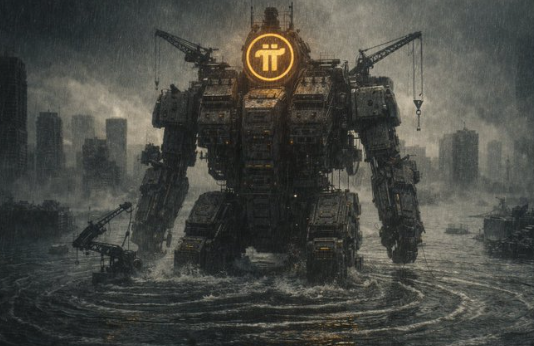
In the changing world of cryptocurrencies, few projects have demonstrated the resilience, adaptability and community-driven strength of the Pi Network. As Twitter user @PiWeb3Army highlighted, the network’s infrastructure tells a story of perseverance and ingenuity: built from salvaged components, powered by millions of users, and designed to be unstoppable.
Unlike venture-backed projects that rely heavily on funding rounds, Pi Network has grown organically. Their infrastructure is literally built from protocols, platforms, and systems that other developers abandoned. Rusted steel and outdated code form the backbone of this colossus, but it works in a way that few fully funded companies could achieve. Every bolt, every line of code is a testament to survival, adaptability, and strategic innovation in conditions that would have ruined most other projects.
The Pi Network architecture reflects lessons learned from the broader cryptocurrency landscape. Failed protocols and centralized platforms serve as reminders of what can go wrong when decentralization is only promised and not delivered. Many networks collapsed under regulatory scrutiny, market crashes, or scalability pressures. Pi Network, on the other hand, integrates only what survives, ensuring long-term robustness and functionality.
A defining characteristic of the Pi Network is its operational state. Unlike other projects whose ideas remained on paper or in test networks, Pi is functional, active and scalable. The shiny Pi symbol at the center of its ecosystem represents not just a token but a fully operational network with global participation. This achievement is notable, considering the bear markets, regulatory uncertainty, and institutional skepticism the project has faced since its inception.
The historical challenges of the cryptocurrency market make the Pi Network’s progress particularly notable. Prolonged bear markets spanning several years tested user engagement and network stability. Many projects failed completely, failing to retain participation or maintain infrastructure. Pi Network’s model of mobile-centric mining, community involvement, and gradual deployment allowed it to maintain momentum when most projects failed.
Regulatory ambiguity also presented significant challenges. While many platforms relied on legal clarity that never came, Pi Network maintained a cautious and adaptable approach. By focusing on community-driven development, decentralized consensus, and transparent operating practices, the network avoided the pitfalls that ensnared other early-stage crypto companies.
The institutional dismissal has not slowed down Pi Network either. While many traditional investors underestimated or ignored the project, millions of individual pioneers around the world continued to participate in the network. Their collective participation provides computational power, validation, and ecosystem growth—proof that decentralized networks thrive when driven by users rather than centralized funding or institutional hype.
The Pi Network ecosystem also demonstrates a sophisticated understanding of scalability without sacrificing decentralization. Many networks collapse under the weight of rapid growth, forcing compromises between efficiency and decentralized principles. Pi Network’s layered approach allows it to expand while maintaining trustless mechanisms, peer-to-peer validation, and equal participation.
Every system failure in the cryptocurrency space offers lessons, and Pi Network has built them into its foundation. Platforms that froze accounts, censored transactions, or sacrificed decentralization serve as a warning. The Pi Network architecture deliberately avoids these vulnerabilities, prioritizing user control, transparency, and resilience in adverse conditions.
The community is fundamental to the operational strength of the Pi Network. Millions of pioneers contribute computational resources, participate in consensus mechanisms, and participate in governance debates. This distributed model ensures that the network cannot be easily disrupted and that its growth is aligned with the principles of decentralization, equity and accessibility.
 |
| Source: Xpost |

From a technological perspective, Pi Network represents a new model for building blockchain. By combining reclaimed infrastructure with innovative protocols, the network achieves operational efficiency and robustness without relying on venture capital or aggressive market strategies. The result is a system capable of resisting external impacts, scaling globally, and integrating emerging web3 applications.
The symbolism of the Pi Network’s construction resonates with broader trends in cryptocurrencies. Many projects promise decentralization but fail under regulatory or market pressure. The Pi Network thrives precisely because it draws on the lessons of these failures, building on components that were tested, discarded, or abandoned but still work. This approach results in a network that is efficient, resilient, and built to last.
Operational resilience also extends to the user experience. By focusing on accessible mining, simple wallet systems, and community-driven token allocation, Pi Network ensures pioneers remain engaged and active. High user participation strengthens consensus mechanisms, reinforces security, and supports sustainable growth across the ecosystem.
The Pi symbol itself, shining at the core of the network, represents more than a token: it embodies a functional, decentralized and long-lasting system. It is a visual reminder of what is possible when technology is designed for survival and scalability rather than short-term speculation.
In conclusion, the evolution of the Pi Network illustrates how a cryptocurrency project can survive and thrive in conditions that cripple most businesses. By building on reclaimed infrastructure, leveraging millions of committed pioneers, and prioritizing decentralized operating principles, Pi Network achieves what few projects can: functional resilience, scalability, and community-driven sustainability.
As the network continues to expand globally, its design principles (resilience, adaptability and decentralized operation) position it to withstand market fluctuations, regulatory challenges and technological changes. Pi Network exemplifies a new paradigm in web3 development: a network built not for hype, but for unstoppable long-term functionality.
For participants and observers alike, the lessons of the Pi Network are clear: decentralization, community engagement, and careful integration of proven infrastructure are the pillars of a cryptocurrency ecosystem that can withstand adversity, scale sustainably, and deliver meaningful utility in a global digital economy.
hokanews – not just cryptocurrency news. It’s cryptoculture.
Writer @Victory
Victoria Haleis a pioneering force in the Pi Network and a passionate blockchain enthusiast. With first-hand experience setting up and understanding the Pi ecosystem, Victoria has a unique talent for breaking down complex developments in the Pi Network into engaging, easy-to-understand stories. It highlights the latest innovations, growth strategies, and emerging opportunities within the Pi community, bringing readers closer to the heart of the evolution of the crypto revolution. From new features to analysis of user trends, Victoria ensures that each story is not only informative but also inspiring for Pi Network enthusiasts everywhere.
Disclaimer:
HOKANEWS articles are here to keep you up to date on the latest rumors in crypto, technology, and more, but they are not financial advice. We share information, trends and knowledge, we don’t tell you to buy, sell or invest. Always do your own homework before making any money moves.
HOKANEWS is not responsible for any loss, gain or chaos that may occur if you act on what you read here. Investment decisions should arise from your own research and, ideally, the guidance of a qualified financial advisor. Remember: cryptocurrencies and technology move fast, information changes in the blink of an eye, and while we strive for accuracy, we cannot promise that it is 100% complete or up-to-date.