
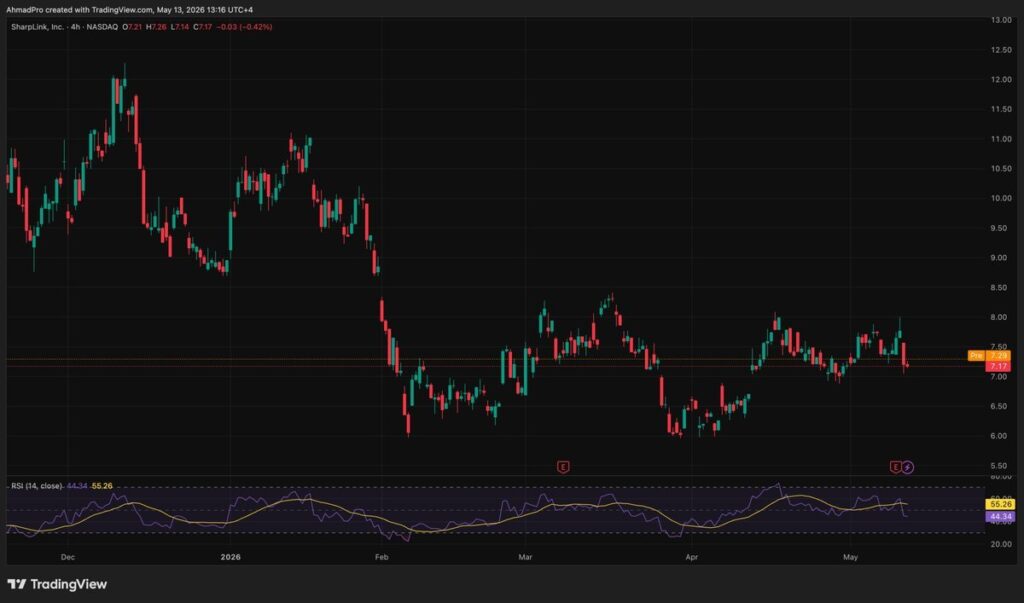
SharpLink reported a net loss of nearly $686 million in the first quarter of 2026, resulting almost entirely from $507 million in unrealized losses in its Ethereum treasury. This figure represents a huge jump compared to the company’s loss, which did not exceed a million dollars during the same period last year, reflecting negative news for the coffers of companies that rely on the ETH currency.
The direct cause of these results was a 45% peak-to-trough decline in the Ethereum price, turning the company’s aggressive accumulation strategy into a paper disaster under GAAP accounting rules.
In the same financial statement, the company announced the launch of an on-chain revenue fund worth $125 million in cooperation with Galaxy Digital, which some analysts consider a “lifeline” under the guise of a strategic partnership.
At the heart of the story is a real question: Does the Galaxy deal reflect institutional confidence in Ethereum’s staking infrastructure, or does it signal SharpLink’s need for a structural overlay to maintain its credibility? They are two completely different things.
How did ETH’s 45% drop lead to a $686 million loss?
It is important to understand precisely the mechanism here; This is not a business loss or operational failure in the traditional sense. SharpLink owns approximately 872,984 ETH worth approximately $2.1 billion at current prices. GAAP accounting rules require the company to mark-to-market these holdings at each reporting date, meaning that any drop in price appears directly in the income statement as an unrealized loss, without an actual sale of foreign currency or outflow of cash.
Ethereum fell from around $3,354 on January 15, 2026 to $2,104 on March 31, a drop of around 37% in the quarter alone, which contributed the bulk of that $507 million paper loss.
During the entire bear cycle, from peak to trough, ETH’s 45% drop diminished the dollar value of SharpLink treasury with mechanical precision; The larger the size of the assets, the greater the paper losses in the event of a decline.


Staking revenue was not enough to offset this decline. However, revenue for the first quarter of 2026 jumped to more than $12 million, up from less than $1 million a year earlier, a real operational improvement supported by the Ethereum cash stored by the company.
SharpLink has collected approximately 18,800 ETH in staking rewards since launching its strategy in June 2025, with a mix of 66% native staking, 33% liquid staking, and 1% staking. This represents an effective revenue driver, but it’s simply not capable of generating $507 million.
The important analytical distinction here is that what occurred was neither a failure of validator economics nor a resulting explosion of financial leverage, but rather an event associated with concentration risk, amplified by accounting standards that require accounting for price fluctuations of assets that have not yet been monetized.
SharpLink ended the first quarter with $16.9 million in cash and the entire amount of Ethereum (872,984 ETH). The loss is real on paper, but the pieces are still there.
However, the accounting and liquidity risks associated with Ethereum’s institutional storage operations are not mere theoretical assumptions. A 45% decline not only creates theoretical losses, but also reduces the capital margin that supports the entire cash flow model, and raises legitimate questions about the shape of the balance sheet in the event of another wave of declines.
Ethereum News: Galaxy Digital Fund is a strong signal but with different objectives
A $125 million revenue fund was announced in conjunction with the first quarter results, with a split of $100 million from the SharpLink vault and $25 million from Galaxy Digital. Galaxy is responsible for protocol selection, exposure quantification, and continuous monitoring of all on-chain activity.
SharpLink provides capital, while Galaxy provides operational oversight.
Mike Novogratz, CEO of Galaxy Digital, described the deal from an industry perspective, saying: “Institutional capital is moving toward working cross-chain, and the supporting infrastructure has matured to a point that allows investors to access returns, liquidity, and risk management with the same rigor expected in traditional markets.
This is an optimistic reading for the future of institutional crypto, supported by the performance of Galaxy stock itself (GLXY), which is up 43% over the past month, recently trading at $30.92.
For his part, Joseph Shalom, CEO of SharpLink, explained that the strategic direction goes “beyond core storage to a broader set of on-chain opportunities”, highlighting the existence of a “comprehensive risk management framework” designed to create shareholder value through different market cycles.
Despite the discipline in the language of the statements, the timing remains questionable. A company that reports a quarterly loss of $686 million is generally not trading from a position of strength.
The potential conflict of interest in this structure cannot be ignored; Galaxy acts as both a financial contributor to the fund and as the entity that manages on-chain publishing decisions. This doesn’t make the partnership wrong, but it does mean that Galaxy’s independence in choosing protocols merits scrutiny from investors and analysts.
If the price of ETH recovers significantly in the second and third quarters, the fund launch will look like a smart shift toward decentralized finance (DeFi) that will transform the fiat losses narrative into one of diversified returns. However, if the currency continues to fall, the $100 million injected from SharpLink’s cash into the chain’s protocols will face additional valuation pressure in the market above its major holdings, making risks present in both directions.
SharpLink Loses Exceeds $686 Million Due to Ethereum Decline appeared first on Cryptonews Arabic.