
A State Street study found that digital assets now represent 7% of institutional portfolios, and this percentage is expected to reach 16% within three years.
Don’t miss the best pre-listing cryptocurrency IPOs
A room with a large table in the middle, surrounded by chairs and surrounded by screens with trading data and charts
Institutional investors expect digitally represented assets to play a much larger role in global investment portfolios by the end of the decade, with private markets being the first to see this shift.
A State Street study released yesterday Thursday indicates that between 10% and 24% of institutional investments could be made through digitally represented investment vehicles by 2030.
Therefore, private equity and private fixed income are seen as prime candidates for going digital. These markets have long suffered from a lack of liquidity and high operating costs, making them prime targets for digital investment vehicles designed to improve efficiency and unlock liquidity.
Commenting on this, Joerg Ambrosius, Head of Investment Services at State Street, said: “The acceleration in the adoption of emerging technologies is clearly visible. Institutional investors have moved beyond the experimental stage and digital assets now represent a strategic lever for growth, efficiency and innovation.”
Ambrosius added that the fields of digital visualization, artificial intelligence and quantum computing are poised to find intersections that will reshape the future of finance with early adopters.
Our 2025 global research on #digitalassets and emerging technologies reveal a decisive shift in the adoption and strategic engagement of institutional investors towards #tokenization and blockchain-based transformation. Learn more: pic.twitter.com/tULwI2Ke88
– State Street (@StateStreet) October 9, 2025
Digital assets make up 7% of investment portfolios and are expected to double within three years
The study also shows that despite the growing rise of digital representation, many investors believe other technologies will have a greater impact on operations. In this context, more than half of the study participants indicated that generative artificial intelligence and quantum computing will have a greater impact than blockchain technology, looking forward to integration between these three technologies.
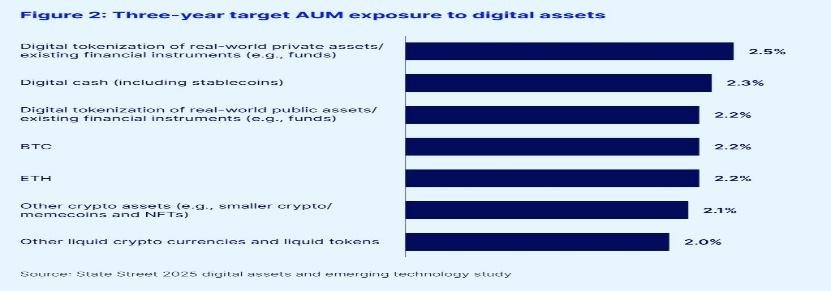
According to this study, digital assets now represent an average of 7% of institutions’ investment portfolios, and this figure is expected to reach 16% within three years. The most common forms of these assets are digital cash, as well as digitally represented stock and fixed income issuances. On average, participants reported holding 1% of investments in each of these categories.
Investment targets in digital currencies and digitally represented assets set by asset managers over the next three years
Asset Managers Outperform Asset Owners in Bitcoin, Ethereum and Digitally Represented Assets
Asset managers appear to be more favored than asset owners in almost every category, with 14% of managers reporting that Bitcoin makes up between 2% and 5% of their investment portfolios, compared to 7% of asset owners. Additionally, a small percentage of managers reported owning at least 5% of assets in Ethereum, meme coins, or non-fungible tokens (NFTs), indicating an increased appetite for risk.
Likewise, asset managers also excel at digitally representing physical assets. They talked about higher investment volumes in public assets, digitally represented private assets and digital money compared to asset owners.
However, cryptocurrencies remain the largest source of yield in digital investment portfolios. In this regard, 27% of participants confirmed that Bitcoin is currently their best performing currency, and a quarter of them also expect it to remain the best performing currency over the next three years.
On the other hand, Ethereum ranks second, with 21% of participants reporting that it is currently their largest source of income, and 22% expecting this trend to continue.
In contrast, only 13% said that public assets represented in digital form were the source of most of their digital revenue, and only 10% cited private assets, and these figures are expected to remain virtually unchanged over the next three years.
State Street Sees Growing Confidence in Sustainability of Digital Representation Trend
The State Street study suggests that private assets could become the first big beneficiaries of digital representation, which will likely happen once infrastructure improves and investor confidence increases.
Additionally, there is a widespread belief among institutions that digital assets will achieve the desired adoption within a decade through step change, not just a market cycle.
Ultimately, these results reinforce the idea that digital representation can transform capital markets. By digitally representing ownership of assets such as real estate and private credit, institutions can reduce settlement times, reduce costs, and expand access to investors previously excluded from private markets.
The article State Street: Digitally represented assets could make up up to a quarter of investment portfolios by 2030 appeared first on Cryptonews Arabic.