


The US Department of Justice’s underlying legal theory in the Roman Sturm cryptocurrency case was never that writing code was a crime in itself. Rather, it centers around the idea that exercising operational control over a platform that processes more than $1 billion in illicit funds – while explicitly refusing to implement meaningful anti-money laundering controls – constitutes running a criminal enterprise.
This distinction is the mechanism that makes this question relevant beyond the Tornado Cash platform.
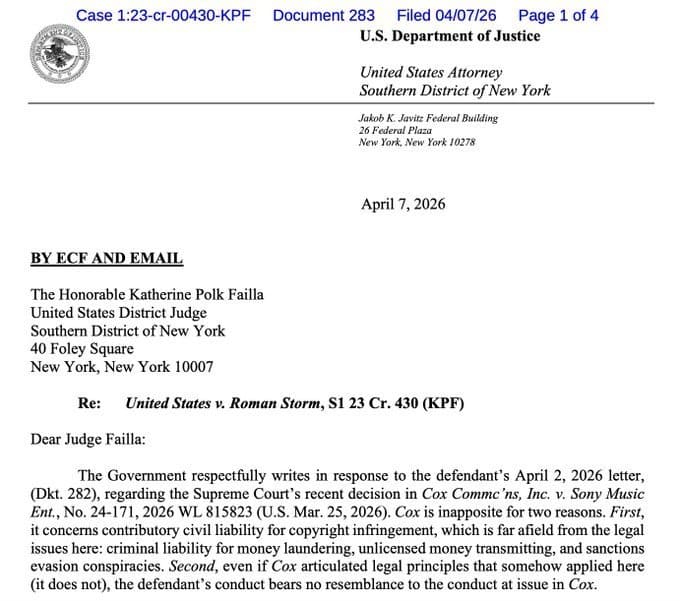
Prosecutors filed a letter Tuesday rejecting Storm’s attempt to invoke the Supreme Court’s March ruling in the case. Sony Music vs. Cox Communications As a reason to drop the charges. The Justice Department called this measure “inadequate,” and the reasoning behind this rejection defines exactly the level of developer involvement that would warrant federal criminal liability under the current enforcement framework.
The lingering question remains: Where is the legal minimum for decentralized finance (DeFi) developers to update protocols, manage governance, and selectively respond to compliance requests? After Tuesday’s filing, that line remains undetermined and prosecutors are seeking to make Storm’s retrial the place where that line is drawn.
- Attempt to waive fees: Storm’s lawyers cited the Supreme Court’s Cox decision — which shielded an Internet service provider from liability for copyright infringement by users — as precedent for dropping the criminal charges. The Justice Department plaintiffs rejected that analogy as inapplicable to Storm’s behavior.
- Control argument: Prosecutors documented more than 250 changes to Tornado Cash’s infrastructure during the accused period, directly contradicting Storm’s defense that the protocol was immutable code beyond its control. This operational file is at the heart of the money laundering conspiracy charge.
- Partial conviction: In August 2025, a jury found Storm guilty of conspiring to operate an unlicensed money transmitting business, but did not make a decision on the conspiracy to launder money and evade sanctions – two charges prosecutors want to retry in October 2026.
- Previous privacy protocols: The Justice Department’s framework—that developers who implement changes and knowingly ignore compliance measures are operators, not mere observers—applies directly to any scalable DeFi protocol with specific founders or core teams.
- Legal risks: Storm faces up to 40 to 45 years in prison if convicted of all charges. The retrial focuses on the two unresolved charges, while the money transfer conviction remains.
- What to watch out for: A meeting between Storm’s defense and Judge Katherine Polk Failla’s court will determine whether October 2026 becomes the deadline for the retrial.
What the Justice Department’s rejection of the Cox measure proves – and why the defense of the “immutable code” is losing its effectiveness
Storm’s legal team drew a specific parallel: The Supreme Court held that Cox Communications should not be held liable for its users’ illicit activities because it had a robust and effective 98% termination policy for repeat infringers. The argument was that Storm, like Cox, was only a neutral infrastructure provider. But prosecutors dismantled that comparison in a filing.
The Justice Department’s letter to Judge Failla confirmed that Cox Inc. I fought actively illegal behavior occurring on its network, while Storm and its partners at Tornado Cash did the exact opposite.
Prosecutors said Storm “actively lied in response to victims’ requests, telling them he had little control over the protocol when in fact he and his associates implemented more than 250 changes to Tornado Cash’s infrastructure during the period in question and openly discussed – but abandoned – meaningful measures to reduce crime on their platform.” »
This last paragraph constitutes the central legal element. Under money laundering and unauthorized money transfer laws, the question is not whether the developer wrote code, but rather whether it was operating a system that it knew would be used for money laundering, whether it had the ability to limit that use and chose not to do so.
Anti-money laundering compliance obligations under the Bank Secrecy Act lie with operators, not passive observers. The plaintiffs’ position is that Storm was, obviously, employed.
“In short, the defendant’s response to the criminal use of his business was at best window dressing and at worst downright misleading,” states the prosecutors’ letter to Judge Failla, filed Tuesday.
The August 2025 jury conviction for unlicensed money transfer effectively rejected Storm’s portrayal of himself as a negative developer. A retrial in October 2026 will directly target charges of conspiracy to launder money and evade sanctions – charges on which the jury deadlocked and did not acquit him. This distinction is important: a deadlock means that twelve jurors could not reach a consensus, not that the evidence was insufficient for a conviction.
The post Tornado Cash Case: Justice Department Rejects Roman Storm’s Attempt to Drop Charges appeared first on Cryptonews Arabic.

