
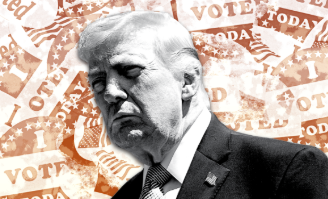
President Donald Trump canceled a scheduled housing news conference and bill signing ceremony that were expected to take place today, according to a White House statement. The decision suspends the event indefinitely as the administration shifts its focus to advancing what Trump calls the “Save America Act,” which he has described as a national emergency priority.
The abrupt cancellation has raised eyebrows in political and financial circles, as the housing legislation was expected to address key policy areas related to affordability, development incentives and federal housing support programs.
Instead of proceeding with the planned event, the administration noted that the housing initiative will remain on hold until Congress moves forward with the broader legislative package tied to the “Save America Act.”
The announcement quickly circulated through policy and market commentary channels, including observers such as Coinbureau, which frequently follows macropolitical developments and their potential impact on financial markets.
While the White House did not provide extensive procedural details, the message was clear: Housing policy efforts are being subordinated to what the administration views as a higher-priority legislative agenda.
According to political analysts, the move reflects a strategic shift in legislative approach, with the administration attempting to consolidate support around a broader policy framework before introducing individual bills.
“This type of delay usually indicates an effort to reframe the legislative push,” one policy analyst told Hokanews. “Rather than pushing multiple separate initiatives, the administration appears to be bundling priorities under a single, high-visibility bill.”
The “Save America Act,” as Trump described it, has not yet been fully spelled out in public legislative language, but it is being positioned as a major national priority. The president has characterized it as essential to addressing pressing economic and political challenges.
By tying the housing bill to this broader legislative effort, the administration is effectively placing the housing agenda within a broader political bargaining framework.
Housing policy in the United States has been a central issue in recent years, with rising home prices, concerns about affordability and regional supply shortages putting pressure on federal and local governments.
The canceled event was expected to highlight new initiatives aimed at improving housing availability, supporting development projects and potentially introducing reforms to regulatory frameworks affecting the real estate sector.
However, the sudden postponement introduces uncertainty about the timing and structure of these proposals.
 |
| Source: Xpost |

Market watchers note that real estate policy decisions often have broader economic implications, influencing construction activity, mortgage markets and consumer confidence.
Therefore, delays in housing-related legislation may contribute to uncertainty in sectors linked to real estate development and financial markets.
While the direct impact of the cancellation on the financial market remains limited at this stage, analysts suggest that political uncertainty around major fiscal initiatives may influence investor sentiment, particularly in interest rate-sensitive sectors.
“The housing market is closely linked to macroeconomic expectations,” another analyst told Hokanews. “Any delay in policy clarity may affect confidence in the construction, banking and real estate investment sectors.”
The administration’s decision also highlights the increasingly interconnected nature of political messaging and legislative strategy.
By framing the “Save America Act” as a national emergency priority, the White House is elevating its importance above other policy initiatives, including housing reform.
This approach is often used to generate legislative urgency and consolidate political support, particularly when there are multiple competing priorities within Congress.
However, it also introduces uncertainty for stakeholders who were expecting near-term policy updates on housing-related issues.
The cancellation of the event has sparked debate among political observers about the broader implications for legislative programming and political negotiating strategies in Washington.
Some analysts interpret the move as a sign that the administration is seeking greater political influence before committing to specific policy announcements.
Others suggest it may reflect internal prioritization of legislative bandwidth, with limited congressional capacity requiring selective focus on key bills.
Coinbureau’s coverage of the announcement further amplified attention within macro-focused communities, where political developments are increasingly scrutinized for their potential economic and market implications.
Housing policy, in particular, is often closely watched due to its connection to inflation trends, consumer spending, and financial sector exposure.
The real estate sector plays an important role in the American economy, meaning that any delay or change in housing legislation can have ripple effects across multiple industries.
Despite the postponement, the administration has not indicated that the housing bill has been abandoned. Instead, it remains on hold waiting for Congress to take action on the broader legislative package.
This suggests that the housing proposal could eventually be reintroduced or integrated into a broader policy framework once political conditions align.
For now, however, the timeline remains uncertain and interested parties will closely monitor developments in Congress.

Political analysts expect more clarification in the coming days as lawmakers and the White House continue negotiations over the structure and prioritization of the upcoming legislation.
“The key issue now is sequencing,” a Washington-based policy expert told Hokanews. “Which bills pass first and how they are packaged politically will determine legislative momentum going forward.”
The cancellation underscores how rapid changes in political priorities can affect scheduled policy announcements, even at high-profile events involving presidential participation.
As Congress continues to debate competing legislative priorities, the fate of the housing bill will likely depend on broader negotiations over the administration’s proposed agenda.
For now, the housing initiative remains stalled, awaiting greater political alignment before moving forward.
hoka.news – not just cryptocurrency news. It’s cryptoculture.
Writer @Victoria
Victoria Hale is a writer focused on blockchain and digital technology. It is known for its ability to simplify complex technological developments into clear, easy-to-understand and engaging-to-read content.
Through her writing, Victoria covers the latest trends, innovations and developments in the digital ecosystem, as well as their impact on the future of finance and technology. It also explores how new technologies are changing the way people interact in the digital world.
His writing style is simple, informative, and focuses on giving readers a clear understanding of the rapidly evolving world of technology.
Disclaimer:
HOKA.NEWS articles are here to keep you up to date on the latest rumors in crypto, technology, and more, but they are not financial advice. We share information, trends and knowledge, we don’t tell you to buy, sell or invest. Always do your own homework before making any money moves.
HOKA.NEWS is not responsible for any loss, profit or chaos that may occur if you act on what you read here. Investment decisions should arise from your own research and, ideally, the guidance of a qualified financial advisor. Remember: cryptocurrencies and technology move fast, information changes in the blink of an eye, and while we strive for accuracy, we cannot promise that it is 100% complete or up-to-date.