


The Trump-Japan trade agreement could remodel the manufacture of the United States, global alliances and cryptography markets
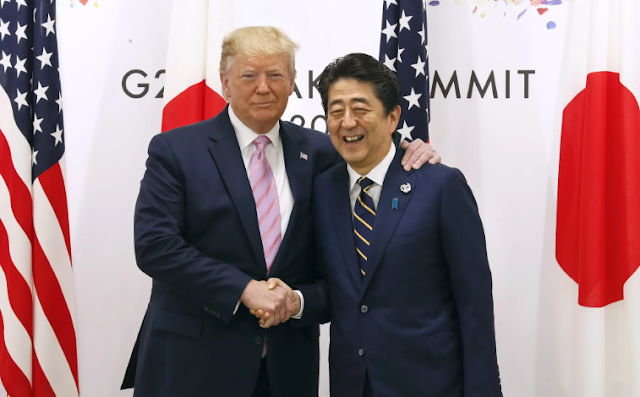
In a movement acclaimed by some as a milestone in modern commercial diplomacy, President Trump has signed what he calls “the greatest trade agreement in history” with Japan, along with parallel agreements with the Philippines and Indonesia, days before his deadline self -imposed on August 1.
The Trump-Japon trade agreement, as is being labeled, has the potential to remodel the manufacturing sector of the United States, deepen US economic footprints in Asia and indirectly influence the evolutionary cryptographic markets, according to analysts that trace the undulation effects of the agreement in all industries.
What is within the Trump-Japan trade agreement?
In the heart of the agreement, Japan has promised an amazing Investment of $ 550 billion in the United StatesA commitment designed to supercharge national manufacturing, restore closed factories and strengthen the president of Ethos “Made in America” has defended since his first mandate.
A key component of the agreement includes Reduction of commercial tariffs and car import taxes from 25% to 15%A movement to make Japanese vehicles more affordable for US consumers while encouraging Japanese car manufacturers to expand their manufacturing presence in the United States.
 |
| Source: x |
In a White House statement, President Trump emphasized that the investment “will create millions of American jobs, will bring factories to our soil and strengthen our industrial backbone.”
For Japan Prime Minister, Shigeru Ishiba, who faces increasing internal political challenges, the agreement offers a moment of diplomatic force that can help underpin its approval qualifications by showing Japan’s influence on the global economic stage.
New tariffs about the Philippines and Indonesia
Together with the agreement with Japan, President Trump also announced new agreements with the Philippines and Indonesia, changing the tariff landscape in these key economies of Southeast Asia.
For Philippines:
-
The assets of the United States exported to the Philippines will face a tariff reduction from 6% to 0%, allowing Filipino consumers to access American products at lower prices.
-
In contrast, The United States will increase tariffs on goods imported from philippines to 19%, compared to 10% in 2024with the objective of promoting the national consumption of US alternatives while protecting local industries.
For Indonesia:
-
A similar structure is applied, with Indonesia reduces tariffs to 0%American imports, while The United States increases tariffs on Indonesian goods to 19%.
The Administration argues that these measures are designed to rebalance commercial relations, support national producers and address long -standing commercial deficits, but critics warn about potential increases in consumer prices and tense commercial ties.
 |
| Source: x |
Market analysts react: “Does protectionism dressed as victory?”
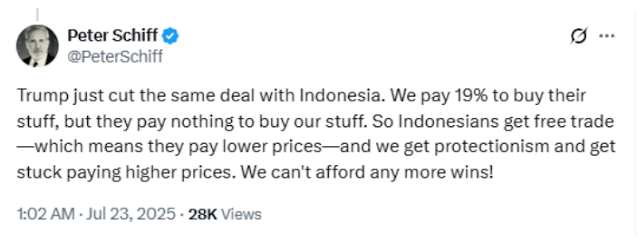
Financial commentator Peter Schiff expressed skepticism about the agreements, calling them “protectionism dressed as victory.” In an X post, Schiff argued:
“We pay 19% to buy their products; they pay zero to buy ours. That is not a victory, we are protecting the markets while obtaining cheaper agreements.”
Schiff also pointed out that, although agreements are framed as “victories” for the US economy, they can increase consumer prices from imported goods, reducing purchasing power while creating tariff imbalances that could lead to diplomatic tensions.
 |
| Source: x |
Despite these concerns, supporters of the administration approach argue that the agreements will promote local manufacturing and reduce the dependence on foreign supply chains, aligning with the broader economic nationalism strategy of the administration.
Potential impact on cryptographic markets
Beyond traditional manufacturing, these international trade maneuvers may have Indirect implications for cryptocurrency markets.
He $ 550 billion of Japanese investment in American sectors The general liquidity of the market is expected to increase. Historically, the increase in liquidity has often translated into capital that flows in alternative assets, including cryptocurrencies such as Bitcoin and Ethereum, since investors diversify portfolios in an expanding economic environment.
In addition, if the expansion of manufacturing strengthens the economy of the United States, institutional and retail investors can see cryptography as an attractive high growth sector within a robust financial environment, which drives additional market tickets to the market.
Another potential factor is the Impact of tariffs on imported technology and electronic components. The highest prices for imported technology could encourage US companies to develop locally blockchain solutions, stimulating investment in the American blockchain sector and new related companies.
Encryption analysts point out that, although the direct effect of commercial agreements in cryptography is limited, macroeconomic changes such as the increase in liquidity, the local industry strengthened and innovation incentives often correlate with higher cryptographic adoption rates.
Ondulation effects on global alliances
Trump-Japan’s commercial agreement also represents a strategic game in the changing geopolitical panorama of Asia. When deepening economic ties with Japan while reconfiguration trade relations with the Philippines and Indonesia, the United States points to counteract the growing influence of China in the region.
Economic analysts suggest that these agreements are not only about commercial figures, but to strengthen strategic alliances, guarantee the safety of the supply chain and maintain the influence on the Indo-Pacific in the midst of growing tensions.
For Prime Minister Ishiba, this agreement indicates the preparation of Japan to get more deeply involved with the United States while maintaining its strategic autonomy in the region.
Will the treatment be delivered?
While the Trump administration announces the agreements as they change the game for US workers and industries, economic historians warn that the true measure of success will be in the implementation.
“The announcement of large figures and rates changes takes holders, but the execution of $ 550 billion in investments, guarantees employment creation and managing the impact of higher import rates on consumers will be the true test,” says Dr. Karen Liu, an economist specialized in commercial policy at the University of Georgetown.
In addition, the cryptographic community will closely monitor how these macroeconomic developments are translated into activity in the chain, investment in blockchain startups and possible regulatory changes as the United States strengthens its economic position.
Final thoughts
He Trump-Japan TradeComplemented by new agreements with the Philippines and Indonesia, it marks a bold movement to remodel the United States manufacturing sector, redefine its economic alliances in Asia and potentially reinforce its indirectly cryptographic market.
Although skepticism remains the long -term consequences for US consumers who face higher import costs, the promise of restored factories, greater work opportunities and a manufacturing base of “made in the United States” stronger supports the impulse of the administration.
For the cryptographic sector, the agreement could represent a quieter but significant catalyst as liquidity and local technological industries increase potentially receive a new wave of interest and investment.
As President Trump’s economic agenda continues to develop, it is clear that these agreements are designed to make more than boost commercial figures, they are treated Revalue the economic future of the United States in an increasingly competitive and digital global panorama.
If this future will fulfill its promises or fall short, it will depend on the execution, the global economic changes and the resistance of the American industry to adapt to this new reality.
Writer
@Ellena
Ellena is an experienced cryptographic writer who loves to explore the intersection of blockchain technology and financial markets. She regularly provides information about the latest trends and innovations in the currency space.
See other news and articles on Google News
Discharge of responsibility:
The articles published in Hokanews are intended to provide updated information on various topics, including cryptocurrency and technology news. The content on our site is not intended to be an invitation to buy, sell or invest in any asset. We encourage readers to conduct their own research and evaluation before making an investment or financial decision.
Hokanews is not responsible for any loss or damage that may arise from the use of the information provided on this site. Investment decisions must be based on an exhaustive investigation and advice of qualified financial advisors. Information about Hokanews can change without prior notice, and we do not guarantee the precision or integrity of the published content.

