
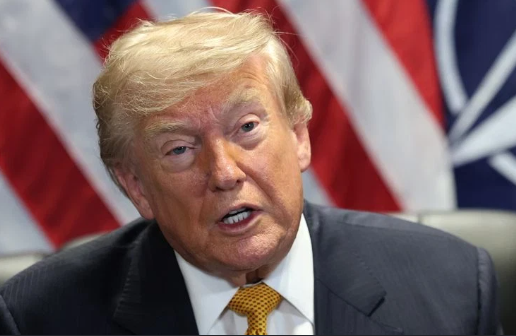
President Donald Trump has issued a strong warning to Iran, stating that any attempt by Tehran to attack the US president through an assassination plot would result in a major response from Washington.
The warning comes amid renewed tensions between the United States and Iran, with both countries facing ongoing disputes involving regional security, military activities and diplomatic relations.
Trump said the United States has prepared significant military capabilities in response to potential threats, saying thousands of missiles could be deployed if Iran attempted an attack on the US president.
The comments have drawn widespread international attention as officials and analysts continue to monitor relations between Washington and Tehran.
The statement was also highlighted by the widely followed Coin Bureau of Account X, which reported on the latest geopolitical developments and their possible implications for global security and financial markets.
Trump’s comments represent one of the strongest public warnings issued toward Iran regarding alleged threats against American leadership.
The president emphasized that any attempt to harm the American president would be treated as a direct attack on the United States and would trigger a significant response.
According to Trump’s comments, military preparations have already been made, with advanced missile systems positioned as part of the United States’ ability to quickly respond to any potential threat.
He stated that “1,000 missiles are locked, loaded and aimed at Iran,” adding that additional military action could occur if Tehran attempted to carry out an assassination attempt.
The remarks immediately raised eyebrows among international observers, particularly as tensions between the United States and Iran have remained high for years.
The relationship between Washington and Tehran has been marked by disagreements over nuclear policy, regional influence, sanctions, military operations and security concerns across the Middle East.
The latest warning comes as both governments continue to navigate a complex geopolitical environment involving multiple regional conflicts and competing strategic interests.
US officials have previously expressed concern about threats against US political figures from foreign actors, including Iran.
Iran has faced accusations from US authorities over alleged plots targeting US officials, although Tehran has repeatedly denied involvement in such activities and rejected accusations made by Washington.
The exchange of statements highlights the continued lack of trust between the two governments.
Security analysts say assassination threats involving national leaders have significant consequences because they can quickly escalate diplomatic tensions and create broader international instability.
A direct attack against a sitting US president would represent an unprecedented international crisis and could have serious military and political consequences.
Experts note that governments often maintain extensive security and intelligence operations designed to prevent these types of threats before they occur.
The United States Secret Service, intelligence agencies, and national security organizations continually monitor potential risks against senior government officials.
Trump’s warning also comes at a time when geopolitical tensions remain high across the Middle East.
The region has experienced increased instability due to conflicts, military confrontations, and disagreements between regional powers and international governments.
Iran remains one of the most influential countries in the region, with significant political and military influence in neighboring areas.
The United States has maintained a strong military presence in the Middle East for decades, citing the importance of protecting allies, maintaining regional stability and securing international trade routes.
Any major escalation between Washington and Tehran could have consequences beyond the two countries.
 |
| Source: Xpost |

Global energy markets often react strongly to developments involving Iran due to the country’s proximity to important oil-producing regions and strategic shipping lanes.
The Strait of Hormuz, located near Iran, is one of the world’s most important energy transit points, and a significant portion of global oil shipments pass through it.
Historically, military tensions in the region have caused concern among investors, energy companies and governments around the world.
Financial markets closely monitor U.S.-Iran relations because unexpected developments can influence oil prices, inflation expectations and investor confidence.
Despite Trump’s strong language, diplomatic analysts note that public warnings do not always translate into immediate military action.
Governments often use strong statements as a way to communicate deterrence and signal consequences to potential adversaries.
Deterrence strategies are designed to prevent hostile actions by demonstrating that the potential costs of aggression would outweigh any possible benefits.
The latest comments appear intended to send a clear message that Washington views threats against American leadership as a serious national security issue.
Iran and the United States have experienced several periods of intense confrontation in recent years.
Tensions have risen following disputes over Iran’s nuclear program, economic sanctions and military activities involving regional allies.
The two countries have also engaged in indirect negotiations through international intermediaries in an attempt to reduce tensions and avoid direct conflicts.
However, deep disagreements remain unresolved.
The possibility of escalation has continued to worry international observers, particularly because both nations possess significant military capabilities.
Analysts emphasize that maintaining communication channels remains important to avoid misunderstandings that could lead to unwanted conflicts.
Regional allies of both countries are also closely monitoring developments.
Countries across the Middle East have expressed concern that any direct confrontation between the United States and Iran could affect regional security, trade and economic stability.
Diplomatic efforts have continued in various forms, but major disagreements between Washington and Tehran remain difficult to overcome.
Trump’s latest statements demonstrate that security concerns involving Iran remain a major topic in US foreign policy discussions.
For investors and global markets, the situation represents another example of how geopolitical events can influence economic conditions.
Energy prices, defense markets, and international trade often respond quickly to events involving major geopolitical powers.
However, analysts caution that market reactions depend on whether political statements lead to actual policy changes or military action.
At this stage, Trump’s comments represent a warning and a statement of possible consequences rather than a confirmation of any immediate military operation.
National security experts continue to assess the situation while monitoring official statements from both Washington and Tehran.
The coming days and weeks may provide more indications about whether tensions are rising or whether diplomatic channels help reduce the possibility of an escalation.
The broader challenge remains balancing national security concerns with efforts to avoid further confrontation.
For the United States, protecting political leaders and responding to potential foreign threats remains a core responsibility of national security agencies.
For Iran, continued confrontation with Washington carries significant political and economic risks, particularly amid existing international pressure.
Trump’s latest warning highlights the fragile nature of US-Iran relations and the potential consequences of any action directed at senior US officials.

While no direct conflict has been announced, the situation underlines the continued importance of diplomacy, intelligence cooperation and international communication.
As tensions remain high, governments, financial markets and security analysts around the world will continue to closely monitor developments.
Any escalation between the United States and Iran could have far-reaching effects on regional stability, global energy markets, and international relations.
For now, Trump’s message is clear: Washington views any assassination attempt against the US president as a serious threat to national security and has warned that any such action would receive a significant response.
hoka.news – not just cryptocurrency news. It’s cryptoculture.
Writer @Victoria
Victoria Hale is a writer focused on blockchain and digital technology. It is known for its ability to simplify complex technological developments into clear, easy-to-understand and engaging-to-read content.
Through her writing, Victoria covers the latest trends, innovations and developments in the digital ecosystem, as well as their impact on the future of finance and technology. It also explores how new technologies are changing the way people interact in the digital world.
His writing style is simple, informative, and focuses on giving readers a clear understanding of the rapidly evolving world of technology.
Disclaimer:
HOKA.NEWS articles are here to keep you up to date on the latest rumors in crypto, technology, and more, but they are not financial advice. We share information, trends and knowledge, we don’t tell you to buy, sell or invest. Always do your own homework before making any money moves.
HOKA.NEWS is not responsible for any loss, profit or chaos that may occur if you act on what you read here. Investment decisions should arise from your own research and, ideally, the guidance of a qualified financial advisor. Remember: cryptocurrencies and technology move fast, information changes in the blink of an eye, and while we strive for accuracy, we cannot promise that it is 100% complete or up-to-date.