
Former Citadel employees Ian Krutinsky and Ashik Dheeraj have secured $17 million in funding to create Fin, an app for international stablecoin payments designed to instantly process international money transfers without the complexities of traditional cryptocurrency trading platforms.
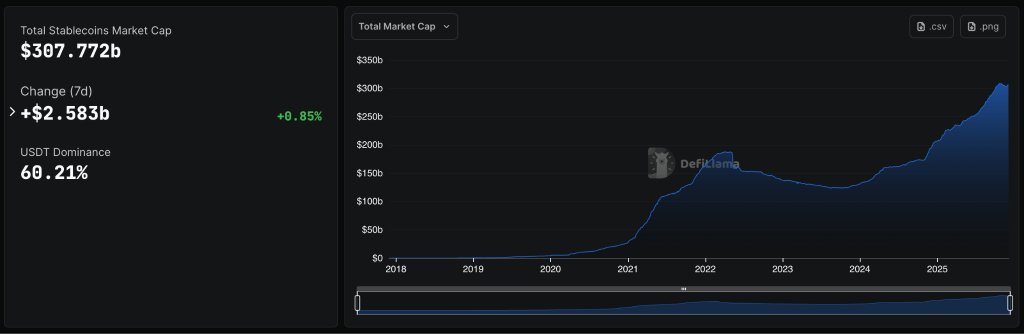
According to a report by Fortune magazine, Pantera Capital led the financing round with the participation of Sequoia and Samsung Next, while the startup is set to launch a pilot program next month dedicated to companies operating in the import and export sector. This funding comes in light of the rapid growth of the stablecoin sector, whose market value now exceeds $300 billion.
Krutinsky and Dheeraj learned about the challenges of the international payments industry while working on side projects at Citadel, when they attempted to pay $50 to users who landed on the first page of a Reddit-like platform they had created.
Build infrastructure for major transfers
Fin fills a gap in current payment systems by focusing on large transactions worth hundreds of thousands or millions of dollars. The app allows users to send money to other Fin users, bank accounts, or cryptocurrency wallets, leveraging stablecoin networks to significantly reduce transfer fees compared to traditional banking channels.
For his part, Krotinsky described the platform as ““Built as a future payments app.”emphasizing that it benefits from the advantages of stable currencies “Without all the complications”With the possibility of working anywhere in the world.
The startup shared an exclusive tour with Fortune magazine, revealing a simple, elegant design that focuses on ease of use rather than technical terminology. It should be noted that traditional wire transfers through commercial banks take several days and impose significant fees, especially in international transactions between countries adopting different financial systems.
Fin therefore aims to disrupt this model by offering near-instant settlement of transactions, whether those made by Swiss watch dealers with customers in the United States, or local transfers that exceed the limits allowed on services like Venmo and Zelle, where payments of up to $100,000 cannot be processed immediately due to delays or verification procedures.


Revenue model and competitive position
The company plans to generate revenue through transaction fees while keeping those fees lower than alternatives, as well as interest earned from stablecoins held in Fin wallets. Although the application has not yet been launched to the public, the pilot program with companies working in the import and export sector represents the first step towards making the service available on a wider commercial scale.
Krutinsky positioned his startup against large commercial banks such as JPMorgan Chase and Barclays, not against companies already active in the digital currency sector.
He pointed out that large financial institutions have poorly built their payment systems over decades and that it will be very difficult for them to transfer their current structure to pathways relying on stable currencies. Krutinski also said: “I think we have a chance to become the next big payments app in the world, and people will be surprised how quickly we can get there.”.
The stablecoin sector attracts traditional finance giants
Fin’s funding round comes after significant institutional moves to create stablecoin infrastructure. Citadel Securities, a market maker founded by Ken Griffin, invested $200 million in trading platform Kraken in November when its market capitalization reached $20 billion, solidifying Wall Street’s commitment to digital assets after years of hesitation due to lack of regulatory clarity.
Additionally, the company participated in a $500 million funding round for Ripple alongside Fortress Investment Group, showing that traditional finance is starting to show interest in major digital platforms as regulatory clarity improves under the Trump administration.
Recently, 10 major European banks formed a consortium to launch a euro-backed stablecoin by mid-2026 to address concerns about over-reliance on US dollar-denominated digital currencies, which currently account for 99.58% of the global stablecoin market.
Sony Bank plans to roll out its 1:1 USD-pegged stablecoin for payments and settlement within its gaming and anime business.#SonyBank #SonyStablecoin $USDStablecoinhttps://t.co/8wVvOWo89Z – Cryptonews.com (@cryptonews) December 1, 2025


Additionally, reports indicate that Sony Bank is preparing to issue a GENIUS-regulated USD stablecoin to US customers as early as fiscal 2026, aiming to reduce payment processing fees in its gaming and animation sectors.
In light of the great innovation seen in the stablecoin sector, major companies are preparing for what they see as the next wave of the financial revolution, as Standard Chartered recently warned of the possibility of more than $1 trillion flowing to emerging market banks into stablecoins by 2028 as global adoption grows.
In fact, federal regulators are also accelerating implementation of the GENIUS Act, and the Federal Deposit Insurance Corporation (FDIC) is expected to release its first regulatory framework for stablecoins later this month, and Acting Chairman Travis Hill confirmed that the agency is working on rules clarifying how stablecoin issuers seek approval, as well as independent prudential standards that will be unveiled early next year.
The post Two former Citadel engineers raise $17 million to launch Fin, a company specializing in stable currency payment solutions, appeared first on Cryptonews Arabic.