
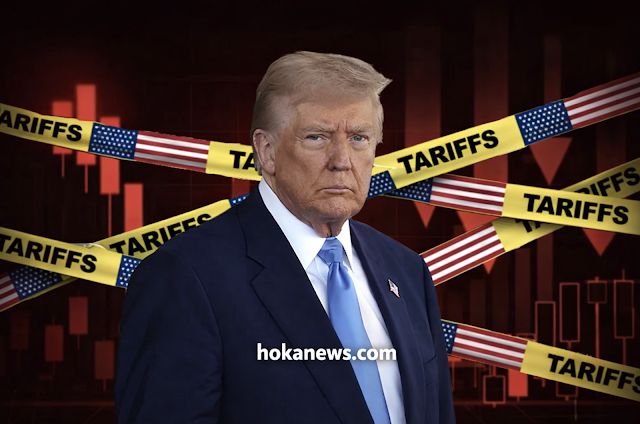
Do Trump’s tariffs strengthen the US economy or increase costs for consumers?
President Donald Trump has reignited debate over US trade policy after declaring that tariffs imposed on foreign nations have reduced the US trade deficit by 78 percent. In a post on Truth Social, Trump suggested that the United States could even post a trade surplus this year for the first time in decades.
The statement immediately caught the attention of financial markets and political circles. Supporters see the tariffs as proof of economic independence. Critics argue that the figures require deeper context.
The question now facing both investors and voters is whether Trump’s tariff strategy is delivering structural economic improvement or simply shifting costs to American consumers.
Examining the 78 percent shortfall claim
Trump’s statement came before the release of official trade data. Some market reports suggested the possibility of a monthly trade surplus of about $55.5 billion, which would mark the first monthly surplus since 1975.
However, federal data shows a broader picture.
According to figures from the US Census Bureau, the trade deficit widened to $56.8 billion in November 2025, up from $29.2 billion in October. Exports decreased to $292.1 billion, while imports increased to $348.9 billion during the same period.
 |
| Source: Official |

For all of 2025, projections indicate that the United States will continue to have a trade deficit of more than $800 billion. While that figure is lower than the $1.2 trillion deficit recorded in 2024, it remains firmly in deficit territory.
Economists warn that the 78 percent figure may reflect short-term monthly volatility rather than sustained annual improvement. Trade balances can fluctuate significantly due to seasonal factors, changes in raw material prices and inventory cycles.
A single monthly surplus does not necessarily indicate a structural reversal of decades-long trade patterns.
Liberation Day Tariffs
In April 2025, Trump announced sweeping tariffs on more than 100 countries, calling the implementation of the policy “Liberation Day” and describing it as a declaration of economic independence.
Tariff rates ranged from 10 percent to up to 50 percent for certain products.
While a 90-day negotiating window allowed some countries to seek lower rates, the immediate effects were visible on trade flows.
U.S. imports from China fell sharply. Between January and November 2025, Chinese imports totaled approximately $288 billion, compared to $401 billion during the same period in 2024.
The decline suggests that the tariffs altered supply patterns.
However, trade data show that reductions in Chinese imports were largely offset by increases in imports from other Asian and European countries. Instead of eliminating dependence on imports, supply chains appeared to go off track.
Economists describe this phenomenon as trade diversion, where tariffs displace trading partners rather than reducing overall demand for imports.
Who pays the fees?
A central question surrounding tariff policy is who ultimately bears the cost.
Trump has repeatedly argued that foreign exporters pay the price through thin margins.
However, research from the Federal Reserve Bank of New York suggests a different conclusion. Studies indicate that nearly 90 percent of tariff costs during the first eleven months of 2025 were absorbed by American businesses and consumers.
Although some foreign suppliers began sharing more of the burden later in the year, most of the expenses were passed on to domestic buyers.
Higher import costs often translate into higher prices for goods ranging from electronics to household items. Companies facing high input costs may increase prices to maintain profit margins.
This dynamic complicates the narrative that tariffs represent a direct revenue gain for the United States without domestic consequences.
Implications for inflation and the Federal Reserve
Tariffs can influence inflation by increasing the cost of imported goods.
In a period when the Federal Reserve remains cautious about interest rate adjustments, persistent trade-related price pressures could delay potential rate cuts.
Market participants closely monitor how tariff policies interact with broader macroeconomic trends, including consumer spending, wage growth and global supply chains.
If tariffs contribute to sustained inflationary pressure, monetary policy could remain tight for longer than expected.
Market Reaction and Bitcoin Volatility
Financial markets reacted quickly to the renewed tariff discussions.
Risk assets initially faced pressure amid concerns over trade tensions and a possible economic slowdown. Bitcoin briefly fell to around $65,900 before recovering and stabilizing near $67,000.
 |
| Source: CMC |

The cryptocurrency’s rally suggests that while geopolitical and trade developments may trigger short-term volatility, investor appetite for digital assets remains resilient.
Stock markets also showed mixed reactions: some sectors benefited from domestic production incentives, while others experienced declines linked to rising input costs.
Investors appear to be focusing on the broader macroeconomic implications rather than isolated notable numbers.
Political consequences and legislative resistance
Trade policy has become a defining issue heading into the 2026 midterm elections.
In a notable development, six Republican lawmakers joined Democrats to pass a resolution aimed at reversing certain tariffs on Canada. The bipartisan measure reflects internal divisions over the long-term economic impact of protectionist measures.
Business groups have expressed concern about rising costs and supply chain uncertainty, while manufacturing advocates argue that tariffs incentivize domestic production.
The policy debate highlights the complexity of balancing business competitiveness with consumer affordability.
Can tariffs generate structural changes?
The broader question remains whether tariffs can fundamentally reshape the United States’ trade balance.
Decades of globalization have integrated supply chains on all continents. Changing that infrastructure requires time, capital investment and policy coordination.

There may be short-term improvements in monthly trade balances, especially if imports temporarily decline. However, structural transformation would require sustained export growth and competitive domestic manufacturing capacity.
Without parallel investments in productivity and innovation, tariffs alone may not create a lasting trade balance.
Historical context
The United States has experienced persistent trade deficits for much of the last half century.
Trade balances are influenced by factors beyond tariff rates, including currency valuations, domestic consumption patterns, and global economic conditions.
Periods of economic expansion often correspond with an increase in imports, as consumer demand increases.
A surplus typically requires strong export performance combined with moderate import demand.
In this context, assessing the success of tariff policy requires comprehensive annual data rather than isolated monthly metrics.
Bitcoin and risk appetite
Bitcoin’s performance during tariff-driven volatility reflects its evolving role in global markets.
While once considered largely separate from macroeconomic forces, cryptocurrency now reacts to interest rate expectations, geopolitical tensions, and trade policy changes.
The rebound after its intraday decline suggests that risk appetite has not disappeared, even amid renewed economic uncertainty.
For some investors, digital assets serve as diversification tools during policy-driven volatility.
Conclusion
President Trump’s claim that tariffs reduced the US trade deficit by 78 percent highlights the ongoing political and economic debate over trade policy.
While monthly trade figures may show improvement, annual data indicates that the United States remains in substantial deficit territory.
Research suggests that much of the tariff cost has fallen on American businesses and consumers rather than foreign exporters.
Markets continue to assess how tariff measures affect inflation, interest rate expectations and overall economic growth.
As the 2026 midterm elections approach, trade policy will remain a central issue.
Whether tariffs ultimately strengthen the U.S. economy or contribute to higher consumer costs will depend on long-term data rather than short-term volatility.
Hokanews provides this analysis for informational purposes only and does not constitute financial or investment advice.
hokanews.com – Not just cryptocurrency news. It’s cryptoculture.