
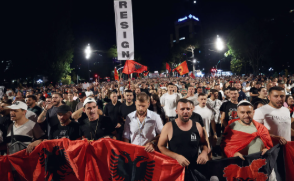
Tensions rose sharply in Albania’s capital after violent protests broke out near parliament over controversial coastal development projects linked to investment entities associated with Jared Kushner. Police responded with water cannon and tear gas as protesters clashed with security forces in one of the most intense political clashes the country has seen in recent months.
The protests, which began as a demonstration against government-backed development plans along Albania’s coast, quickly escalated into violent scenes in front of government buildings. Authorities confirmed that several vehicles carrying lawmakers were attacked as protesters threw eggs and other objects during the riot.
Growing public anger over coastal development projects
At the center of the protests are large-scale coastal redevelopment initiatives that critics say favor foreign-linked investors and raise concerns about transparency, land use and environmental impact.
The projects, which have been associated in public discourse with investment interests linked to Jared Kushner, have become a focal point of the political opposition in Albania. Protesters argue that the developments prioritize high-end tourism and luxury real estate over the needs of the local community and environmental preservation.
Opposition groups and civil society organizations have accused the government of a lack of transparency in approving strategic investment deals involving coastal lands, considered some of Albania’s most valuable natural resources.
The government, led by Prime Minister Edi Rama, has defended the projects as part of a broader economic modernization strategy aimed at attracting foreign investment, increasing tourism revenues and creating jobs in coastal regions.
However, public skepticism has continued to grow amid concerns about the long-term social and environmental consequences of large-scale construction along the Adriatic and Ionian coasts.
Clashes outside Parliament turn violent
The situation quickly escalated as thousands of protesters gathered near Albania’s parliament in Tirana. What began as a peaceful demonstration soon turned confrontational as crowds attempted to breach security barriers surrounding government buildings.
Police used water cannon and tear gas in an effort to disperse protesters after tensions escalated. Eyewitnesses reported chaotic scenes as protesters advanced, chanting slogans demanding government accountability and calling for the resignation of Prime Minister Edi Rama.
Security forces established cordons around key government institutions as clashes continued into the night. Authorities said several people were detained, although full casualty figures have not yet been confirmed.
Despite repeated warnings from law enforcement, groups of protesters continued to gather in central areas of the city, blocking traffic and disrupting normal activity in some parts of Tirana.
Lawmakers attacked amid rising tensions
One of the most serious events during the riots was the attack on vehicles carrying members of parliament. Protesters reportedly threw eggs, bottles and other objects at official vehicles as they attempted to pass through busy streets near the protest area.
While no serious injuries were immediately reported, the incidents have increased political tensions and raised concerns about the safety of public officials during periods of civil unrest.
Government representatives condemned the violence, called the attacks on legislators unacceptable and warned that legal action would be taken against those responsible for property damage and attacks on public officials.
 |
| Source: Xpost |

The opposition calls for accountability and transparency
Opposition leaders have used the protests to renew calls for greater transparency in Albania’s investment approval process, particularly regarding large-scale infrastructure and real estate developments involving foreign capital.
They argue that the government should provide clearer details on the terms of agreements, environmental assessments and the long-term economic impacts of coastal development projects.
Civil society groups have echoed these concerns, emphasizing the need for public consultations and stricter regulatory oversight before approving projects that significantly alter Albania’s coastline.
Activists have also raised concerns about potential conflicts of interest and the influence of politically connected investors in shaping national development strategies.
The government defends the economic strategy
Prime Minister Edi Rama’s administration has defended its approach, stating that Albania’s economic future depends on attracting international investment and modernizing its tourism infrastructure.
Officials maintain that the coastal development projects are designed to position Albania as a competitive destination in the Mediterranean tourism market, with potential long-term benefits for employment and economic growth.
The government has dismissed accusations of irregularities, insisting that all investment deals comply with national laws and regulatory frameworks.
The authorities also stressed that environmental standards are taken into account, although critics are not convinced and continue to demand independent evaluations.
International attention to development disputes
The protests have drawn attention beyond Albania, highlighting broader regional debates about foreign investment, territorial development and governance transparency in southeastern Europe.
The participation of projects linked to high-profile international figures in the public debate has added an additional layer of scrutiny to the situation, increasing the interest of the media and politicians in the events that are unfolding.
Observers note that Albania’s strategic location along the Adriatic Sea has made it an increasingly attractive destination for international real estate and tourism investments, but also a source of domestic political tension.
Security and political stability concerns
The scale of the protests and the intensity of the clashes have raised questions about political stability in the country. Analysts warn that prolonged unrest could dent investor confidence and slow ongoing development projects.
Law enforcement agencies remain on high alert in Tirana following the incidents and additional security measures are expected at government institutions in the coming days.
Officials have urged calm and called for dialogue between political actors, civil society groups and community representatives to address underlying grievances.
Economic and social divisions highlighted
The protests have also exposed deeper social and economic divisions within Albanian society. While some citizens support foreign investment as a path to economic growth, others fear that rapid development comes at the expense of local communities and environmental sustainability.
Coastal regions in particular have become a flashpoint for these debates, as tourism-driven projects often require large-scale land transformation and infrastructure expansion.
The government’s challenge going forward will be to balance economic development goals with public concerns about transparency, environmental protection and equitable growth.
Conclusion
The violent protests in Tirana mark a significant escalation in public opposition to coastal development projects linked to foreign investment interests, including those associated with Jared Kushner.

With clashes between protesters and police, attacks on government vehicles and renewed political calls for accountability, the situation highlights growing tensions between economic modernization efforts and public concerns about transparency and governance.
As Albania continues to seek foreign investment and tourism expansion, the government now faces increasing pressure to address public demands for greater oversight and clearer communication regarding major development projects.
The coming weeks are expected to be critical in determining whether dialogue can ease tensions or whether more unrest will occur in response to ongoing disputes over the country’s economic direction.
hoka.news – not just cryptocurrency news. It’s cryptoculture.
Writer @Victoria
Victoria Hale is a writer focused on blockchain and digital technology. It is known for its ability to simplify complex technological developments into clear, easy-to-understand and engaging-to-read content.
Through her writing, Victoria covers the latest trends, innovations and developments in the digital ecosystem, as well as their impact on the future of finance and technology. It also explores how new technologies are changing the way people interact in the digital world.
His writing style is simple, informative, and focuses on giving readers a clear understanding of the rapidly evolving world of technology.
Disclaimer:
HOKA.NEWS articles are here to keep you up to date on the latest rumors in crypto, technology, and more, but they are not financial advice. We share information, trends and knowledge, we don’t tell you to buy, sell or invest. Always do your own homework before making any money moves.
HOKA.NEWS is not responsible for any loss, profit or chaos that may occur if you act on what you read here. Investment decisions should arise from your own research and, ideally, the guidance of a qualified financial advisor. Remember: cryptocurrencies and technology move fast, information changes in the blink of an eye, and while we strive for accuracy, we cannot promise that it is 100% complete or up-to-date.