


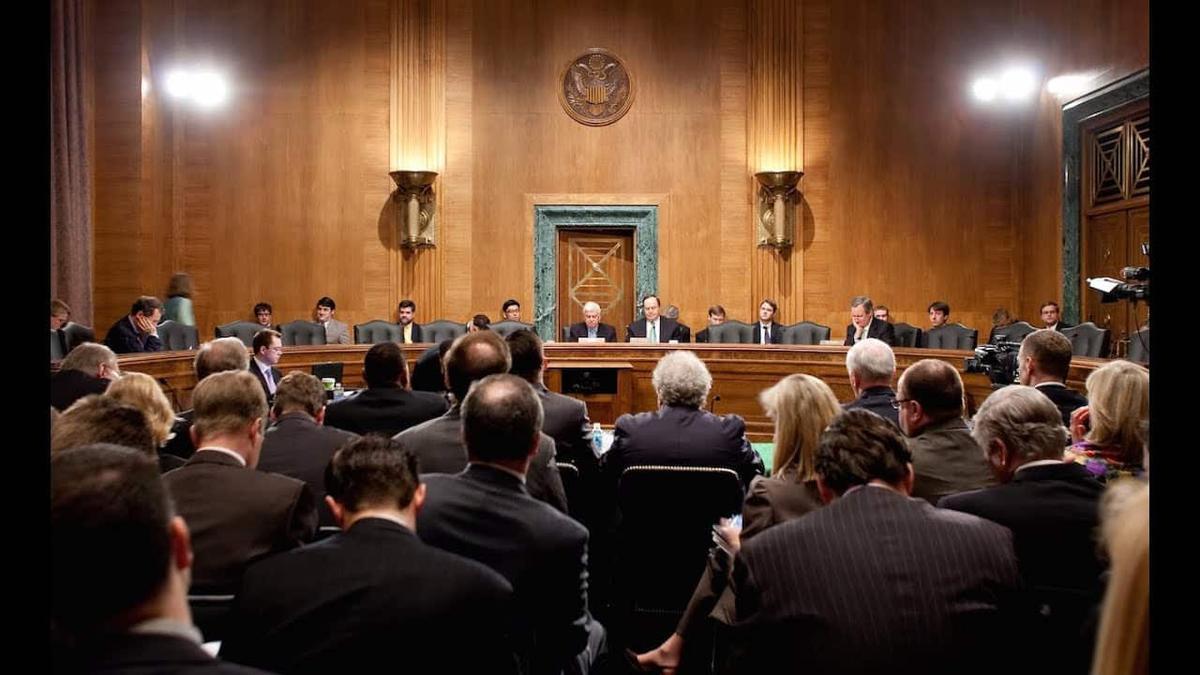
Senator Cynthia Lummis issued a direct and frank warning that any delay in passing the CLARITY Act now would effectively mean that the United States has given up on developing a comprehensive regulatory framework for crypto through 2030.
This vision is based on a purely procedural logic; If the bill fails to pass the Senate during the current legislative session, the 2026 election schedule will reduce the time available for debate to almost zero. As a result, the next realistic window for establishing a comprehensive framework for market structure will not open until the convening of the next Congress at the earliest.
For institutional capital, this timeline is not just a political abstraction, but an operational constraint that compliance teams at major asset managers and trading platforms are beginning to take into account when making investment decisions, increasingly moving toward jurisdictions that already have clear answers.
If the United States doesn’t set the global standard for regulating digital assets, someone else will.
China is not waiting.
The Clarity Act is how America runs the show – and how we ensure our adversaries don’t write the rules for the next financial era.– Senator Cynthia Lummis (@SenLummis) May 30, 2026
To date, digital assets in the United States have been primarily managed through enforcement, relying on SEC litigation, CFTC rulings, and agency guidance, rather than through legislative laws that define what is and is not permitted in crypto markets.
Since 2017, SEC enforcement filings have served as de facto rules, from DAO reporting to crackdowns on initial coin offerings (ICOs) to lawsuits against Ripple and Coinbase.
This prosecution-based approach creates asymmetric uncertainty; Companies only know what is prohibited after they are sanctioned, but they cannot get clarity in advance about what is allowed. While this disparity may be acceptable for crypto startups, it is completely unacceptable for the compliance departments of large institutions like BlackRock, Fidelity or JPMorgan.
Extending this regime for another four or five years – which would mean pushing the deadline to 2030 – not only delays institutional adoption in the United States, but also reinforces competing jurisdictions as the default destination for compliant securitization, stablecoin issuance, and DeFi institutional architecture, at the critical period in which these markets are being built.
Institutional capital needs legal certainty before moving
The mechanism by which the effect moves from regulatory inertia to capital flight seems very clear. Without a legal framework ending the jurisdictional divide between the SEC and CFTC, compliance teams at large institutions cannot approve crypto transactions under strict internal banking policies.
Without approved trading platforms, custodial arrangements cannot be structured to meet fiduciary standards. Due to the lack of compliant custody, institutional liquidity – the kind that moves markets and narrows spreads – will not flow to US spot trading platforms.
This liquidity will certainly find another route. For example, the European Markets in Crypto-Asset Regulation (MiCA) was adopted in 2023 and entered into full force in 2024, and its application to crypto-asset service providers and stablecoin issuers was completed by 2025.
The Clarity Act is not just a crypto bill. It’s a question of whether America will lead the next financial system or watch from the sidelines.
– Senator Cynthia Lummis (@SenLummis) June 1, 2026
MiCA provides a uniform framework across all 27 EU countries, giving institutional offices prior certainty that US law currently lacks. In Singapore, the Monetary Authority System (MAS) under the Payment Services Act 2019 has successfully attracted securitization trials with JPMorgan, DBS and Temasek through Project Guardian, thereby attracting institutional liquidity to Asia. Dubai’s VARA has also attracted platforms such as Binance, OKX and Bybit, as these exchanges scale back or restructure their US operations under pressure from authorities.
Forecasting platforms like Polymarket indicate that it is likely in the mid-to-late 1950s that a federal market structure law such as the CLARITY Act will be passed by the end of 2026. These converging probabilities are incentivizing macro funds to actively hedge Chicago Mercantile Exchange (CME) Bitcoin and Ether futures and offshore perpetual contracts, thereby shifting liquidity from U.S. spot trading platforms to derivatives markets in Europe and Asia. Thus, the impact of the CLARITY Act on liquidity markets is already taken into account even before the law is adopted.
What does the deactivation of the CLARITY law mean structurally?
The CLARITY Act infrastructure addresses the precise ambiguity that has made crypto compliance in the United States impossible for institutional entities. The law establishes a jurisdictional division between the SEC and the CFTC depending on whether a digital asset functions as a security or as a commodity.
The law also creates a pathway for decentralized certificates that allows assets to transition from securities classification as their networks mature, and includes consumer protection provisions governing asset segregation in the event of stock market insolvency. The law passed in committee by vote 15 against 9This is a result which reflects the presence of real opposition, but sufficient to move forward.
Loomis’ warning message is that the committee’s outcome will be worthless if the Senate debate time is wasted. Without these legislative provisions, the fundamental question of whether a particular symbol represents a security will remain dependent on the outcome of the litigation, meaning that each institutional entity will have to choose between bearing the legal risks or refraining from participating, and will most often choose to abstain.
Jamie Dimon has publicly called for bank-like capitalization and anti-money laundering standards to be imposed on stablecoin issuers, warning that lighter treatment creates regulatory gaps in the banking system. This concern, regardless of the position on the CLARITY Act, highlights that even traditional financial players (TradFi) who want stricter rules need a legislative tool to work with.
In 2023, the Financial Stability Board established global crypto policy recommendations, and regulators in the European Union and Asia began implementing them, while the US Congress has yet to provide a parallel basis for this.
The article Warning Against Losing US Leadership: Will Crypto Regulation Be Delayed Until 2030? appeared first on Cryptonews Arabic.

