


Ripple CTO Emeritus David Schwartz laid out an ambitious vision for the future of the XRP Ledger (XRPL) network in a video posted on June 5. Schwartz explained that the network is becoming a settlement and issuance layer for tokenized stocks, money market funds, repurchase agreements (repos), and on-chain lending, going beyond its traditional role as just a quick payment method. These developments are positive news that reinforce the bullish outlook for XRP.
The roadmap is well defined, with a tight timetable for the implementation of infrastructure and a real list of institutional partners. The fundamental question remains which parts have already started work and which are still in progress.
The reality of real assets on XRPL: huge growth and pending products
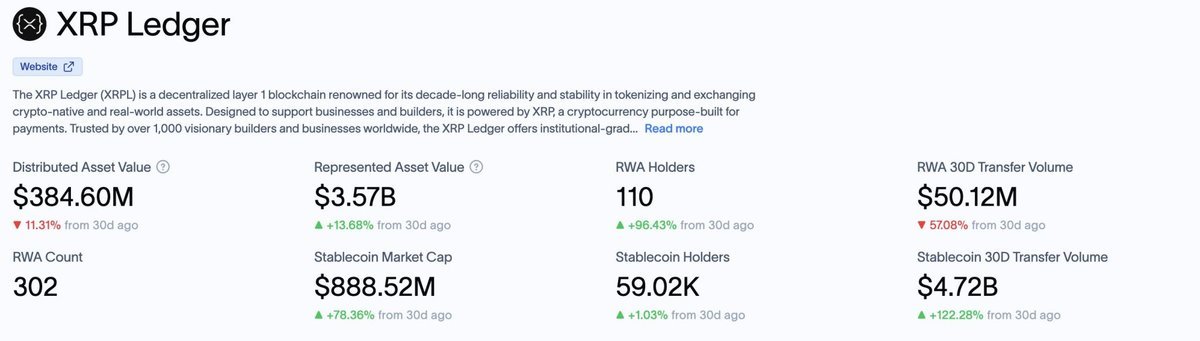
The current momentum of the XRPL network’s Real Asset Layer (RWA) is not just a prediction, but a data-backed reality. Real assets tokenized on the network increased from $24.7 million to $567.9 million in 2025, a staggering 2,200% increase, reaching approximately $2.325 billion by early 2026.
This upward trajectory places the XRPL network in eighth place globally for distributed tokenized real assets, representing approximately 1.53% of the total global market.
VERT Capital, RLUSD and OpenEden top the list of issuers, collectively representing 85.5% of tokenized value as of mid-2025. Ripple’s regulated stablecoin RLUSD has a market capitalization of approximately $1.3 billion, making it the third largest regulated stablecoin in the United States.
These figures represent an actual current structure of $2.3 billion. What this means for XRPL’s equity and credit token ambitions is another aspect that requires analysis.
At the protocol level, two central mechanisms emerge in Schwartz’s vision: the first is the Multi-Purpose Token (MPT) standard, which allows complex structured assets such as bonds and funds to be represented on the network with built-in attributes such as maturity dates and transfer restrictions, without the need for custom smart contracts.
The second mechanism is the Native Lending Protocol, which is launched under Proposal XLS-66 as part of XRPL 3.0.0. This protocol enables fixed-term institutional loans with separate vaults and automated repayments. Additionally, a decentralized exchange (DEX) dedicated to authorized participants (KYC) has started offering its first live demos. These aren’t just concepts, they’re infrastructure already in progress, awaiting auditors’ votes on XLS-66, which requires a supermajority of 80% to fully activate the lending protocol.
The Implications of Schwartz’s Statements and the Sequence of Product Launches
Schwartz’s framing of events in the “XRP in a Minute” segment was deliberate in its sequencing. He began by highlighting Bitcoin’s contribution to demonstrating the ability of a public blockchain to enable individuals to own and transfer value, then positioned XRPL as the next layer providing native digital assets similar to Bitcoin, as well as issued assets that could represent stablecoins or any type of tokenized asset.
Schwartz clearly defined the related product categories: tokenized securities, money market funds, and even tokenized stocks. On the credit side, he mentioned repurchase agreements and token loans. This order reflects the priorities; Securities and funds come first due to clear institutional demand and scalable compliance infrastructure on the network, followed by loans and repos which require XLS-66 protocol activation.
Although tokenized stocks were mentioned, they had not yet been announced as live products on the network as of the date of the report. However, Archax, a UK-regulated digital exchange, has committed to providing a billion-dollar asset flow comprising stocks and fund units.
The infrastructure represented by the MPT standard, a dedicated decentralized platform and identity-linked order books is technically capable of supporting tokenized stocks, but the actual products are not yet on the market.
Schwartz’s institutional thesis revolves around the idea that companies will provide features that will attract widespread adoption by individuals, where decentralized finance (DeFi) can deliver on its promise as an alternative to traditional finance (TradFi). This logic suggests that compliance-focused financial products designed for institutions are the gateway to the next wave of tokenization adoption, not open-ended protocols or individual speculation.
The article A New Vision for the XRP Network: A Seamless Shift Towards Tokenization of Stocks and Loans appeared first on Cryptonews Arabic.

